

Or: Why I no longer aim for 10 lb. dry weight.
Introduction
Catchy headlines like 10 lb. Gear List for Hiking The Appalachian Trail suggest that 10 lbs. is the target ultralight dry weight for serious multi-day backpackers. After many years, I achieved that target, but now choose to carry more for comfort. Such additions don’t come lightly, as I have learned the hard way that less packweight = more fun, but there is a balance. What I carry depends on the conditions. While I write this to get it straight in my own mind for future trips, it might help others at whatever stage they are in their backpacking journey. This will be different from other accounts, from the “professional’s” posts, like the reference above, or my fellow-blogger Scott’s “What’s In the Pack?” series, but there is not a “right” way. The most valuable thing to do is to go backpacking with whatever you have, enjoy, and learn. As always, Hike Your Own Hike!
Here’s my ten year journey from over-weight to under-weight to compromise.
(After I wrote this, I found this video with a comfortable 7.5 lb baseweight, and it’s made me rethink a few things, but I’m happy with my current setup and am not about to change it)
My backpacking journey with Samuel started by shivering through the night due to woefully inadequate sleeping bags on Texas’s Guadalupe Peak in 2015. I followed this with an immense struggle carrying water into Big Bend’s Chisos Mountains in 2016. I embraced a Sawyer Squeeze water-filter for Big Bend’s four-day Outer Mountain Loop in 2017 and added a bear box for Colorado’s five-day Snowmass/Capitol circuit in 2018, but I sensed there was a better way to backpack than with a dry weight of 19-lbs per person. In 2019, my packweight-focused journey took me on a five-night tour of the peaks of England’s Lake District. 2021 brought a thru-hike of Texas’s 92-mile Lone Star Hiking Trail, though the highlights are a completion of Colorado’s Collegiate Loop over fourteen days in 2021 and following the Grand Canyon’s Bill Hall trail for a rim-to-river-to-rim trek in 2022. While I achieved the 10-lb dry weight for the Grand Canyon hike, I have chosen a heavier dry weight on subsequent treks like Arkansas’s Eagle Rock Loop or Colorado’s Gore Range. This range of hikes has taught me that a pack’s contents depends on the hike. Below, I walk you through my gear journey and my current options.
As with any problem, the first step is recognizing the problem, though this was more of an opportunity as we had some great hikes with our “heavy” gear. REI guidance is that a backpack should not exceed 20% of bodyweight, and while this is a good start, it is somewhat arbitrary. I read about light and ultralight backpacking (less than 15 or 10 lbs. dry weight) and various techniques to achieve such targets, though recognized the goal was “as light as possible.” My dry-weight reduction journey followed the following steps:

- Weigh everything in ounces or grams. Excel is your friend, which I was already using to create checklists. This develops the mindset about pack weight and increasing awareness about what weight is worthwhile.
- After any trip, identify what you did not use, and leave it behind next time. The only items that are OK not to use are emergency items, such as a first aid kit, but beware:
- Recognize that “you pack for your fears.” You bring extra layers of clothing in case you get cold or everything gets wet. You bring extra food in case you run out. You bring spare batteries for your headlamp or redundant water treatment options. Take risks. In most “emergency” situations, you’ll either be uncomfortable or choose to abandon the trip and walkout – without permanent damage. I have found such risks are well worth leaving behind the extra pounds.
- Identify items that can have two uses so you can leave something behind. For instance, ziplocks are great for organizing food, but after that first meal, they can be used for collecting water or packing trash. A buff protects you from the sun and prefilters silty water. A trekking pole can be a tent pole in a trekking-pole tent.
- Note that the list above has not involved spending money, though investing in a shipping scale for step one is worthwhile and invaluable for packing the right amount of food. You will also identify opportunities to save weight by “upgrading.” Treat any spend as an investment in packweight reduction. Recognize that reduced packweight does not come by just spending money, but by investing in a piece of gear, testing it out, and refining it, before moving to the next “investment” project. It can add comfort too :).
I believe there is a turning point in this journey where you change your gear store and footwear. Let me explain with my journey. I bought my first set of gear for backpacking with my son at REI (my local outdoor store). Their sales associates are very helpful and knowledgeable and will recommend low-risk options. Low-risk translates into heavy: a strong tent, a comfortable backpack, and robust boots to prevent turned ankles. After the first of the trips I mentioned above, I was ready to upgrade. I got a lighter tent, but it is more fragile. With a lighter load, I could use a much lighter backpack that remained comfortable with less weight. With less weight on my back, I could migrate to trailrunners, supplemented by hiking poles to add stability. I evolved from 54.5 oz boots to 26-oz shoes, and research suggests that extra weight on your feet is equivalent to five-times that weight on your back. While this post focuses on dry weight rather than clothing, everything that you take into the backcountry is part of one harmonious system, including what your fellow hikers bring.

For equipment upgrades, much of the lightest gear is directly sold by small independent manufacturers which you are less likely to find it at a bricks-and-mortar outdoor store. Garage Grown Gear launched in 2017 as a hub for such manufacturers. This excellent article from thetrek.co details many gear options for a long thru-hike that are equally valuable for shorter trips. Such articles start with “the big three” which are Sleep System, Shelter, and Pack, as these are the heaviest items in the backpack and offer the greatest opportunities to reduce weight.
Bigger than the Big Three: Water Filter
Our earliest hikes were limited by how much water weight we could carry. I had yet to embrace water filtering and I did not like sterilization tablets. A gallon of water (which weighs eight pounds) per day per person quickly adds up, and completely overshadows all other weight. To thrive on multi-day backpacking trips, you must have a water filtering system and develop your trust in it. I started with the Sawyer Squeeze, swapped out their bags to the CNOC 3 liter squeeze-bag that doubles as a bladder, and bought its coupling so I can field-backflush with a Smartwater bottle. At less than eight ounces, this is the most important savings in weight. You might need to prefilter silt (hence, bring a buff), or clear away pond scum on the Texas LSHT, or forget about sheep peeing in that highland tarn in the English Lakes. It requires post-trip maintenance and pre-trip checks, but my Sawyer is still going strong after eight years. I did not bother trying other brands.
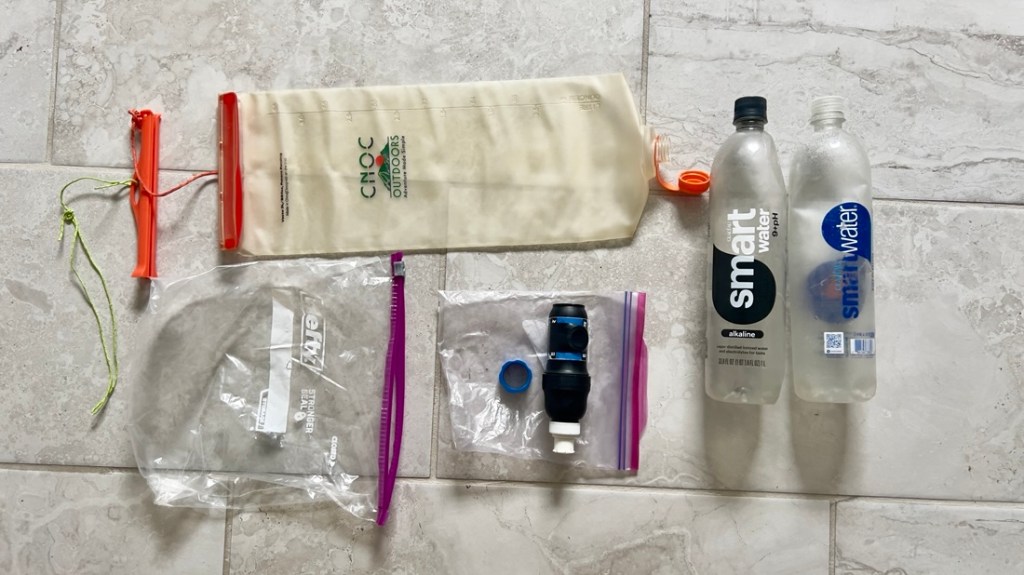
Summary: My water filter system weight equals 10.1 oz.
Big Three Part One: Sleep System
While “less weight = more fun,” sleep is even more important. I divide this system into four components.
The first component is the mat. I started with a $10 foam mat from Academy and it worked well for short trips and a younger body. When I first started taking this seriously, I bought the Thermarest Prolite Plus (Small) weighing 15.8 lbs. I saved ounces by going small, and place my pack under my feet at night. I upgraded to the Neoair Uberlite at 5.8 ounces. However, I have found that I sleep less well on the Neoair due to getting cold, and only use it for warm nights, with its R rating of 2.3, using the heavier Thermarest Prolite, with a R rating of 3.4, for cooler nights. (See REI’s discussion of R values here). I am considering increasing this further with a 1/8″ thin foam pad adding an R of about 0.5 and about three ounces, with Gossamer Gear suggesting twelve uses!
The second component is the sleeping bag. My first serious bag was the REI Igneo Regular sleeping bag with treated down. It weighed 30.9 oz, lower limit temperature of 17 degF and comfort of 30 degF. Recent research has not find anything better with the same function. The bag’s effectiveness is the down, this technology has not improved, and REI made me a great initial recommendation! This has worked well. I also have a 4.3 ounce Cocoon Silk Mummy Liner. This can add up to 10 degF of comfort, and keep the main bag cleaner. I’ve used this on the colder sub-freezing nights though have lost focus on trying to keep my bag clean. For warm nights, I use the 22.2 ounce Zefabak black-300 down quilt, lower limit 32 degF, comfort 41-50 degF, with the silk liner for comfort. While I can find better quilts (like Cleverhiker’s list), they generally retain the concerns in very cold weather while only saving a few ounces. I need to try my quilt in colder temperatures and sleep in my puffy!
The third components is the pillow. Some people are OK using a stuffsack or inflated ziplocks, but I sleep much better with my 2.7 ounce Sea to Summit Aeros premium (regular) pillow. After a few years of use, it started leaking from the seams, and the manufacturer replaced it for free. I don’t consider any alternatives.
The fourth component is the stuffsack. All of my “night time” gear, and spare dry clothes, go into my 2.6 oz Sea to Summit Event medium waterproof compression stuffsack. Each morning, I squeeze it tight, confident it will be dry that evening, regardless of my pack, any covering, the rain, and river crossings. Fantastic. At night, this bag goes unused, but I do not wish to use it either as (a) a pillow case or (b) a hanging bear bag.

Summary: My sleep system weight ranges based on temperature between 31.8 oz and 40.5 oz.
Big Three Part Two: Shelter
The shelter is where I have shaved the most weight. I’ve transitioned from a 115.5-ounce 2P Berghaus Snowdonia 2.1 to a 99-ounce 2P REI Camp Dome 2 to a 64-ounce 2P REI Quarter Dome to a 20-ounce 1P Gossamer DCF One. The latter two are the ones I currently use, the Quarter Dome when I am with Samuel. The Quarter Dome weight includes the weight of the dedicated footprint, the DCF One weight includes the weight of a polycro groundsheet. I also have a 17.7 ounce REI Quarter Dome SL Tarp that I have taken as a shelter for eating under in wet weather.
- The REI Quarter Dome has served Samuel and I very well since 2017. It is dual-wall, freestanding, with two vestibules. The inner tent can be taken down first creating a shelter you can eat in which we did once in the Lakes but it was awkward. I worry less about the 64-ounce weight as I have had Samuel to carry it :). In addition to a couple of other repairs, we’ve recently sealed the seams after the tape came off. For some upcoming trips, I’ve purchased a 39-ounce Big Agnes Copper Spur HV UL 2 (including footprint), saving nearly a pound in weight.
- I bought the Gossamer DCF One as my solo (1P) tent. As a single-wall, trekking pole tent, it’s very light at 20 ounces with a polycro groundsheet. It’s worked very well in dry weather, but condensation disturbed my sleep on a recent wet, humid trip. Wet walls makes the tent feel a lot smaller. As a wet-weather alternative, I’m considering the Durston X-Mid 1 which is one of the few dual-wall trekking pole tents around and would take my 1P tent to about 31 ounces.
I could sleep under the tarp, but I’ve needed the inner tent’s bathtub in some rainstorms. I have tried hammock-camping but have struggled with comfort while the system was heavier. I’d like to avoid taking the tarp as the extra shelter, but I have really appreciated it in wet weather.

Summary: The 64-ounce 2P Quarter Dome when with my son, or the 20-ounce DCF One by myself, though migrating to the 39-ounce Big Agnes Copper Spur HV UL 2. I also take the 17.7-ounce tarp sometimes.
Big Three Part Three: Packing System
My first backpack was an 80-ounce, 60-liter Osprey. I wanted to ensure it would hold everything I needed it to, and that it was comfortable. Osprey continues to sell similar packs, and they are good packs, but a five-pound pack uses up half of the ten-pound target! The volume does not discourage taking less as there is room. I saved over two pounds in weight when I switched to my 47-ounce, 40-liter REI Trail 40 “day” pack, which still worked very well. I needed more volume for our 2×7-day Collegiate Loop, so I upgraded to the 32-ounce, 55-liter Hyperlite 3400 SW which has served me very well with a weight saving! The material is waterproof, but the seams are not, so I still use a waterproof stuffsack.
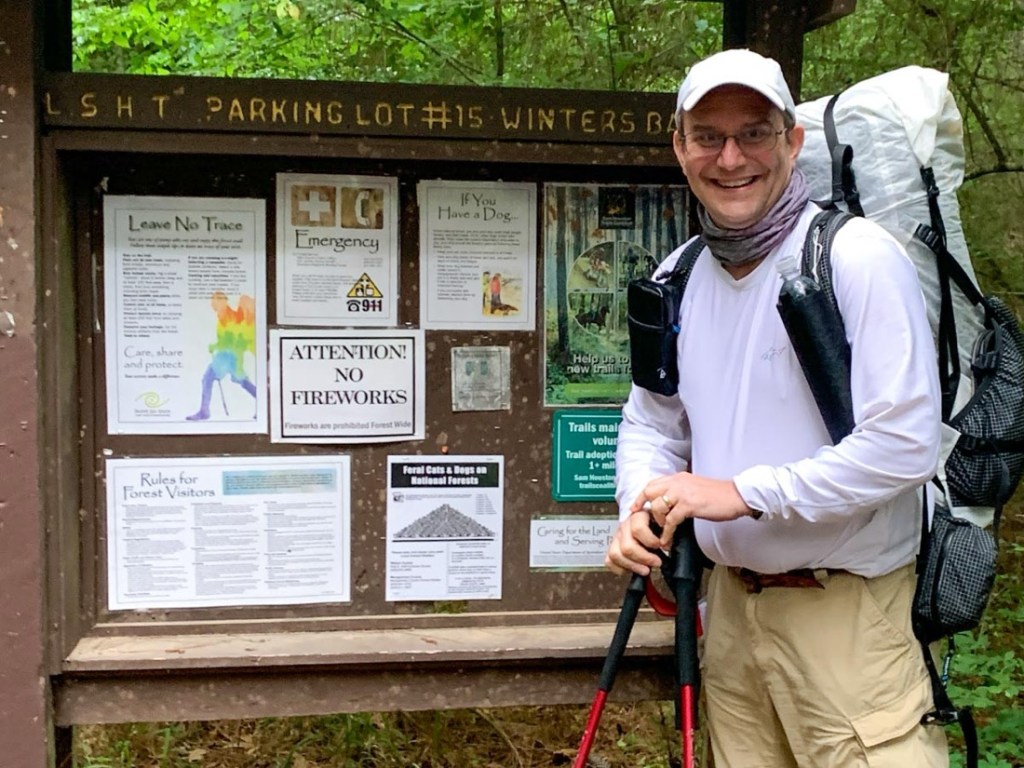
Summary: My go-to backpack is the Hyperlite 3400 SW at 32 ounces.
Summary of the Big Four
The table below shows the weight difference that I achieved from the above four items:
| Initial Approach | Current Approach | Weight Savings | |||
| Water System | Carry two days of water | 16 lbs = 256 ounces | Sawyer Squeeze | 8 ounces | 248 ounces |
| Sleep System | Mat, Sleeping bag, pillow, waterproof stuffsack. | 36.2 ounces | Use a quilt in mild weather | 31.8 ounces | 4.4 ounces |
| Shelter | REI Camp Dome (2P) | 99 ounces (2P) | Big Agnes Copper Spur HV UL 2 | 39 ounces (2P) | 60 ounces (2P) |
| Packing System | 60-liter Osprey | 80 ounces | 55-liter Hyperlite 3400 SW | 32 ounces | 48 ounces |
The above table highlights how essential a water filter is. Even though it adds to the dry weight, it’s the overall weight that matters! The changes to the Big Three resulted in a weight saving of 4.4 + 60/2 + 48 = 82.4 oz or 5.15 lbs, which dwarfs most of the items below.
The weight of my water filter system and the big three is 91.3 ounces, a little under 6 lbs.
The Rest of the Pack: In or Out?
The remaining items in my pack weigh between 53 and 120 ounces, depending on expected conditions. In these categories, weight can be saved in two ways: bring a lighter alternative, or just don’t bring it! Much of this is influenced by personal preferences.
There are things I don’t bring:
- Spare hiking clothes. I hike in only quick-drying clothes and don’t carry an extra pair of pants or shirt. Low temperatures might lead to an extra strategic layer (i.e merino wool thermal).
- A camp chair. I just can’t justify the weight, and I don’t find them very comfortable anyway! I bring a trashbag instead to keep my bum dry when sitting and prevent my waterproof pants getting ripped (again…) on sharp rocks.
- A large multitool. Be careful toting your favorite Leatherman. Weigh it!
- Suncream and bugspray. I don’t like these at the best of times, and with limited washing opportunities in the backcountry, it is even worse. For sun protection, I always wear long sleeves, long pants, and a hat/buff/hoodie. For bugs, I pre-treat clothes, tent, and sleeping bag with permethrin, and have used a head net.

Things I might leave these behind:
- The cooking system. On our trip into the Grand Canyon, leaving this behind saved a pound, and we chose food accordingly. On the most recent Eagle Rock trip, waterlogging of my lighter and stove led to cold-soaking the dehydrated dinner, and it was surprisingly good. This is the item I COULD leave behind to get down to a 10-pound dry weight, but I will generally choose to bring it.
- Waterproofs. These are another pound, but I’ve left them behind and regretted it when I ended up wet and cold.
- A spare phone battery, and/or having one phone for the group. Phones and the spare battery are heavy at nearly 10 ounces each. However, I use my iPhone for many purposes (digital maps, camera, journal, communication) and that use needs the spare battery. I’ve done one trip where I left it behind and relied on Samuel’s and it’s a good way of changing things up!
- I have replaced paper for journaling with the Notes app on my phone.
These things I consider bringing for specific reasons.
- Other camera equipment. I have brought my drone (DJI Mini 2), with a trail weight of thirty ounces on some trips where drone flying was allowed. I doubt whether the weight is always worth it to get the extra photo or video footage. I used to bring a nice point-and-shoot camera, but the iPhones are now better. For trips that have a focus on wildlife photography rather than mileage, I’ll bring my SLR with long zoom lens.
- A paper book. If a trip is about reflection, or there will be plenty of spare time, I’d consider a paper book. I’ve struggled to find digital books as satisfying.
The one item in my pack where I could save weight but choose not to is my latrine kit. First, I could use a trekking pole instead of my 0.6 ounce latrine trowel, but I know I would not dig as good a hole! Second, I could have a bidet system where I wash after number two rather than use TP, but I won’t…
The Rest of the Pack: Contents
This is a long list of everything else that is in the pack. I find it important to itemize such a checklist so that (a) I don’t forget anything and (b) I don’t add extra things last minute!
Cooking System
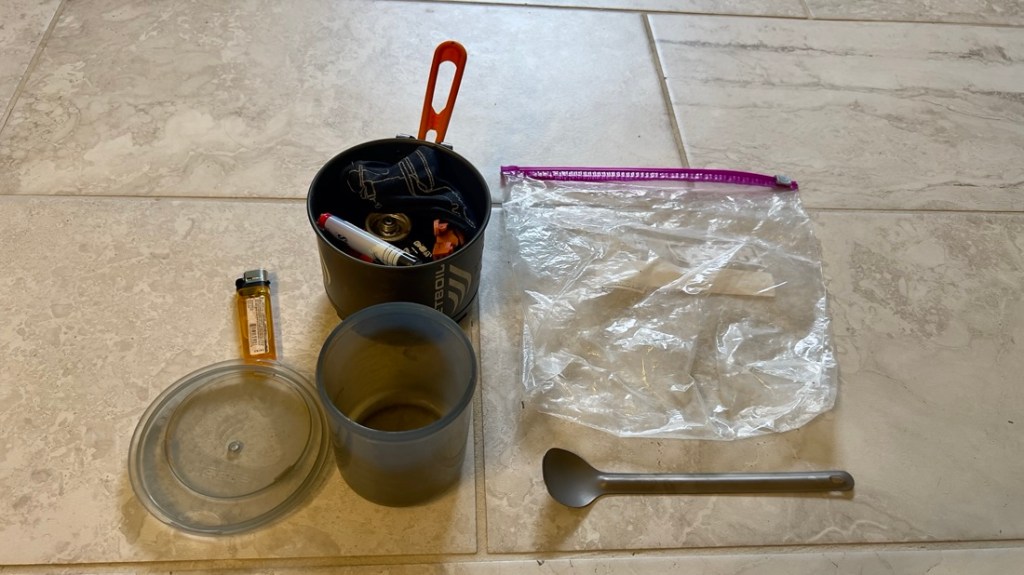
While the lightest cooking system is none at all, there are multiple options. I like the simplicity of gas and the efficiency/ease of Jetboil. I tried a BRS300T/PocketRocket with a titanium mug, but didn’t like the metal mug. I only boil water and eat food out of packaging, either the oatmeal packet or a ziplock bag. I upgraded my original 15-ounce Jetboil to the 8.8-ounce Jetboil stash. I’ve made the mistake of bringing too much gas and have learned a full 3.5 oz container is enough for 20 boils, supporting two people for a week. If I run out of gas, it’s not the end of the world, but I haven’t yet! It helps to get an adapter that allows you to consolidate gas from multiple containers. The weight of the gas is a consumable. Total Dry Weight (Stash, lighter, empty fuel canister) = 12.3 ounces.
Water System
I bring two 1.3-ounce Smartwater bottles with my Sawyer squeeze. I have an easily-accessible bottle sleeve that attaches to the front of my backpack straps and lets me drink whenever I want. I started with a 7-ounce Nalgene and would only consider this for very cold nights when I’d use the Nalgene as a hot water bottle. I could leave the CNOC bag behind but I appreciate the extra storage. Water System (Bottles, Sawyer, backflush adapter, CNOC 3l bag) = 10.1 ounces.

Food System
The heaviest part of this category can be food protection. Regulations for our 2018 Colorado hike required a bear box and our BV500 Bear Vault weighed 41 ounces. When a bear vault is not required yet bears are possible, I use an 8.1-ounce Ursack (resists being ripped open) with one or two 1.6-ounce Opsaks (odor-proof bags). With no chance of bears and minimal reports of rodents, I would use just the Opsak. I have a 2.2-ounce stripped-down GSI Infinity plastic mug, a 0.6-ounce long handled spoon (to reach into the bottom of a ziplock without getting food on my hand/glove), and a 1.4-ounce cozy to keep food warm and upright while rehydrating. The food system ranges from 5.8 ounces (Opsak, mug, spoon, cozy) to 13.9 ounces (add an Ursack) to 43.8 ounces (bear vault).
Electronics
I’ve mentioned my iPhone (13 Pro, 8.3 ounces), and battery (10.3 ounces with cables). I also have a 3.6 ounce Garmin InReach for checking in, in-field weather forecasts, and emergencies. Research for this blog led me to the 1.3 ounce, USB-Rechargeable, Nitecore Headlamp NU25, which I am buying myself for Christmas. While this saves a couple of ounces, I prefer the USB recharging. I haven’t hiked with spare AAA batteries for my current headlamp for many years. The iPhone, or a fellow hiker, or the moon, is an emergency backup. Electronics (Phone, battery, cables, InReach, headlamp) = 23.5 ounces.
Toilet
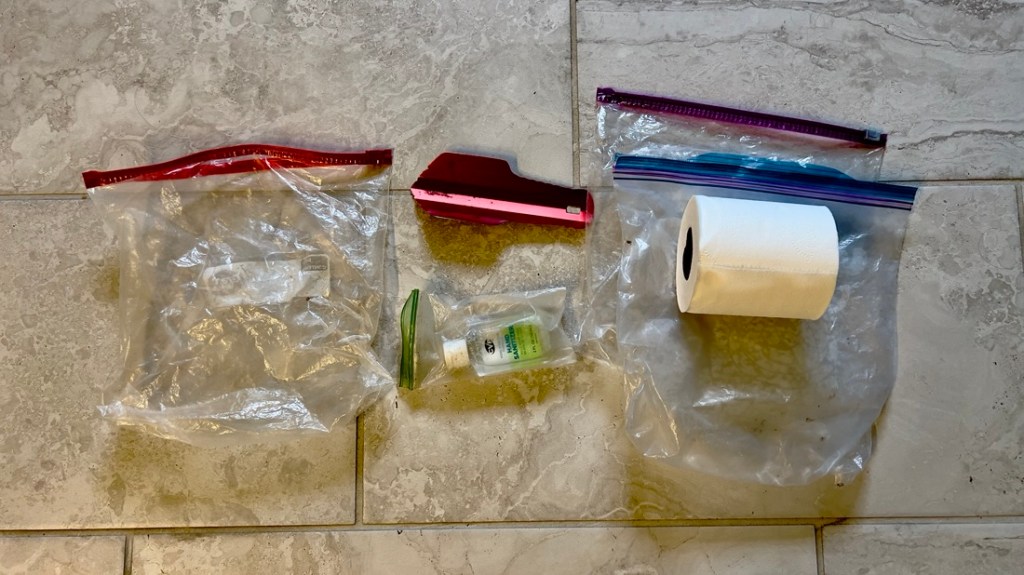
The Deuce #2 goes in a ziplock with other ziplocks for clean and used TP, and handsanitizer. The TP and hand sanitizer are consumables. I also bring a few wetwipes which I keep in the food bag and they might be used in this category. Dry weight of toilet system (Trowel, ziplocks) = 1 ounce.
Emergency
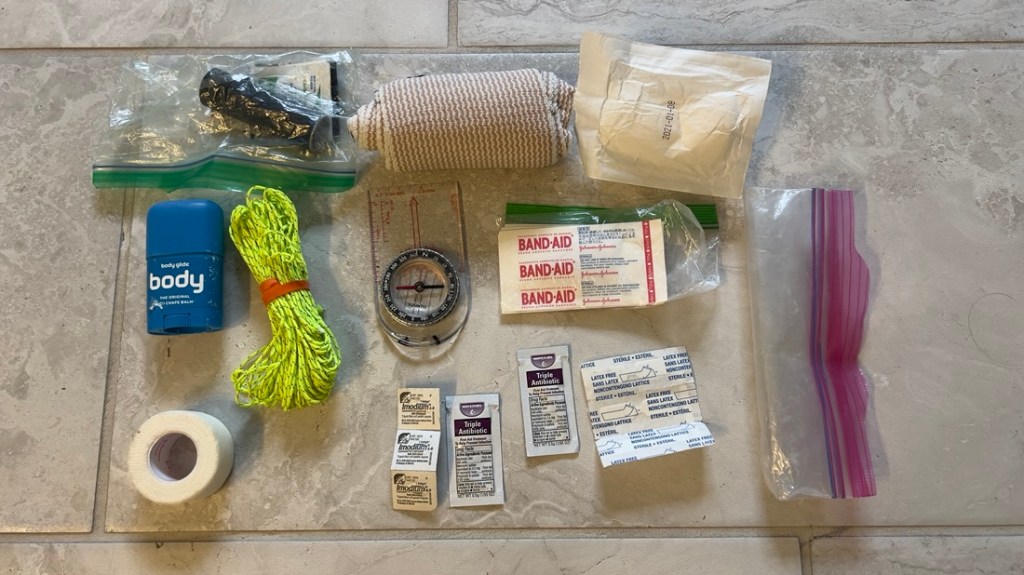
I reserve this category for things that I will bring again, even if I don’t use, though I try to minimize. This includes a small supply of fixing tape/patches (0.3 ounce), thin rope (1.1 ounces), and the car key with some cash, credit cards, ID, and insurance card in a ziplock (1.9 ounces). I have created my own first aid kit based on the incidents I consider might happen to me and what I would use to help me self-rescue. This includes bandaids, Imodium, and a bandage. I treat Ibuprofen as part of the food! I started with a purchased kit and evolved to this one weighing 4.1 ounces, keeping it in a ziplock. Having wetwipes available to clean cuts helps justify them in my consumable category, using them as a “luxury” item when emergency needs don’t happen. Emergency items (Tape, rope, key and ID, first aid) = 7.4 ounces.
Miscellaneous
This is a dangerous category as it can get big without a designated use. Mine used to be much broader, but I have separated out the categories above. First, this includes toothbrush and paste. I made my toothbrush shorter to save weight, though it’s a fraction of an ounce. I tried using tablet toothpaste but they have a short shelf-life once opened – I might try dehydrating my own, though very small toothpaste tubes work. Next, I bring eyepatches and earplugs in case I can’t sleep, though I prefer not to use them. I bring a microfiber towel with my singlewall tent to wipe condensation off the insides. I bring a small penknife, a trashbag for sitting on, a compass, and sunglasses. These total 7.6 ounces.
Clothes in my pack
On trips with cold nights, the extra clothes I carry in my pack can be my heaviest “category” at 52 ounces. I choose these carefully. I used to prefer a 19-ounce fleece over a 10-ounce puffy through a fear of getting it wet and the puffy losing all insulation, but realized a wet fleece is also miserable so I ensure my puffy stays dry in a dedicated ziplock and don’t wear it when it’s raining. I always bring 11-ounce sandals as campshoes to allow my feet to breathe, and I could hike in them in an emergency. I have 13.7-ounce merino thermals and 13.4 ounce Outdoor Research Helium waterproofs. I consider bringing heavier waterproofs if a significant amount of rain is forecast. I have a 2-ounce wooly hat and 2-ounce gloves. I bring spare undies, and a spare pair of hiking socks so I have a dry pair in the evenings and for emergencies. The weight of clothes in my pack has varied from 11 ounces to 52 ounces, depending on the weather.
“Hidden” Weight
The goal of focusing on dry weight is reducing the total weight carried as your comfort wishes. Dry weight does not include food, other consumables, or clothes worn. The boundaries between these categories can be blurred. The risk is that we fall into the trap of moving something from one category to another to reach a goal, which not reducing overall weight.
The line between items worn and items carried is not concrete as it changes. I can easily reduce my dry weight by saying I wear my thermals or waterproofs. At least one ultralight checklist includes their phone in items worn. I aim to categorize items so that I can weigh my pack’s total weight at the trailhead, and it matches my excel spreadsheet. It’s amazing how weight appears to creep in, as the total weight always appears to be more than the sum of the parts!
The line between dry weight and food is also a bit blurry. I prefer the concept of consumable vs not, so that the weight of your pack at the end of the trip should equal the beginning weight minus the consumables. This is not exact as you might not eat everything, or use all of the TP, gas, or hand sanitizer. However, after our first five-day Colorado trek in 2018, our trash weighed two pounds. I have since strived to reduce that through more efficient packaging. One saving is placing store-bought dehydrated meals into a freeze ziplock bags.
A Few Words on Food
I am far from an expert on backcountry food and have unfortunately approached it as fuel rather than fun. Here are my key learnings.
- I used to bring too much food, ending with a few pounds of food at the final trailhead. Now, I plan by weighing and calculating the calories of every item. For the lengths of my trips, we will be OK eating fewer calories than we burn, but there is a happy place for everyone. My last trip was about 2200 calories per person per day, and we ate our final snacks in the last mile.
- It’s pointless bringing food that you won’t want to eat. I’ve learned that taste buds change in the back country. On my first trips, I worked out a daily food plan and repeated it for each day. Day three of the same is too much! When we resupplied at our Collegiate Loop halfway point, the outdoor store only stocked spicy dehydrated meals, and they were a disaster. I’ve discovered that adding seasoning can be fantastic! We’ve learned that ANY of the egg-based dehydrated meals don’t work for us, and I love the cooler trips where we can bring cheese, salami, chocolate, and even precooked bacon! Variety is precious, and heavier food for the first day enriches the experience.
- To optimize food weight, I look at calories per ounce, aiming for over 100. Nuts are 150-200 cal/oz. Other calorie-dense food, including dried bananas, raman, cheese, salami, and chocolate, and generally in the 100-150 range. I tend to include a few <100 items for variety, such as raisins, hot chocolate, tortillas, nuun tablets. Items such as coffee or seasoning have no calories. I purchase or repackage to minimize packaging weight.
On my last 3-day, 3-night trek of Eagle Rock Loop with two people, I brought just under 6 pounds of food, averaging 115 calories per ounce, though I still had 1/2 pound of trash!
Conclusion
The most important camping gear you have is what you use. I undertook thrilling and challenging adventures with my “heavy” starter-gear and I would have enjoyed continuing with the same.
I can achieve a <10-lb dry weight by (a) hiking with others to share the load, (b) camping in a mild climate to negate the need for extra clothes, and (c) compromising in areas of comfort. Less than 10 lbs suits a Grand Canyon trek which is warm at night and involves a lot of climbing, but this is not a typical trek. I will normally want to bring extra clothes for warmth, and bring my stove to enjoy hot coffee and heated meals. Food protection is often required. I have tried the lightest air-mattress and moved back to my heavier one.
Decreasing backpack weight is about increasing fun, not hitting a weight goal. I’m happy with the weight on my back, and need to focus on the excess weight around my belly.
Below is a summary of my lightest pack, and one for cooler weather. If you are strange enough to want to see my full analysis :), it’s here, though that’s really for me to be able to find it!

I expect my equipment list to continue to evolve and welcome suggestions!
 The Adventures of the Cajunlimeys
Great write-up and thank you for the mention 🙂 My pack definitely is a bit more comfort-driven. I tend to pare back weight in one area so I can carry a bit more in another, such as with my Helinox chair to which I’ve grown increasingly attached, haha. I’ve been considering a trekking pole tent and have a ton of Amazon credit thanks to my parents and in-laws; you can get the Six Moon Designs Lunar Solo on Amazon (as well as one of those neat little fuel adaptors!). That’ll save me about 2 pounds. I think you’ve logged a lot more backpacking miles than my son and me, but once we got over the learning curve of how to care for the Sawyer (manufacturer-prescribed methods plus homebrew hacks from the Internet), ours are doing great after about 5 seasons! I also went all-in on the trail runners a few years ago. On our first trip with them I accidentally dunked both my feet in a creek, still managed to hike about another 5 miles to camp without developing blisters, and my feet were dry by mid-morning the next day (after stuffing some paper towels in them overnight and swapping out my socks for the hike out of camp). Anyhow I loved reading all the detail on the weights and your thought process!
LikeLiked by 1 person
Most of my hiking over the last ten years was focused on getting in miles, hence the focus on weight. I embraced wet trail runners but have recently tried Sealskinz waterproof socks (which I did not mention) which work very well if you don’t completely immerse. I’m hoping to do some camping soon that is more photography-focused, and then I’ll bring more of those “luxuries” ! We shall see 😎.
LikeLiked by 1 person
I am going to need to look into those waterproof socks! Again I really enjoyed your write-up. I have settled down into a starting “all-in” pack weight (gear, food, and water on my back) of around 31-33 pounds for most 3-4 day, moderate weather trips (temps from overnight lows in the high 40s here in PA). Doing the tarp instead of the tent sheds maybe 3 pounds but we only tarp camp in the non-buggy season! I do need a scale, though, so I can see the impact of some of these little items.
LikeLike