
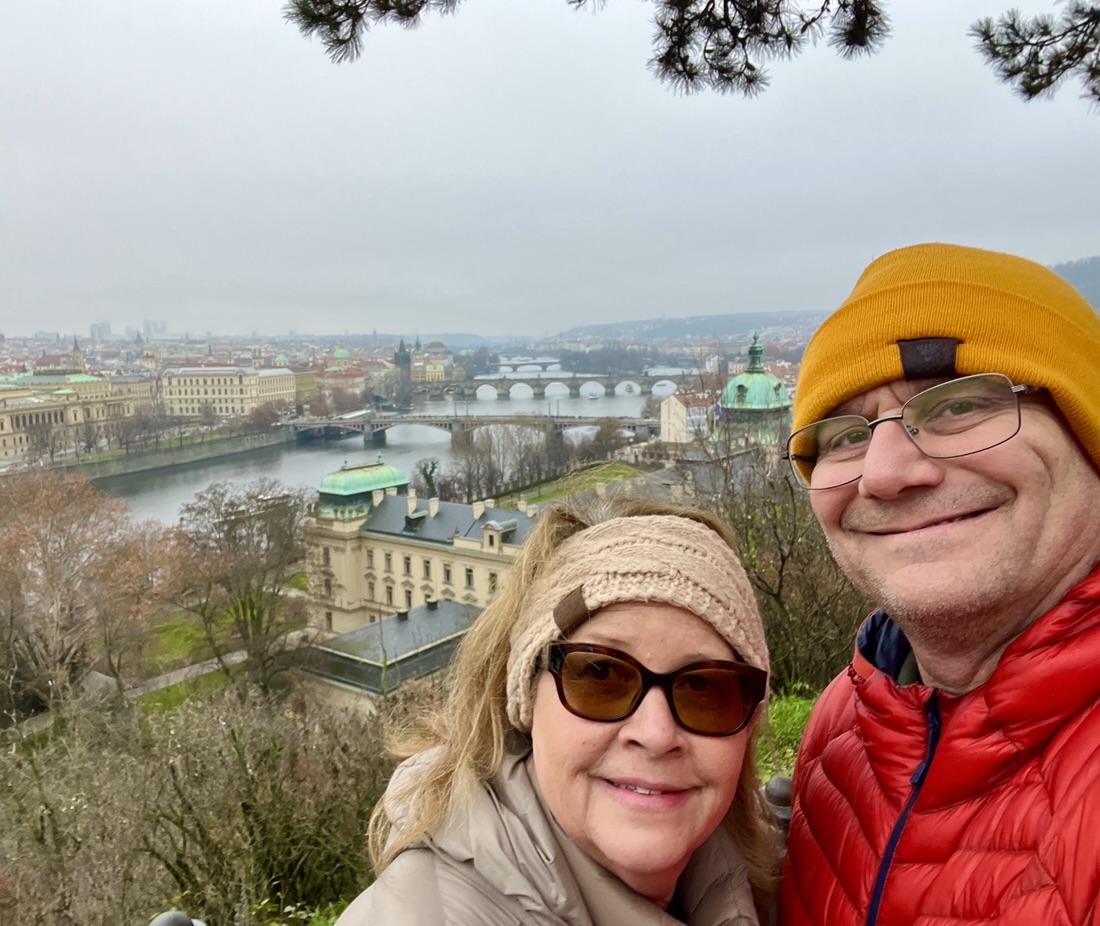
A window of opportunity opened for me to take Janet to Europe for some Christmas markets. Fortuitously, Prague had recently joined our wish list. After finding a good flight, booking two Hyatt hotels with points, and lots of planning, we were heading to the Czech Republic!
Day 1: Strahov Library and Petrin Hill
A Brief History of Prague and the Czech Republic
Day 2: Lesser Town and the Charles Bridge
Day 3: Prague Castle
Day 4: New Town, Markets, and a River Cruise
Day 5: Bethlehem Chapel, the Jewish Quarter, and a Classical Concert
Day 6: Old Town, the Klementinum, and a Black Light Show
Reflection
Day 1: Strahov Library and Petrin Hill
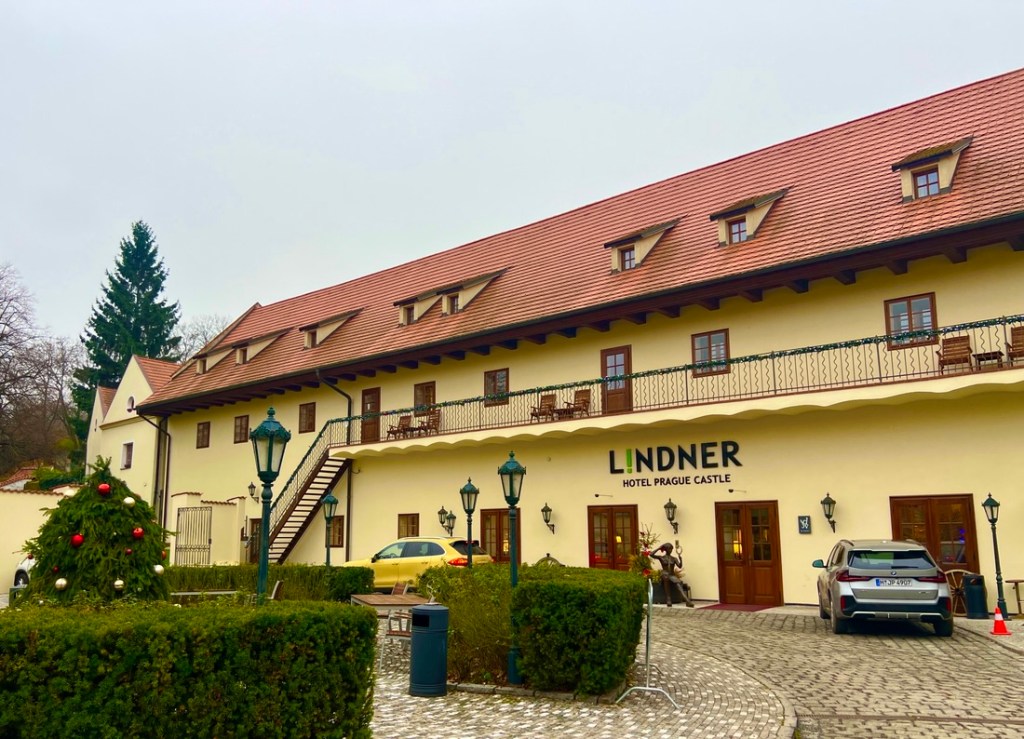
A peaceful Prague airport greeted us on our arrival from Houston via Munich. An enthusiastic Uber-driver whizzed us to Hyatt’s Lindner Prague Castle hotel, where we checked in, dropped our bags, and bundled up. The previous week’s heavy snow had melted, but with the temperature still close to freezing, we donned our thermals and puffy jackets.
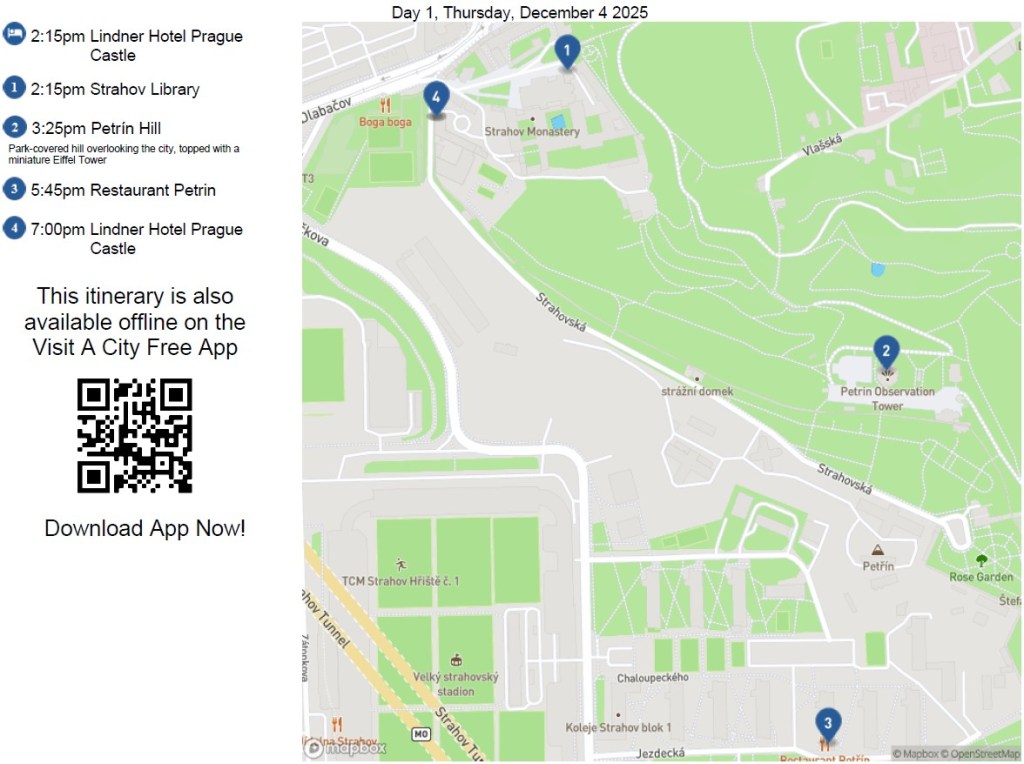
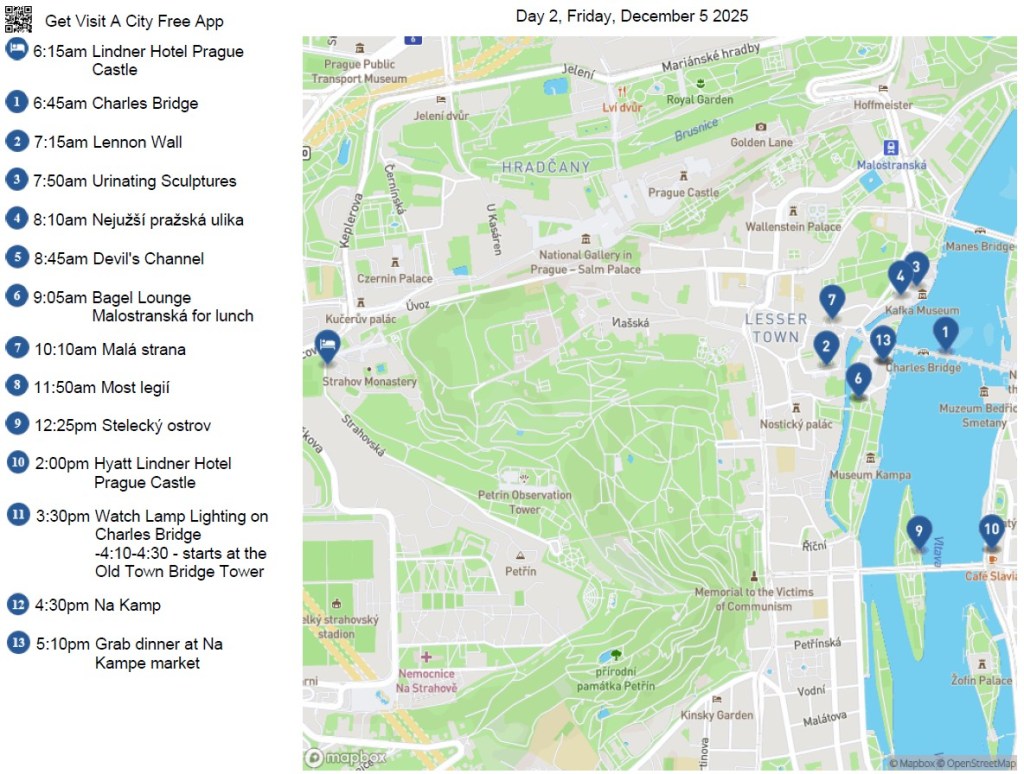
We had a plan! Well, we had Janet’s plan to be specific. Janet had researched every aspect of each day and created a detailed itinerary in the Visit A City app. The detailed research really helped us get the most out of each day. We generally didn’t stick to the timeline and stayed flexible, but we ended up following the plan’s sequence pretty closely. A copy of her plan is linked here. I have included a copy of each day’s itinerary below.
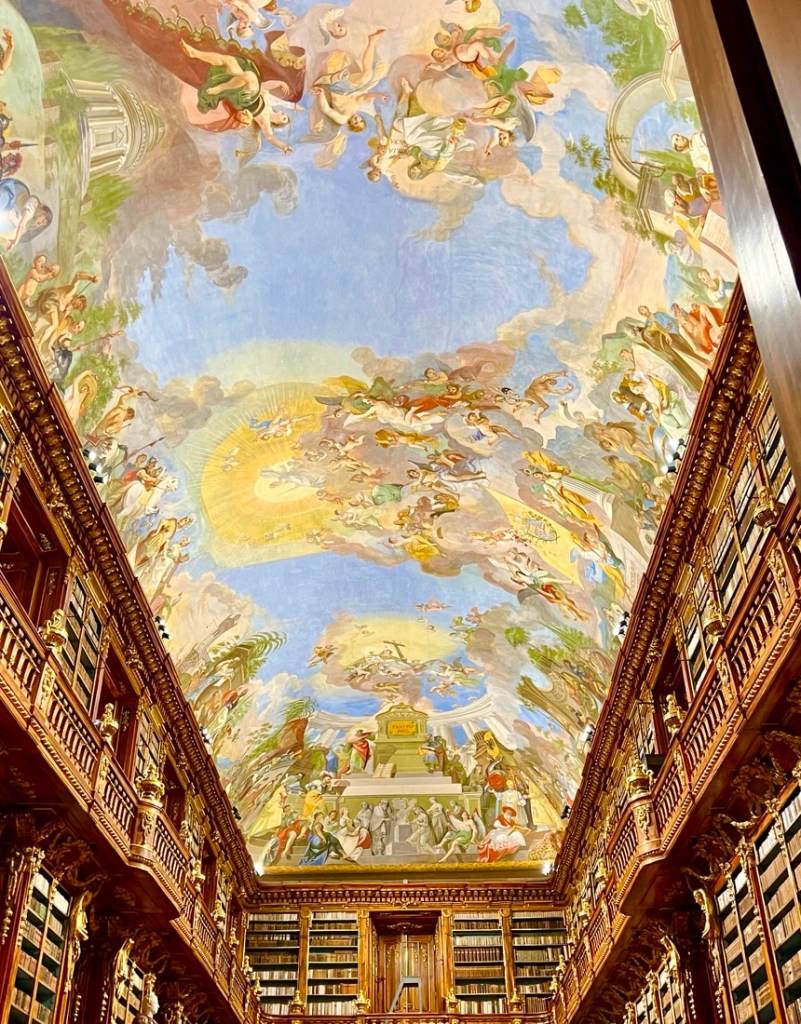
Our first stop was the Strahov Library, adjacent to our hotel in northwest Prague. We had chosen to stay at the Lindner hotel for three nights before moving to the Andaz hotel in the city center to give us more time to explore this area. The Strahov Library’s main buildings were from the 17th century as part of a monastery, with the two main libraries being the Theological Hall and the Philosophical Hall.
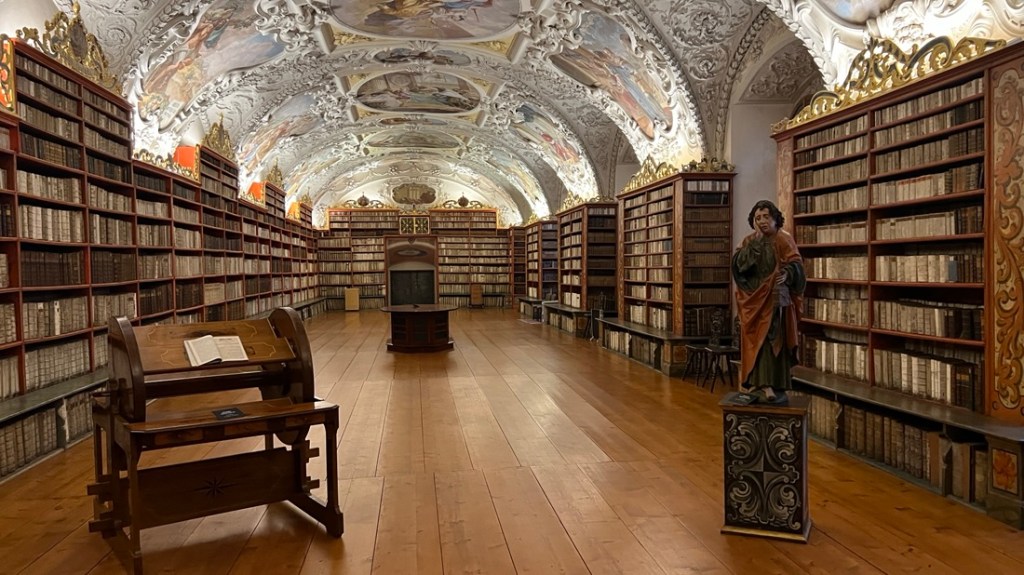
We got our first insight into Prague’s academic history and its study of the planets with a display of many celestial (showing the stars) and terrestrial globes (showing earth).

Of the library’s 200,000 manuscripts, the most precious is arguably the Strahov Gospels in Latin from 860 AD, but these were hidden away. We were able to see the oldest extant Czech translation of the Bible from the 15th century, created before verse numbers were introduced around 1551. Written before the Reformation, when the Roman Catholic Church insisted that its Latin translation, the Vulgate, was the only Bible to be used, this Czech Bible was a hint at the church tensions that we would learn more about.

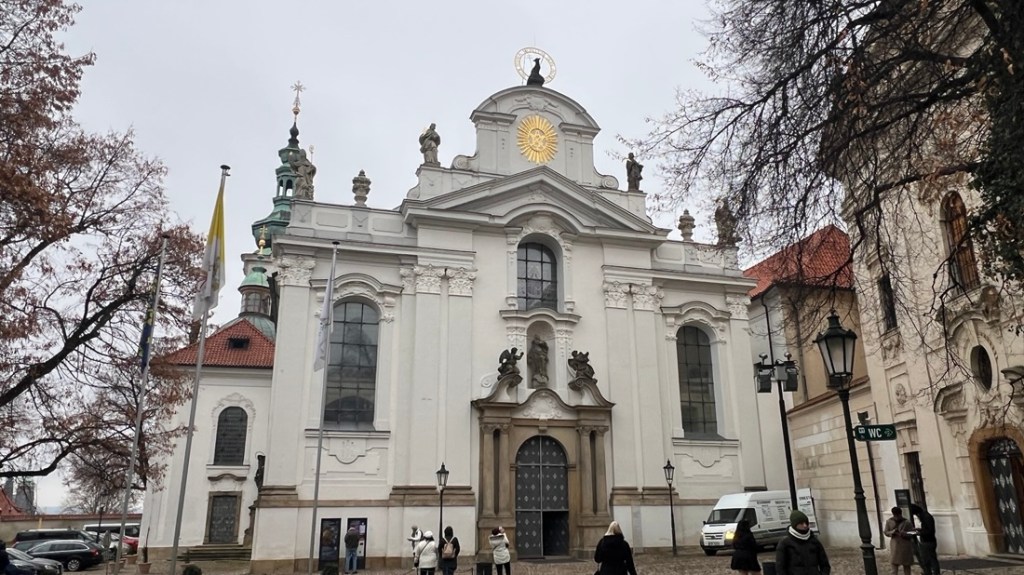
The monastery complex included the Basilica of the Assumption of the Virgin Mary, the first of many grand churches we would see.

Without realizing it, we were witnessing the result of the centuries of struggle that this Czech nation had endured. Before the trip, I had read Heda Margolius Kovaly’s Under a Cruel Star: A Life in Prague 1941-1968. The author’s autobiography describes her life as a Jew under the Nazi occupation, having escaped a transport to Auschwitz, only to suffer even more under the communists, who executed her husband in 1952. I understood that Czechoslovakia had been formed in 1918, that the communist government was overthrown in 1989, and that the Czech and Slovak Republics separated peacefully in 1993. I had a lot to learn about its history from the 10th century to 1918, including Good King Wenceslas and the Cyrillic script!
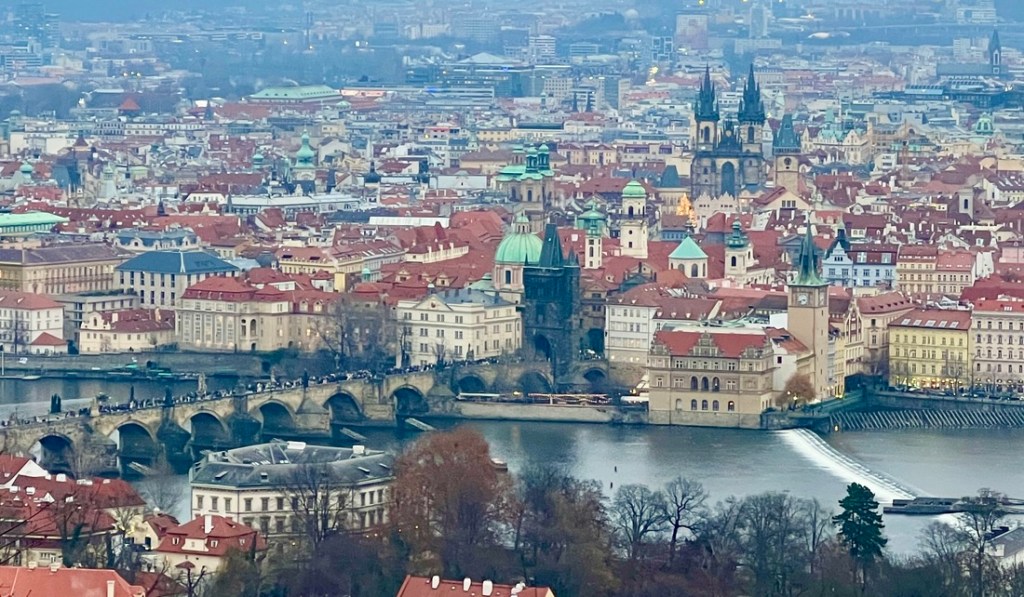
Our first day’s mission was to beat jet lag, so we walked up Petrin Hill to a tower and a city viewpoint. It was good to get the heart pumping.


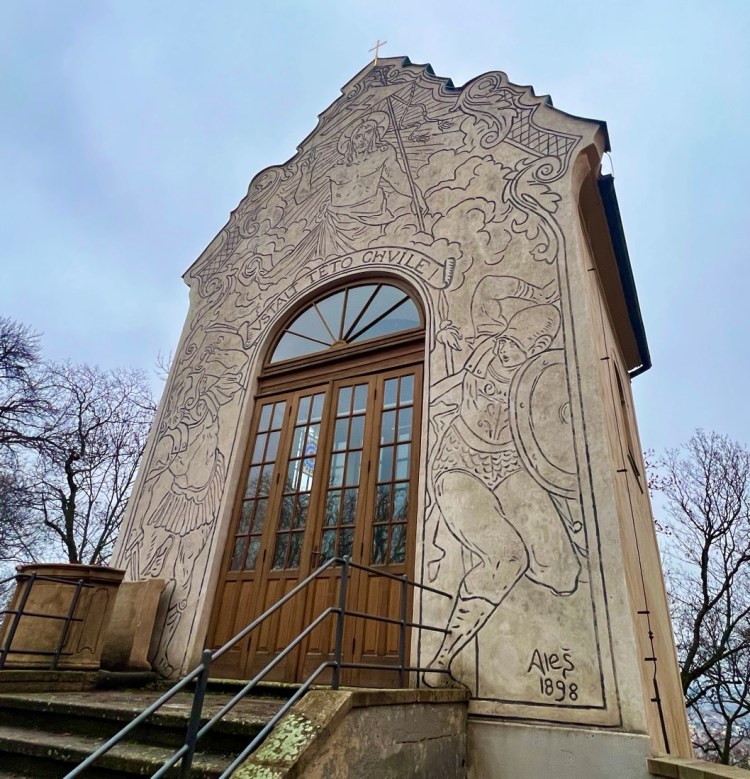
Near the top of the hill, there was a series of monuments representing the stations of the cross, ending at a small church with artwork depicting Jesus’s resurrection. Nearby was another church, and another old church-like building that housed a mirror amusement.
This was the paradox we found everywhere in Prague. There were churches everywhere, with a very strong Christian heritage, but it is one of the most secular and unreligious countries in the world. Perhaps this is a side effect of the people’s quest for a national identity for so long, or a hangover from communism. The turmoil has left behind so many architectural marvels.
The early 4 pm sunset and subsequent darkness emphasized the bleakness of the bare deciduous trees and the dormant gardens. However, it was oddly refreshing, as we don’t get such seasons in South Texas, and we have not travelled recently in the winter. We wandered up and over the top of the hill, towards a restaurant Janet’s prior research had identified. We mistook college accommodation for Soviet-era construction before we arrived at the Restaurant Petrin, which was a very quiet pub. We were overjoyed that we could eat at 5 pm and greatly enjoyed our first Czech delicacies of garlic soup, baked camembert, and goulash. Watching a documentary about London’s St. James’s Palace, dubbed in Czech, on the pub’s big TV was surreal! Ironically, this meal was probably the most authentic, tastiest, and cheapest of the trip!
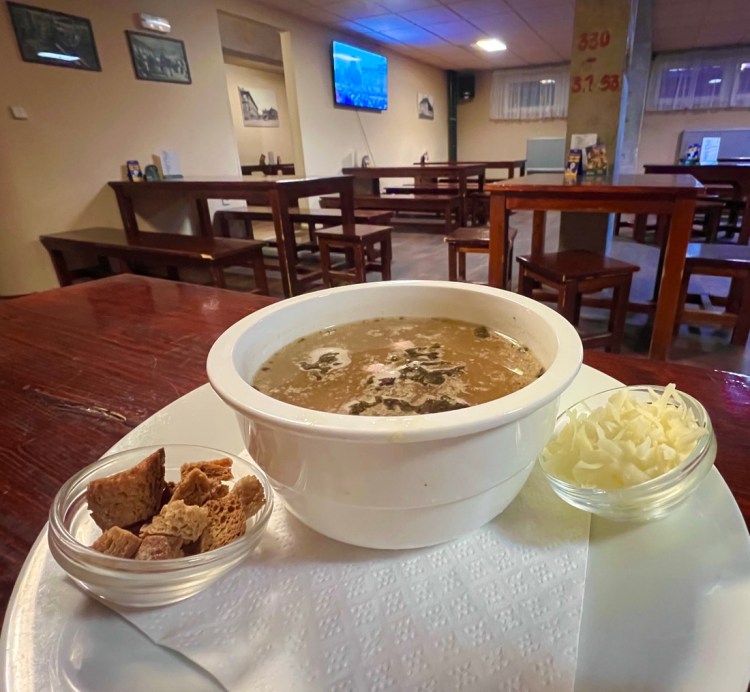

With satisfied appetites, we pulled up Google Maps and headed back to the hotel. We reflected on how this maps app has revolutionized travel, from finding viable walking routes to highlighting convenient public transport options. It was a very quiet and dark twenty-minute walk back to the hotel, but we never felt the slightest danger. Our bed was loudly calling, but we were very content with our first day. We’d seen a few cool things and were getting the feeling that there was a lot more to learn about Prague and its history.
A Brief History of Prague and the Czech Republic
Each day that we were in Prague, I learned more about its history. The fog slowly cleared about where Wenceslas, Jan Hus, Kafka, and the Velvet Revolution fit into the timeline. Indeed, writing it out below has clarified it, and I share it here as it helps all the sites fit in.
You can skip to Day 2: Lesser Town and the Charles Bridge here.
| 4th C. BC | Earliest evidence of the Celtic tribe “Boii,” which led to the name “Boiohaemum” or “Bohemia.” (yes, as in Queen’s Bohemian Rhapsody.) |
| Lots of migration of Celts, Slavs, and Germanic tribes. | |
| 865 AD | Cyril and Methodius brought Christianity to Prague from Thessaloniki. Methodius baptizes Prince Borivoj and his wife, Ludmila. The Czechs had no written language, so Cyril created an alphabet to enable a written Bible in their language. Cyril’s disciples evolved this language into today’s Cyrillic script, named to honor him. |
| 880 | Borivoj moved his seat of power to Praha (anglicized Prague) on the Vltava River, with Praha meaning “threshold” or “ford” in Slavic. He started the construction of Prague Castle. Prague’s other castle, Vyšehrad, dated to a similar time. |
| 921 | Borivoj and Ludmila’s grandson, Wenceslas, becomes king. His unifying the Czech people with Christendom led to his moniker, Good King Wenceslas. Built the basis of today’s St. Vitus Cathedral in Prague Castle. |
| 935 | Wenceslas’s younger brother, Boleslav, assassinated Wenceslas. |
| 1172 | Judith Bridge, the first bridge over the river, was built. It collapsed after about two hundred years, and was replaced by Charles Bridge. |
| 1347 | Coronation of Charles IV as King of Bohemia. Prague becomes the capital of the Holy Roman Empire, marking the beginning of Prague’s medieval golden age, which led to the construction of the city’s best-known monuments. |
| 1348 | King Charles established the University of Prague, the first university in central, northern, and eastern Europe. |
| 1357 | Construction started on the Charles Bridge, replacing the Judith Bridge that collapsed in a 1342 flood. It remained the only major bridge across the river for centuries until Legion Bridge was built in 1841. |
| 1409 | Roman Catholic priest Jan Hus preaches in Czech against indulgences, and in support of the eucharist for all, leading to his excommunication by the Pope. His teachings inspired Martin Luther, who started the Protestant Church in 1517. |
| 1415 | Jan Hus was executed, beginning centuries of turmoil and conflict between Hussites (and subsequent protestant Lutherans) and Roman Catholics. |
| 1620 | After the Catholics defeated the Protestants in the Battle of White Mountain in the Thirty Years’ War, protestants were banished from Prague. The victorious Habsburgs moved their court to Vienna, and Prague declined. The Habsburg Empire evolved into the Austro-Hungarian Empire, which was dissolved after its defeat in World War I. |
| 1848 | Jews arrived in Prague in the 10th Century and settled on marshy land by the river. Their fortunes rose and fell over the centuries, from pogroms (organized massacres) to when the Jewish Mayor, Mordecai Maisel, was the Minister of Finance at the end of the 16th Century, and used his wealth to develop the Jewish ghetto. Prague grew into one of Europe’s largest ghettos with 11,000 inhabitants in 200 wooden buildings. In 1781, Emperor Josef II emancipated the Jews, eventually leading to the ghetto walls being torn down. The area was renamed Josefov to honor the emperor. |
| 1897 | The Jewish Quarter, or Josefov, was rebuilt. Only the medieval-era synagogues were kept. |
| 1914 | Even though the Czech lands were inside the Austro-Hungarian Empire, they formed legions that fought alongside the Allies (Russia, the UK, France, Italy) against the Central Powers (Austro-Hungarian Empire, Germany). Their goal was independence. |
| 1918 | At the end of the First World War, the Allies supported the creation of an independent Czechoslovakia. Prague Germans experienced discrimination. |
| 1924 | Franz Kafka, the author, died in Prague of tuberculosis, aged 40. Born into a German-speaking Czech family, his writings are seen as premonitions of a totalitarian future. |
| 1938 | Chamberlain (UK) and Daladier (France) gave the Czechoslovak Sudetenland to Germany in the Munich Agreement, without consulting the Czechs, hoping to appease Hitler. |
| 1939 | Contrary to the Munich Agreement, Hitler invaded and occupied the rest of the Czech Republic. The mass deportation of Jews started in 1941. German occupation caused the death of 77,297 Czechoslovak Jews, whose names are inscribed on the walls of the Pinkas Synagogue in Prague. |
| 1942 | The Czech Resistance assassinated Reinhard Heydrich in Prague. Heydrich was an architect of “The Final Solution to the Jewish Question” and was the most senior Nazi in Czechoslovakia when killed. Hitler’s retributions were severe. |
| 1945 | Soviet troops liberated Prague from the Nazis. Many Czechs were sympathetic to communism after the Nazis, as the country rebuilt its democracy after the war. |
| 1948 | Communists took power with a coup, and the country was governed with strong Soviet ties. In her autobiography, Under a Cruel Star: A Life in Prague, 1941-1968, Heda Margolius Kovaly describes her horrific life under the Soviets. |
| 1968 | When Prague’s intellectual community attempted to evolve communism, in what is known as the Prague Spring, the Soviet Union occupied Czechoslovakia to suppress any innovation. |
| 1989 | After the fall of the Berlin Wall, the Velvet Revolution was a peaceful transition from the one-party communist rule to a parliamentary republic. |
| 1993 | Czechoslovakia peacefully split into two countries, the Czech Republic and the Slovak Republic, with Prague as the Czech Republic’s capital. |
| 1999 | Czech Republic joined NATO |
| 2004 | The Czech Republic joined the European Union. They are part of the Schengen Agreement, allowing free movement between the member countries. The Czech Koruna remains the nation’s currency, perhaps for the long term. |
Day 2: Lesser Town and the Charles Bridge
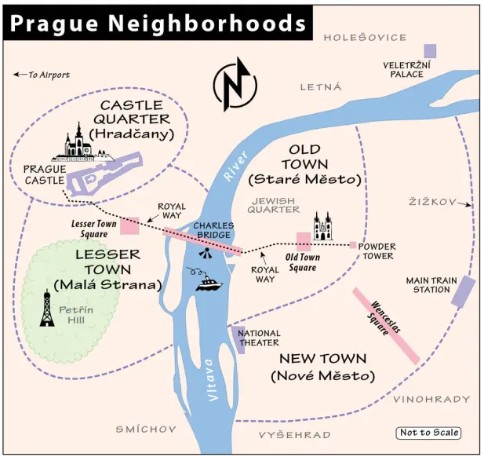
We divided our days by the Prague neighborhoods, visiting Lesser Town and Prague Castle on Day 2 and Day 3 when staying at the Lindner Hotel between Prague Castle and Petrin Hill. On Day 4, we moved across the river to the Andaz hotel in New Town next to the Powder Tower. The Andaz was a great base for exploring the New Town, the Jewish Quarter, and Old Town.
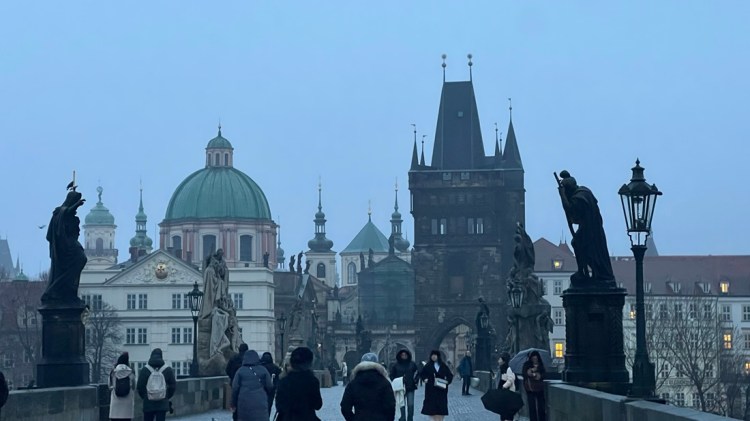
The first night’s sleep was not great. Jet lag woke us at 3 am, so we watched TV until breakfast started at 6:30 am. Our first stop was Charles Bridge, but rain prevented a great sunrise.
The rain kept the crowds away, but we were not the only ones braving the rain. The mist added atmosphere to the bridge’s statues, though St Vitus’s Cathedral in Prague Castle stayed in the clouds. The original statues are kept in museums to prevent further damage and have been replaced by replicas, which still attract plenty of attention.

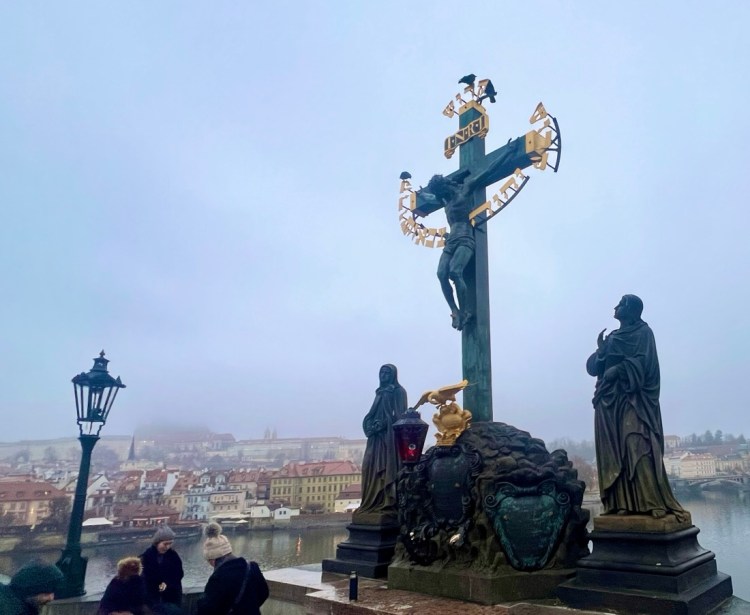
There are probably more birds now!
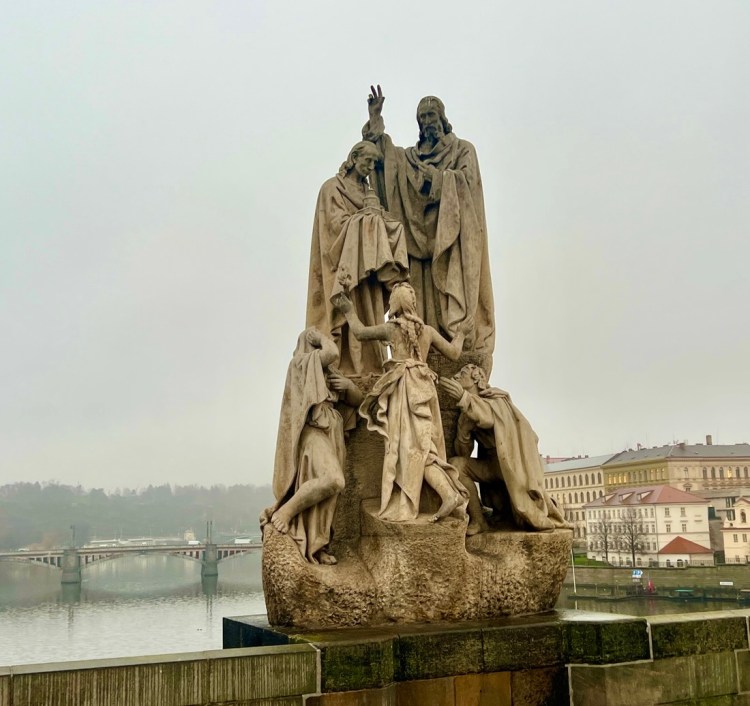
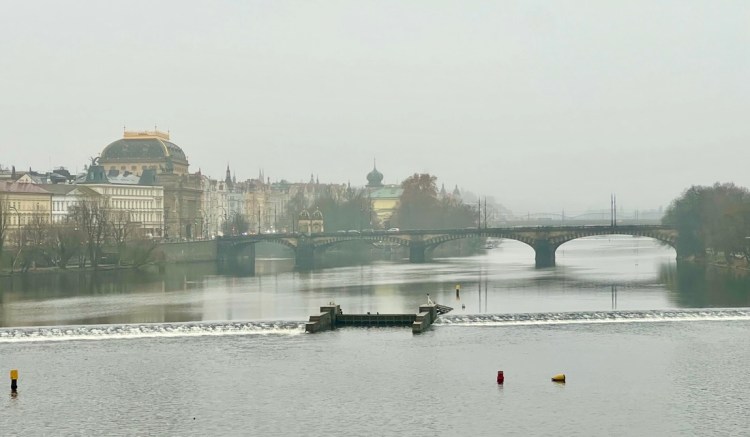
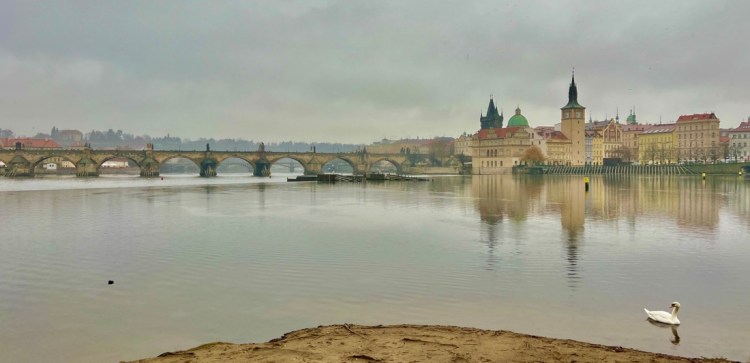
After checking out the bridge, we returned to the left or west bank of the river to wander around the Lesser Town, following Janet’s guide, Google Maps, and some geocaches. First was a fine view of Charles Bridge with wooden icebreakers on the upstream side to protect it.

Across from the French Embassy is the Lennon Wall. In the 1960s, love poems and short messages against the regime led to it being called the Wailing Wall. After John Lennon’s murder in London in 1980, his image and songs were painted on the wall, and it evolved into a silent protest against Czechoslovakia’s communist government. The government tried to control the images by frequently painting over the wall, but the messages and pictures would return. After 1989’s Velvet Revolution, the wall has remained a symbol of love and peace.

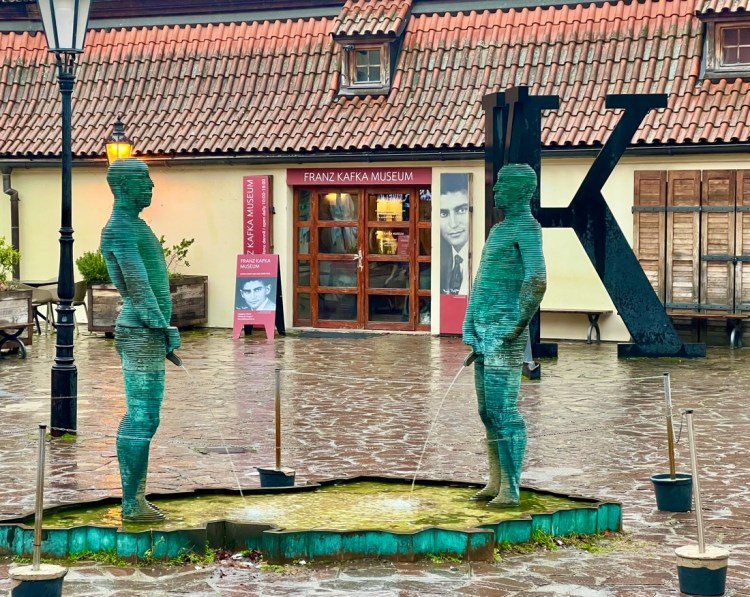
Local artist David Cerny has made sculptures throughout the city. I can only describe them as “interesting.” In front of the Franz Kafka museum is a sculpture from 2004 of two men urinating onto a map of the Czech Republic.
Next were the babies. It seems David Cerny has a thing for them. On his website, he writes, “Babies are kind of weird things. They don’t know the rules. So they might kill someone.” I hope that our friends who have just had babies don’t read this!

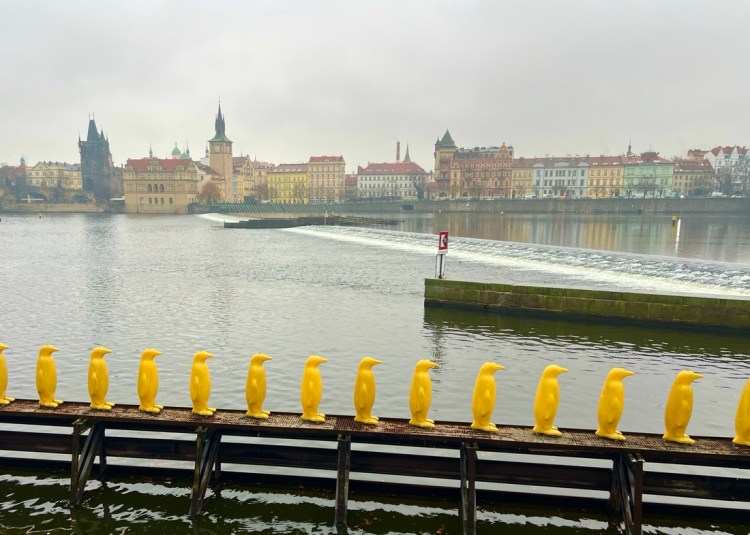
Complementing Cerny’s work is a line of yellow penguins, made from repurposed plastic as an ecological statement.
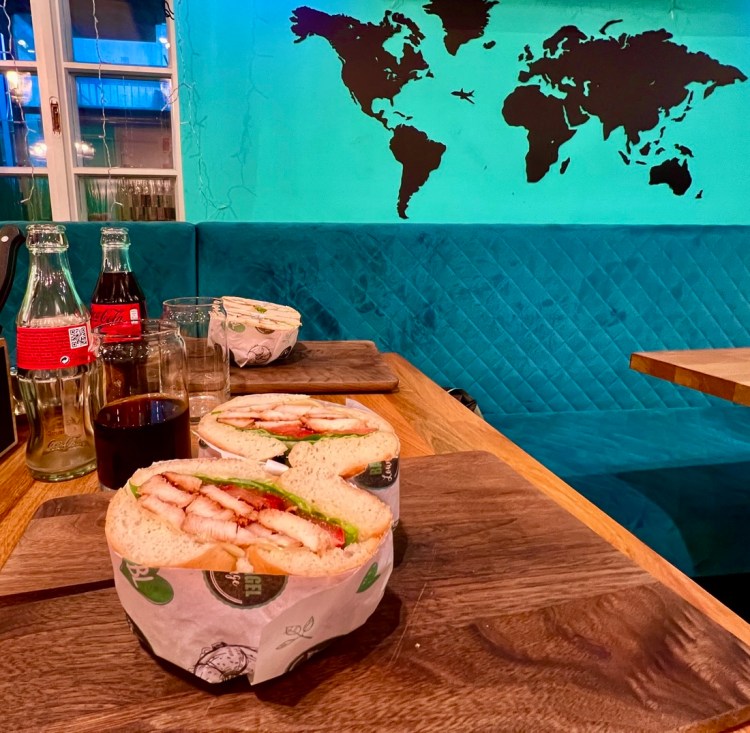
Our wanderings took us onto Strelecky Island. We were excited when we thought that we saw a beaver, but were dismayed when we realized it was just a large rat called a Nutria, of which there are plenty in Louisiana. They are an invasive species in both places, having been introduced from South America. At least we got a good view downriver before heading to the Bagel Lounge for lunch.

In our wanderings, we passed both the US and UK embassies. There was additional security by the US embassy, checking underneath all cars. The statue of Churchill outside the UK embassy suggested that he made amends after Chamberlain threw Czechoslovakia under the bus (or German tanks) when he gave their Sudetenland to Hitler in the 1938 Munich Agreement in a failed attempt at appeasement. The UK Embassy was flying the Ukrainian flag. When we visited, the Czech Republic was hosting nearly 1/2 million Ukrainian refugees, driven out by Russia’s invasion. Prague was less than 1000 miles from Kiev, a sixteen-hour drive through Poland.


The plan allowed for some rest before the evening’s activity. However, our flat map hid the steep hill to get back to our hotel. So, with Google Maps’ help, we quickly learned that Tram #22 could take us from Lesser Town to a stop right outside our hotel. We could pay with our phones, and they were fast, frequent, clean, and uncrowded. Tram #22 became our friend!
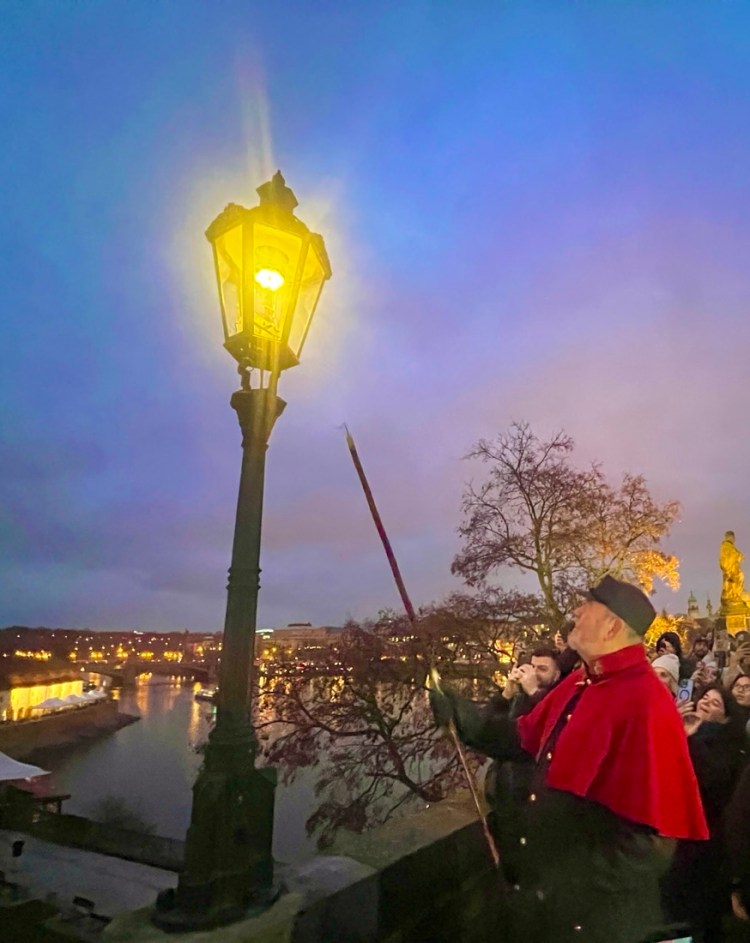
Our itinerary had one essential visit—Charles Bridge at 3:30 pm for the lamp lighting. A lamplighter in traditional costume manually lights 46 gas lamps shortly after 4 pm, attracting many crowds. We arrived early to get a good position.
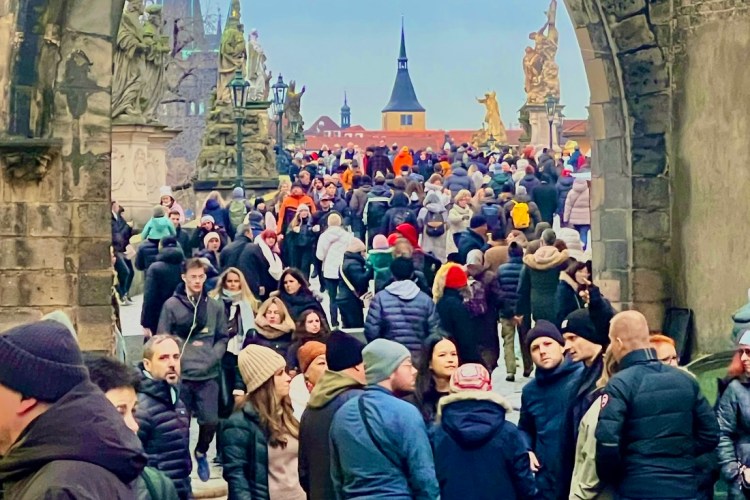
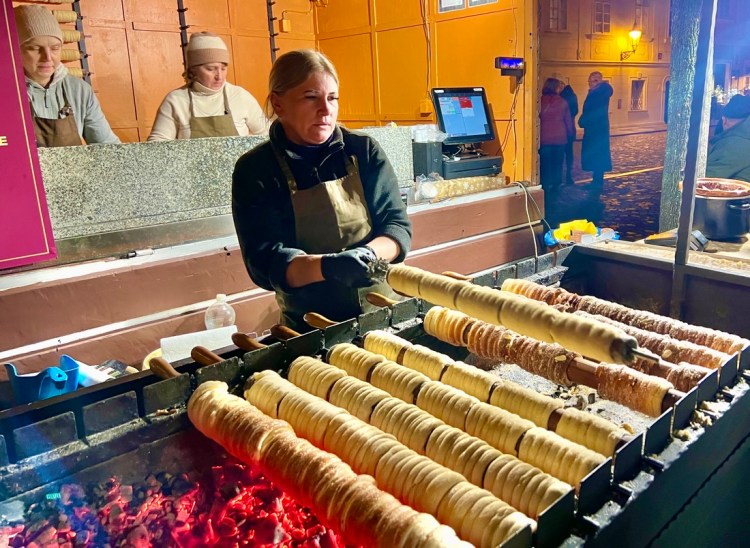
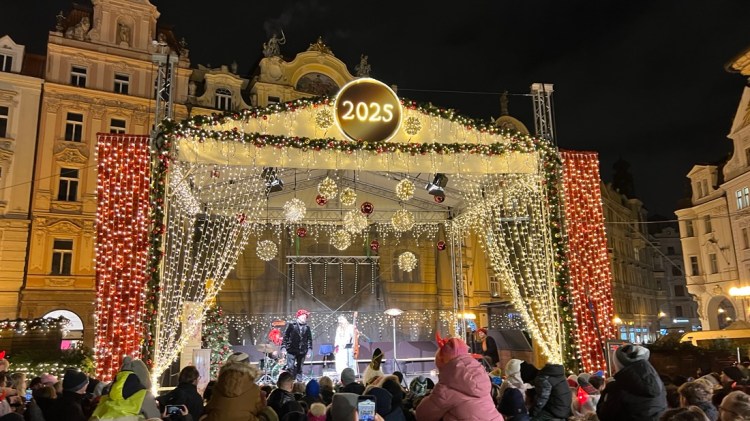
Below Charles Bridge on the left bank was the small Na Kampe Christmas market. At first, it wasn’t too crowded, and we enjoyed Trdelnik and hot drinks while listening to a men’s choir.
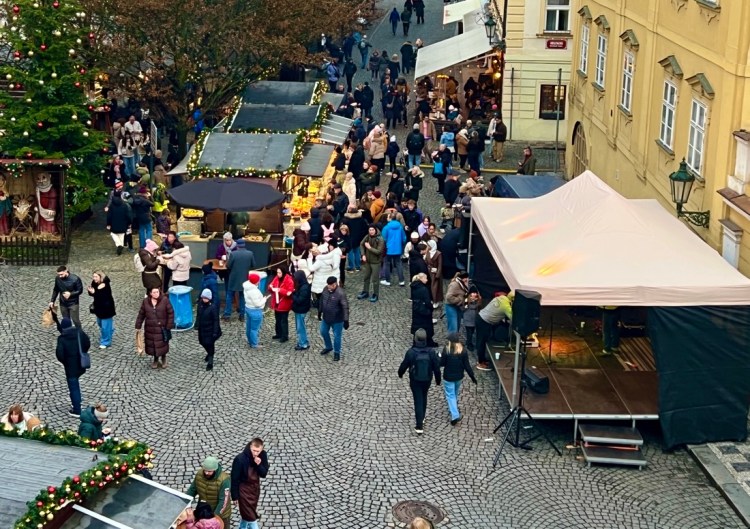

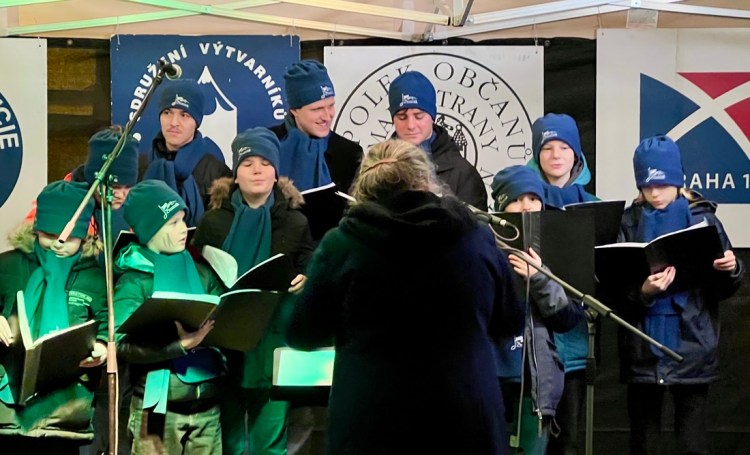
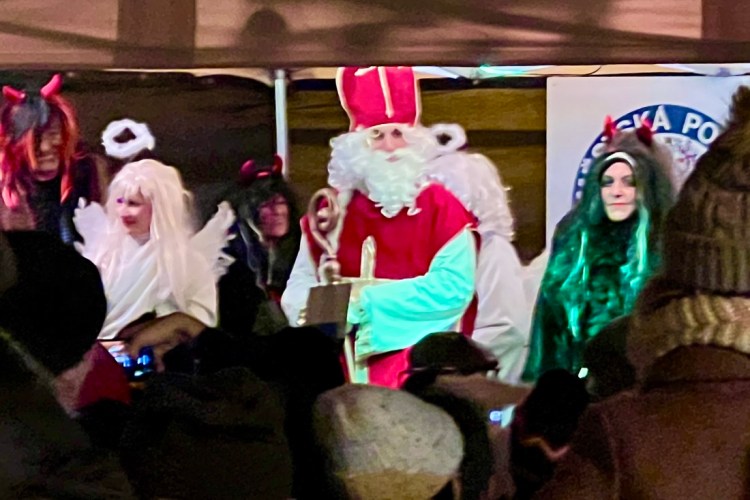
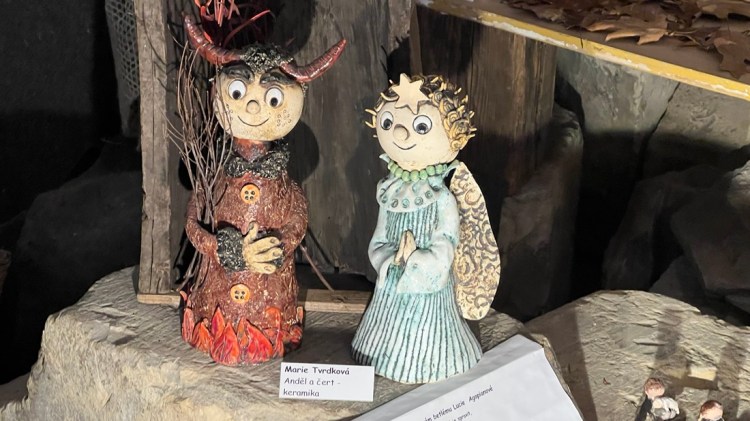
Then, it got really busy. The Czech tradition of Mikulas (St. Nicholas) on December 5th involves a visit by St. Nicholas (looking like a mixture of Santa and a bishop), a devil (to scare kids to be good), and an angel (to reward kids for being good). St. Nicholas, with a crew of many angels and devils, paraded through the crowds to the stage and gave quite the musical performance.

With some spare time before taking the tram back to the hotel, we crossed Charles Bridge to check out Old Town Square Christmas market, Prague’s largest and busiest. It wasn’t part of the plan, but we decided to get a lay of the land. We managed to wade through the crowds on Charles Bridge and get a flavor of the large market. Everything was busy, but it was not crazy. The main issue was that everyone seemed to be smoking.
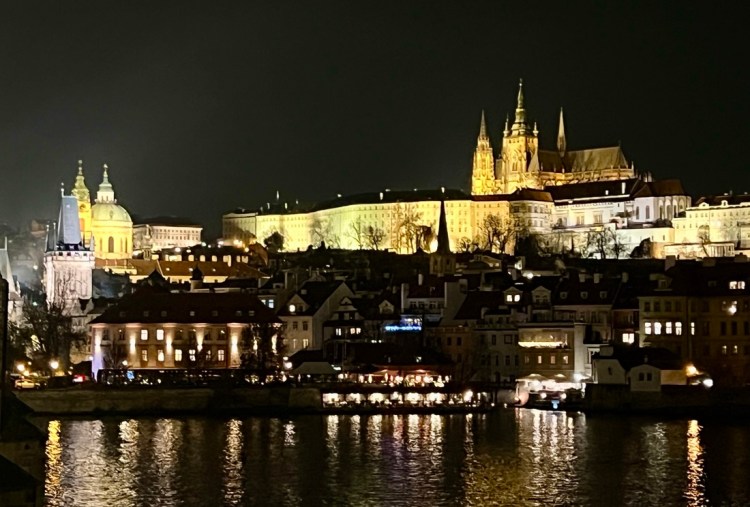


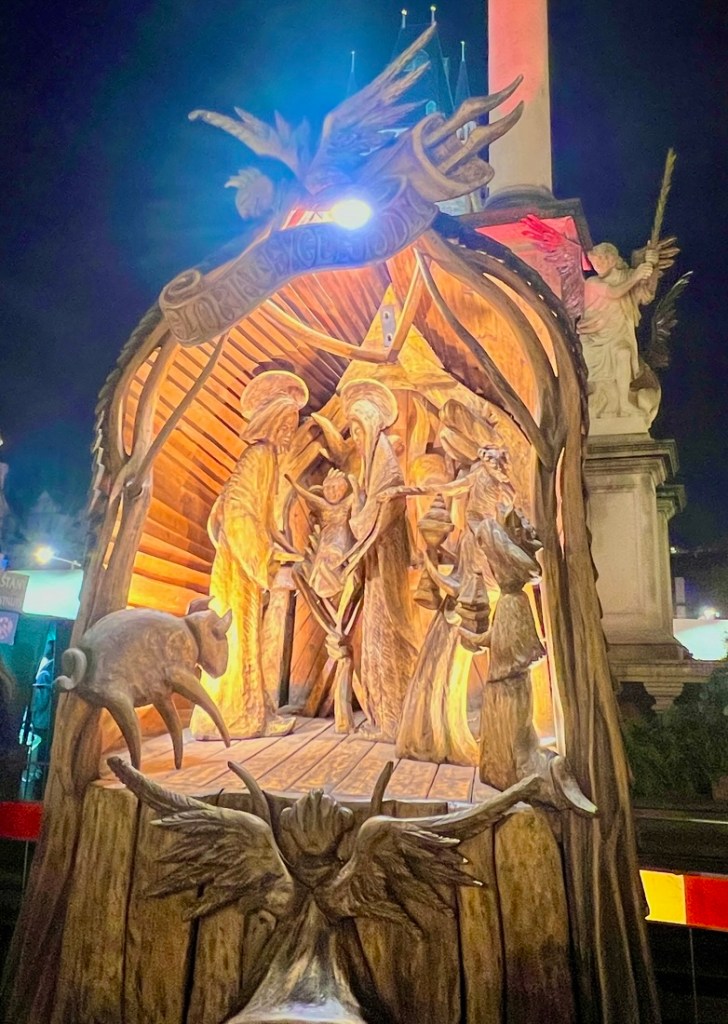
Once again, we were very happy to take the tram back up the hill. We had walked a hard 27,000 steps (~ 10 miles), and we collapsed on our bed, immediately falling asleep.
Day 3: Prague Castle
Our legs recovered overnight, and we were soon headed down the hill to Nerudova 211 cafe for breakfast at 8. We’d read that crowds build at the castle.


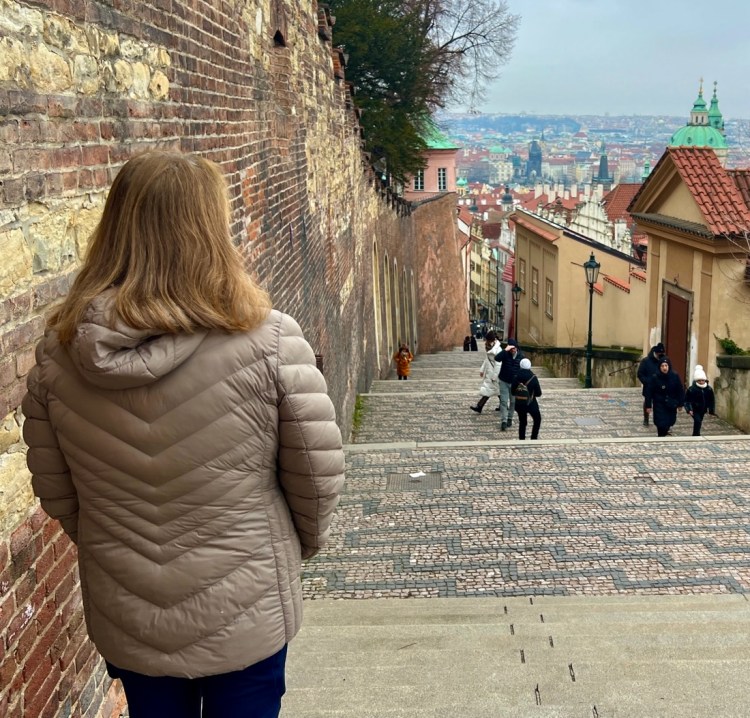
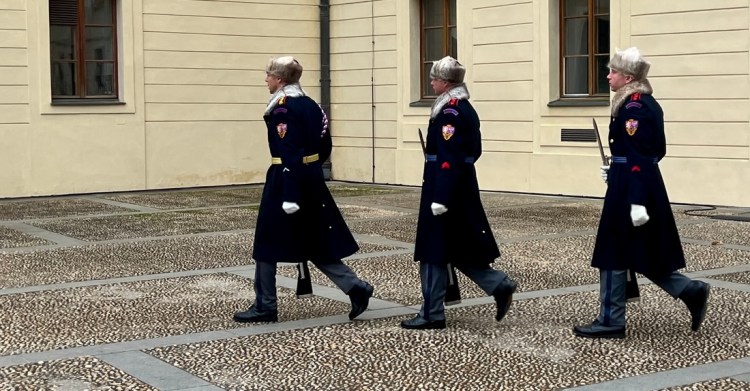
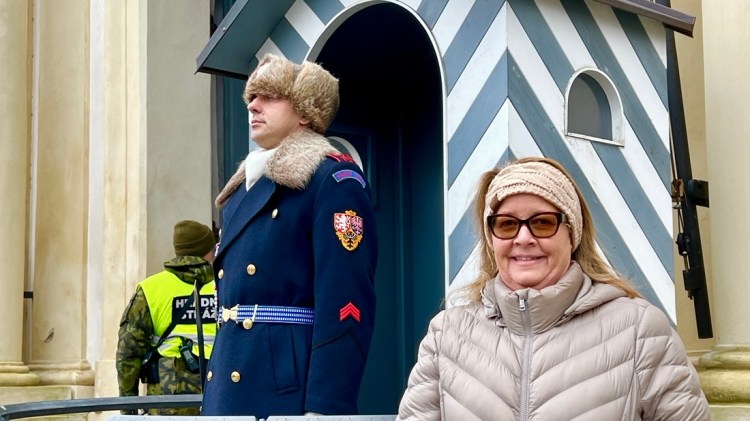
The climb back up the hill to the castle woke us up! They built castles on the tops of hills for good reason. We spotted some ceremonial guards and arrived at St Vitus Cathedral as it opened at 9 am.
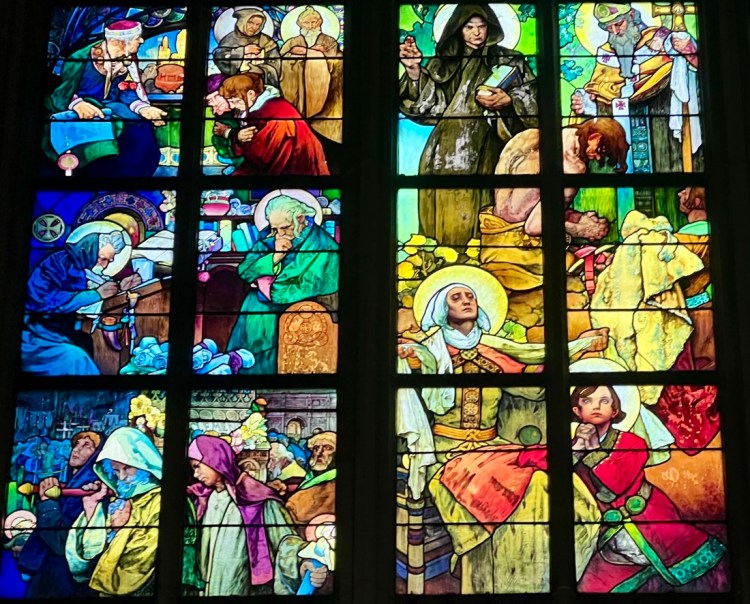
The short queue barely delayed our entry into the cathedral, and I was thankful for our Rick Steves guidebook highlights tour, as there was so much to see. Our first stop was at the 1931 Mucha Stained-Glass Window, which celebrated the birth of the Czech nation and Wenceslas’s life. The left panels showed Cyril and Methodius’s journey, with their arrival as monks in Prague in 865, their translation of the Bible into a written form of the local language that they created (which evolved into the Cyrillic script), and the untimely death of Cyril. The right side showed Cyril and Methodius baptizing a new convert and then Ludmila teaching her young grandson, Wenceslas, how to pray.
The view from the central nave highlighted the elegant architecture. I appreciated how it was not too gaudy, and loved how the organ pipes emphasized the rose window.
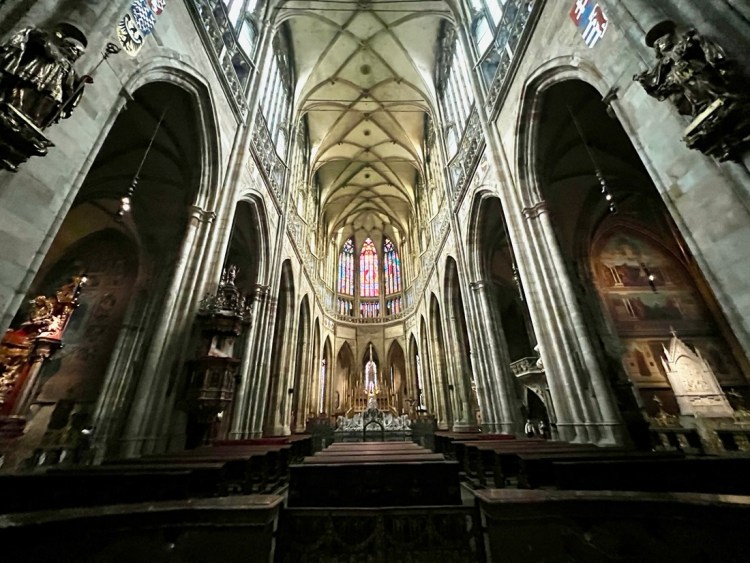

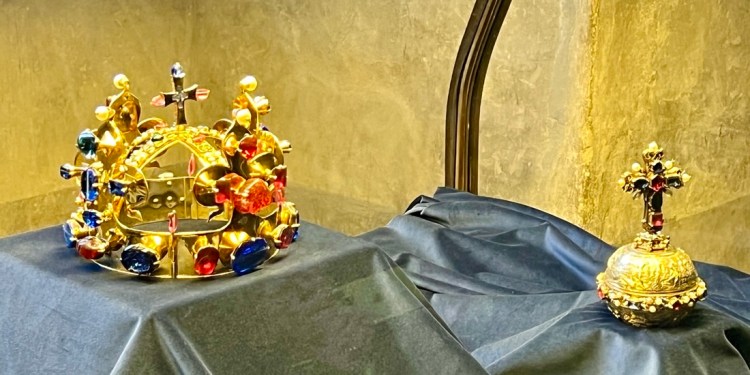
There were several tombs in the church, including those of some Habsburg kings, from when Prague was the empire’s capital. The Wenceslas Chapel, containing its namesake’s tomb, is where Bohemian kings were crowned, and the Czech crown jewels are kept but not displayed. Remarkably, the 14th-century crown jewels survived all the conflicts.
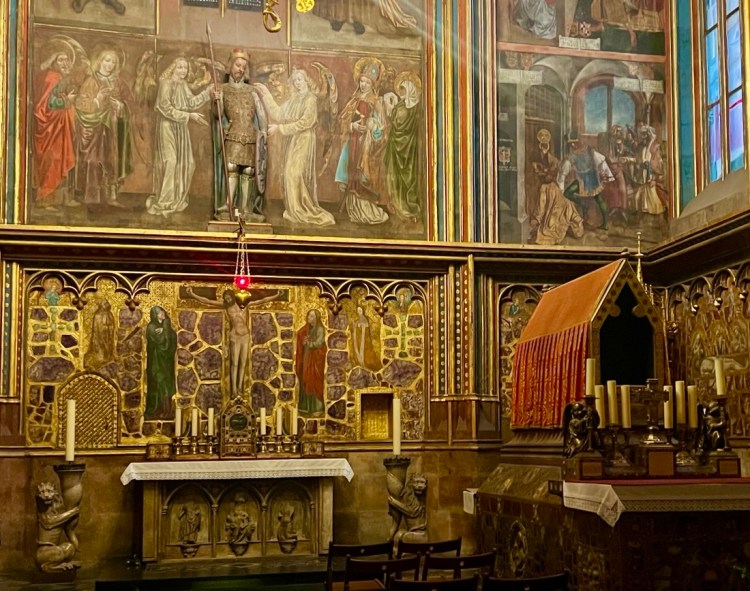
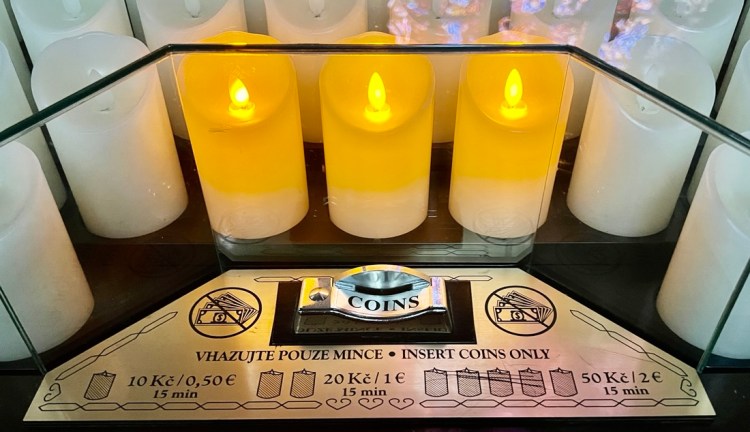
This was the first church where I noticed the change from traditional to electric votive candles. They are both safer and cleaner while being controversial.
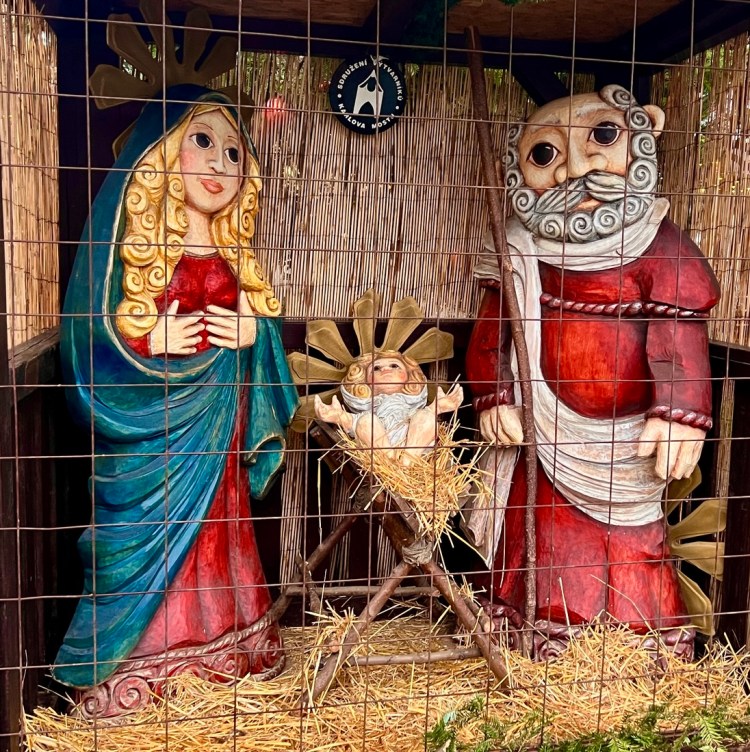
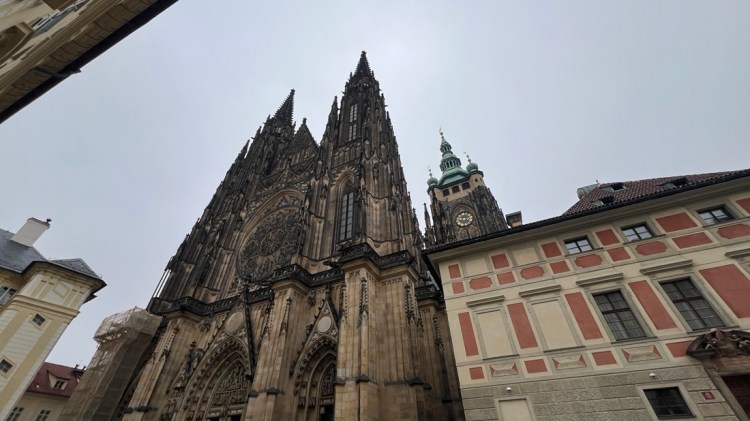
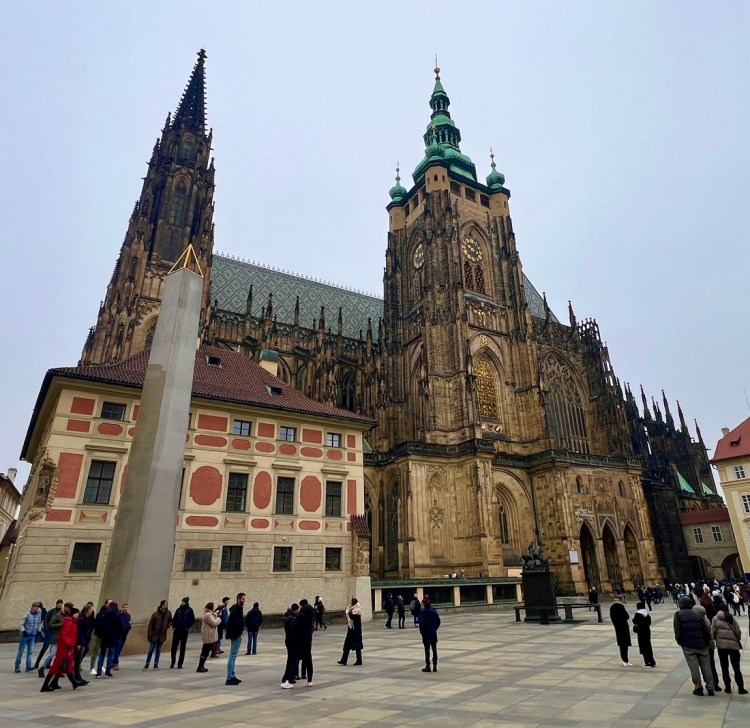
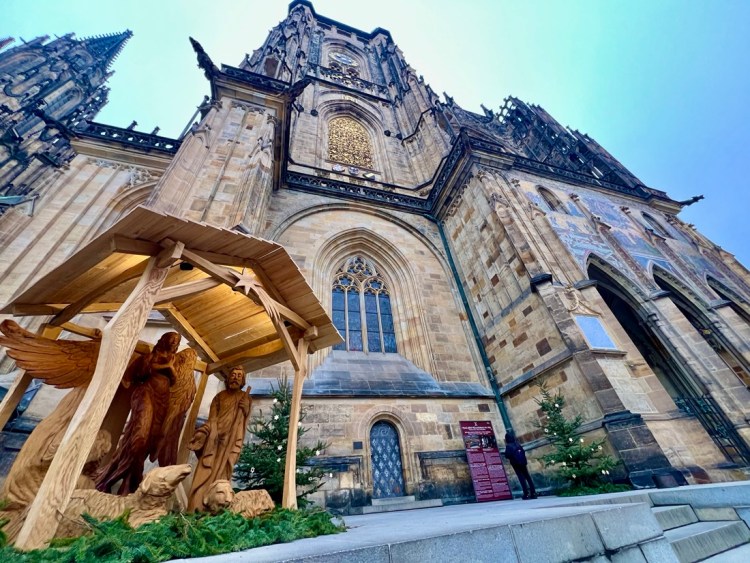
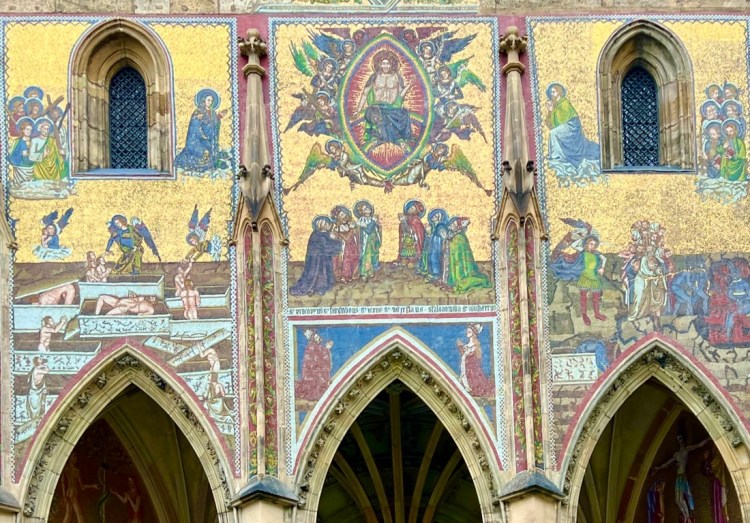
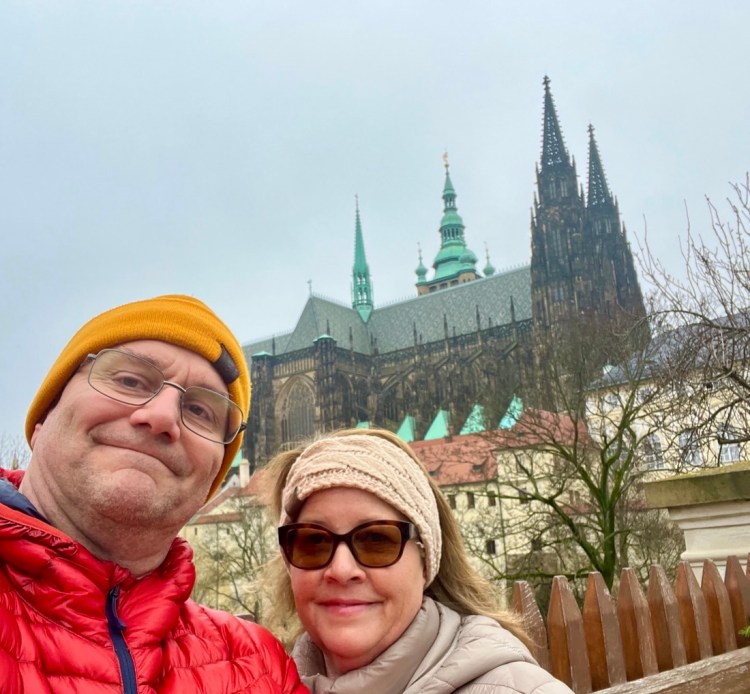
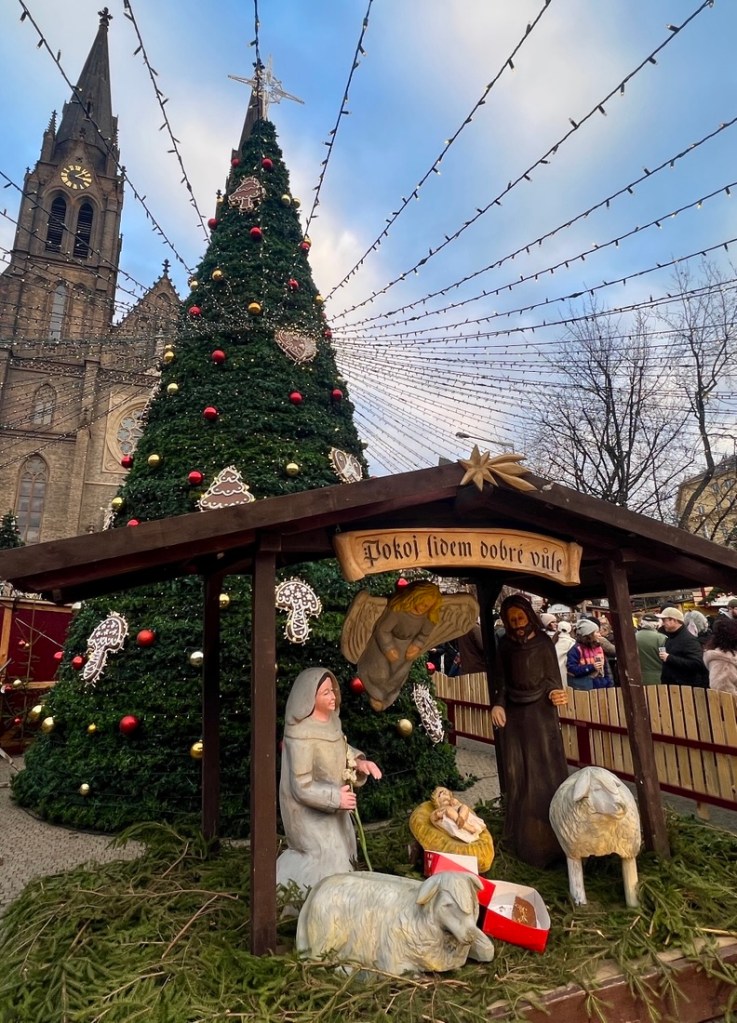
We exited the church into crowds but could still easily explore the castle’s Third Courtyard, appreciating the outer views of the cathedral, having been inside. A central feature of the courtyard was a 52-foot-tall obelisk, erected in 1928 to mark Czechoslovakia’s tenth anniversary. The original piece of granite was about twice as long, but it broke in half during transit, perhaps an early indication of Czechoslovakia’s short 74-year existence. A fine nativity sat next to the cathedral’s Golden Gate, which had a 14th-century mosaic of the Last Judgment. Czech royalty would pass under this mosaic, with it reminding them that no one is above God’s judgment.
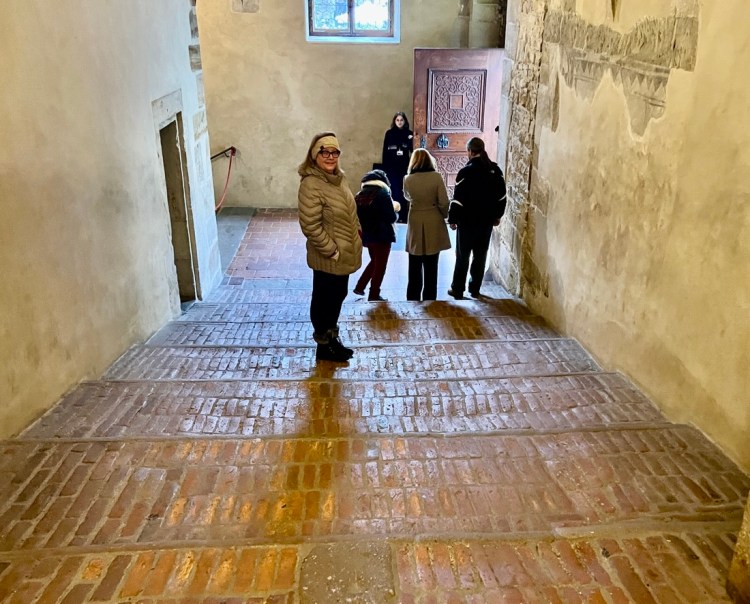
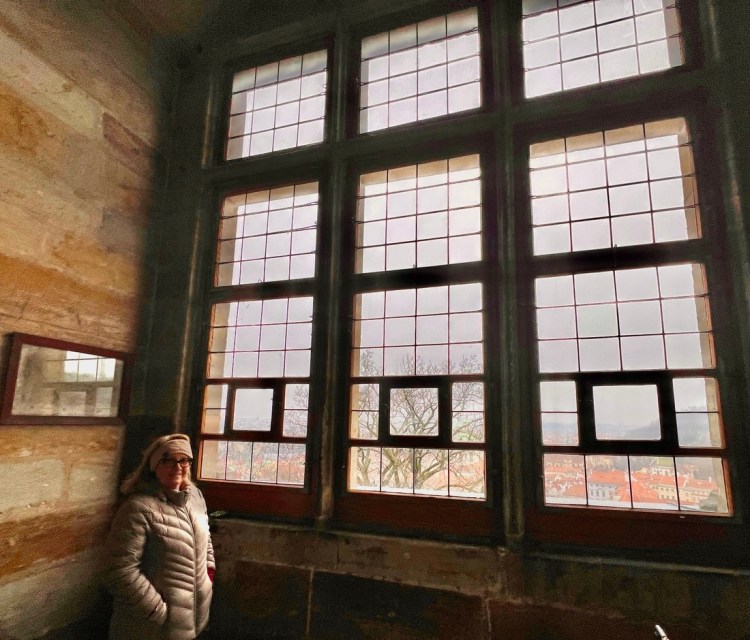
Next stop was the Old Royal Palace, with a hall so huge that it hosted jousting competitions, stairs that jousting horses could enter by, windows that were used for the “defrenestrations” (i.e., throwing undesirables out of the window), and crown jewel replicas.

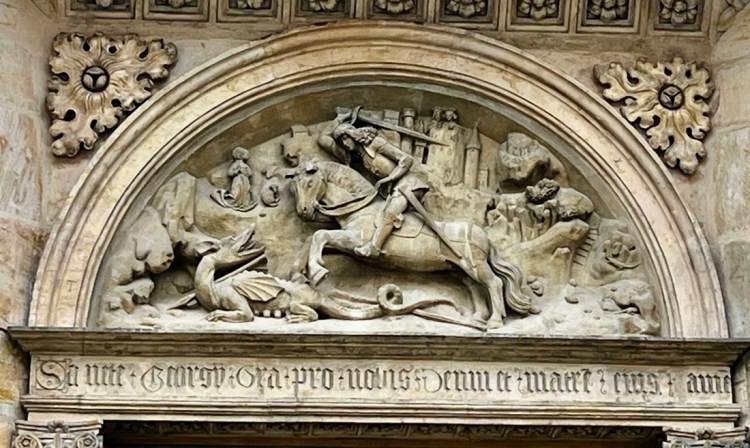
Next was St. George’s Basilica, founded by Wenceslas’s father before 920 AD. The oldest Czech kings, and Wenceslas’s grandmother, Ludmila, were buried here. The interior’s simplicity was striking. I thought George slaying the dragon was an English thing, but England did not adopt St. George as their patron saint until 1350.

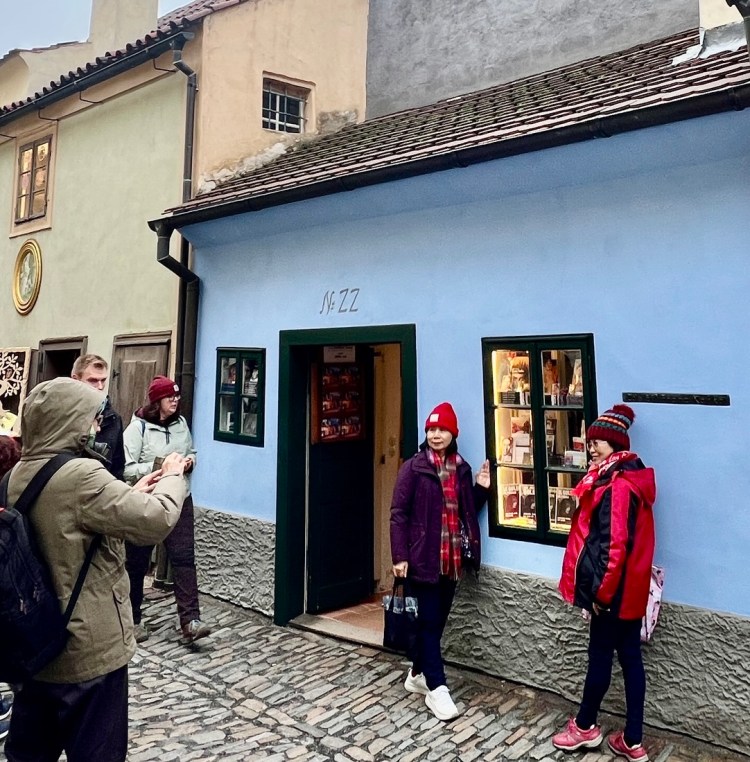
Our final stop in the castle was Golden Lane, a medieval merchant street, where Kafka wrote The Country Doctor. We enjoyed a fine view of the city as we headed out of the castle, but were blown away by how long the queue was to enter St. Vitus’s Cathedral.
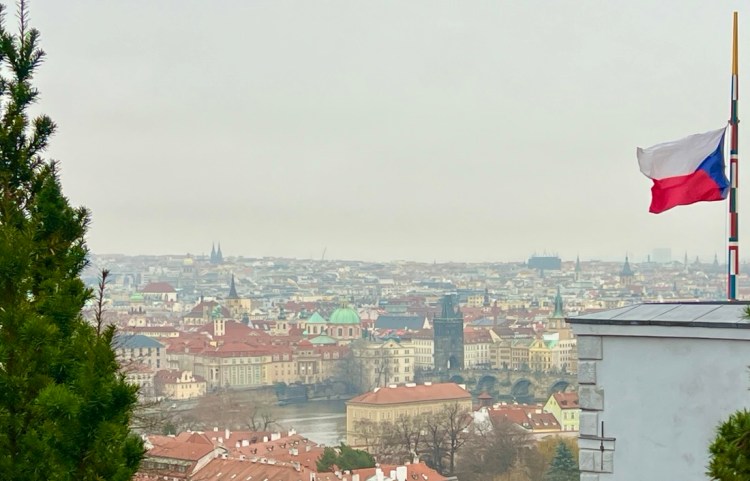

Our next stop was Letna Park, overlooking Prague from the north. We passed the Summer Palace, which was closed for the season, and enjoyed fine views of Prague and the River Vltava’s bridges. Our destination was a 75-ft tall metronome, built in 1991 to replace a huge monument to Stalin that was destroyed in 1962. The metronome’s plaque reads, “In time, all things pass…”


There is a time for everything, and a season for every activity under the heavens (Ecclesiastes 3:1).
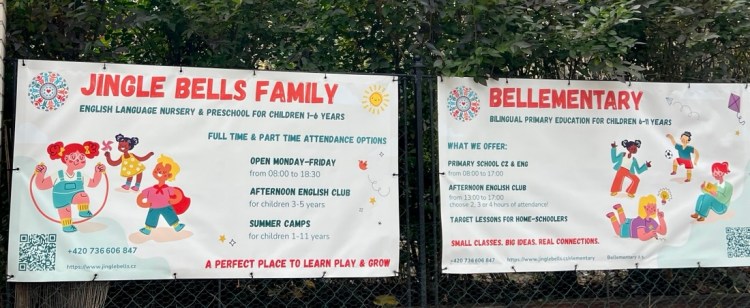
We meandered back to our hotel via a cafe, a geoache, a Tesco Express (very exciting!), an elementary school that was typically bilingual, and enjoyed looking at the residential architecture and a special tram decorated for Christmas.

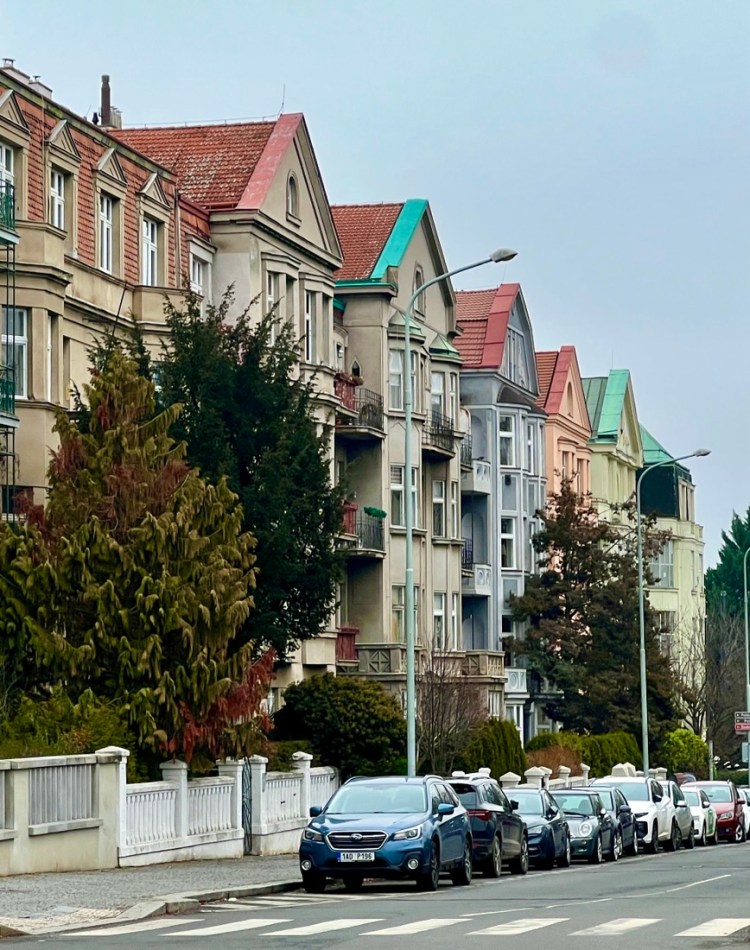
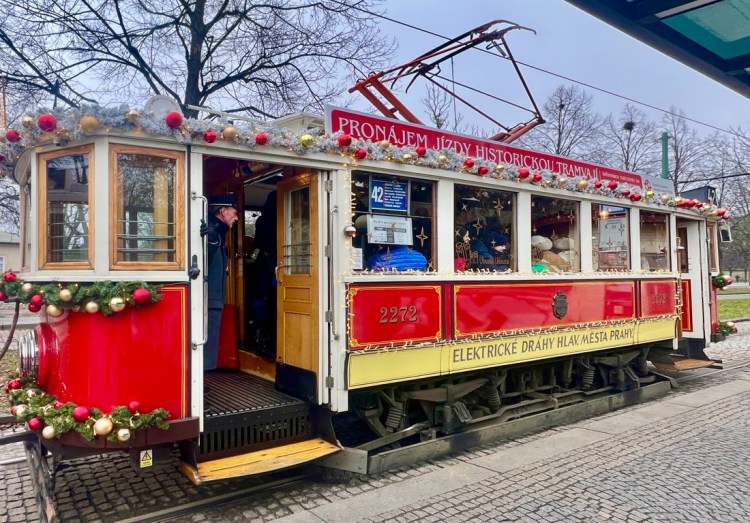
Once again, we returned to our room for an afternoon rest. We felt more tired than normal, probably due to the cold weather. We had looked into having a medieval dinner with a show this evening, but it had been sold out, so we just went to eat at the medieval tavern, U Sedmi Svabu. The food was delicious, but we ate enough meat for a week.
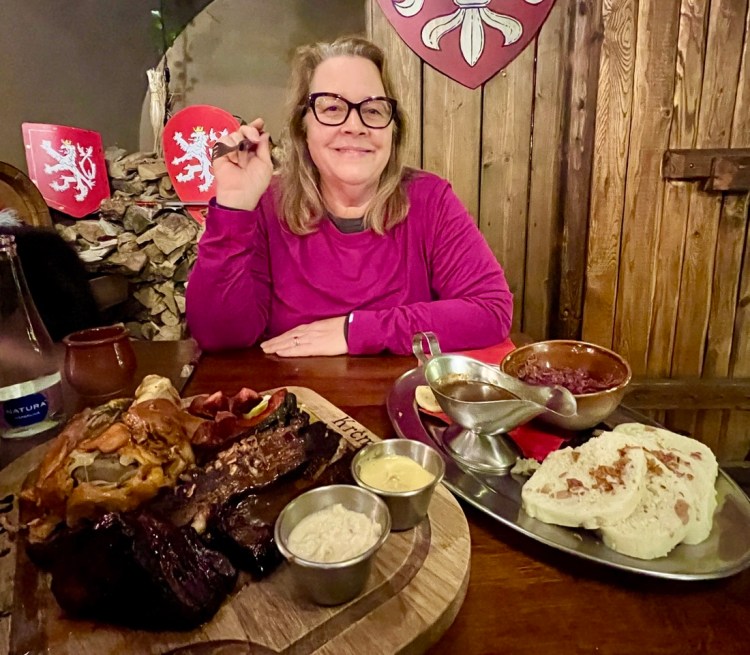
That was the end of another exhausting day.
Day 4: New Town, Markets, and a River Cruise
We started this moving day with breakfast items we’d bought at Tesco. It was easy to pack up and catch a tram to the Andaz hotel. Our luggage wheels did not like the cobblestones, and our legs were feeling them. Both of our calves remained sore, and we think it must have been the cobblestones. Regardless, we had a plan to follow, so there was no slowing down!
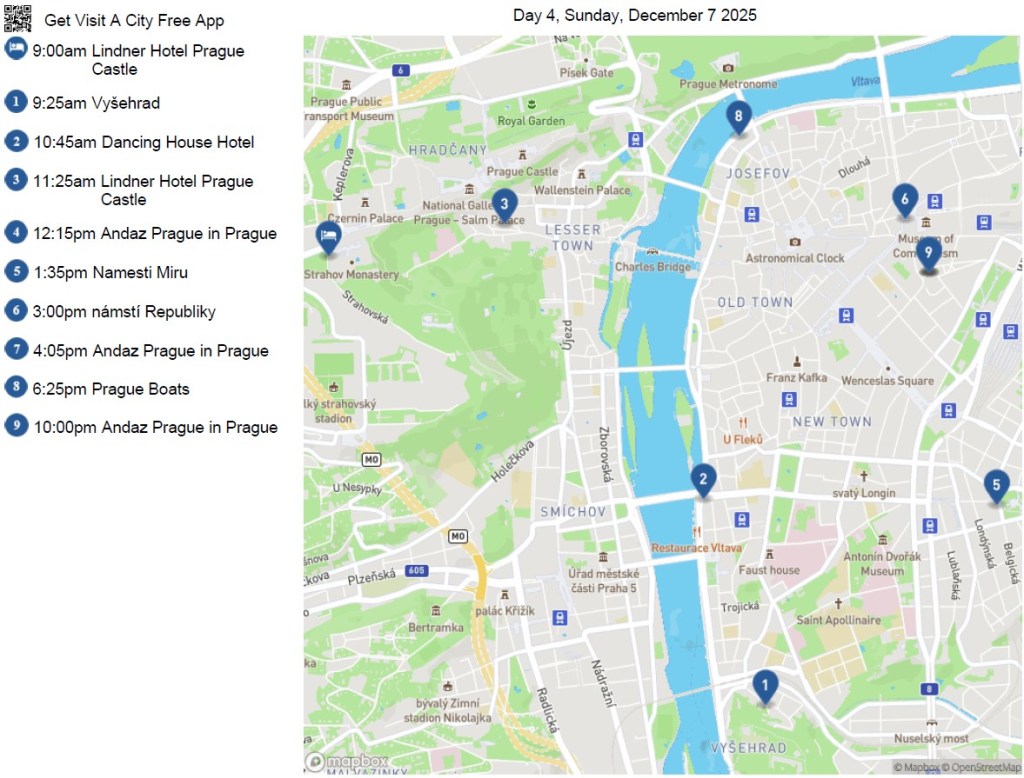

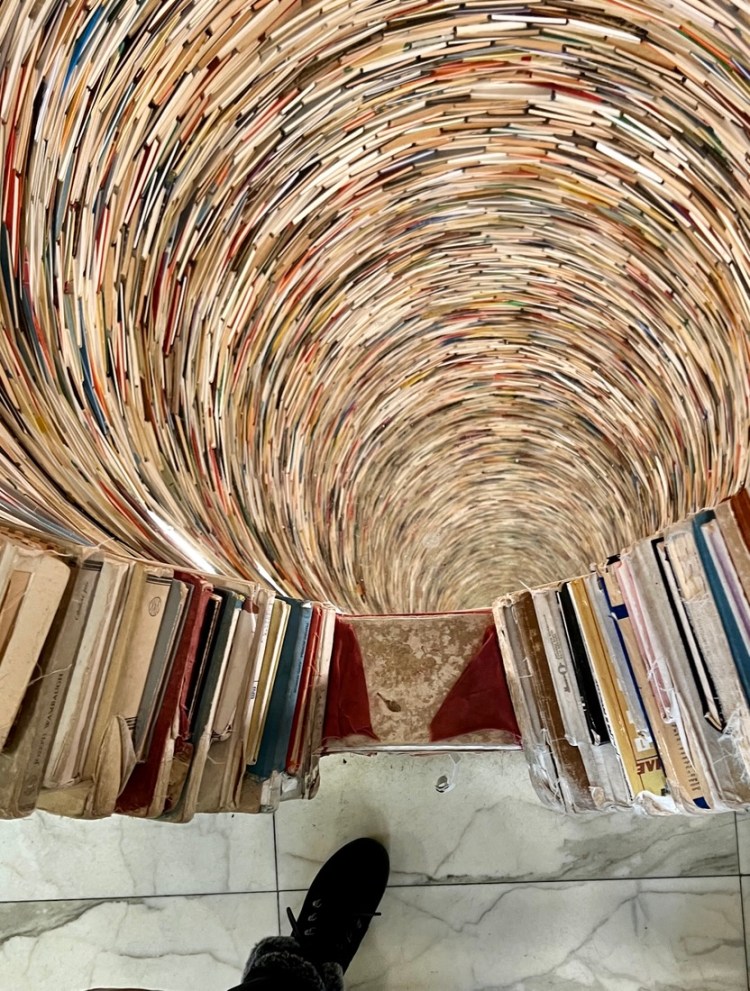
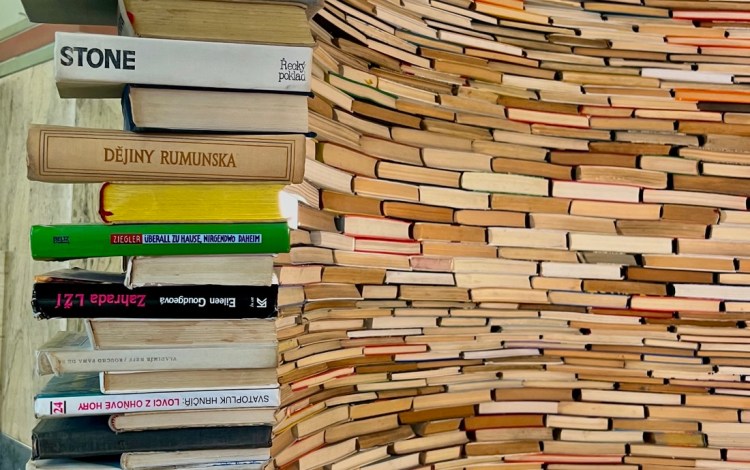
After dropping off our bags, we headed to a remarkable exhibit at Prague’s Municipal Library. The Idiom, or Infinity Book Tower, uses over 8,000 salvaged books. Mirrors inside make the books appear to go on forever, representing infinite knowledge. We waited for over an hour to see this, our longest wait of the whole trip. It was very cool.

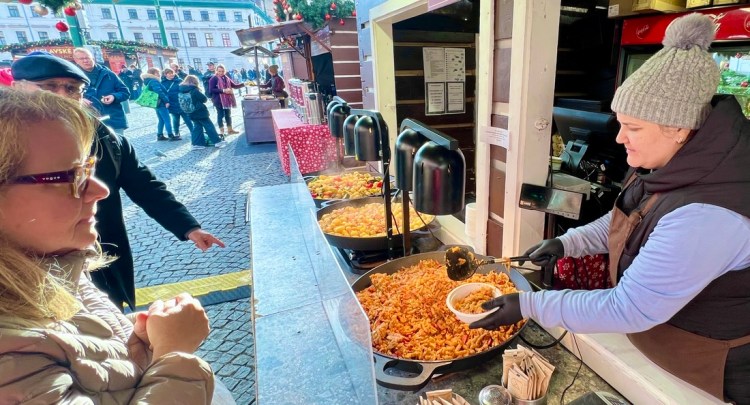
Our next stop was the Namesti Republiky Christmas market next to our hotel. Janet did her first shopping, and we enjoyed some potato dishes and another trdelnik for lunch. We were able to buy everything by tapping-to-pay with our phone. On the whole trip, I noticed just a couple of stalls that would only take cash, but there were plenty of others happy to take our credit card!


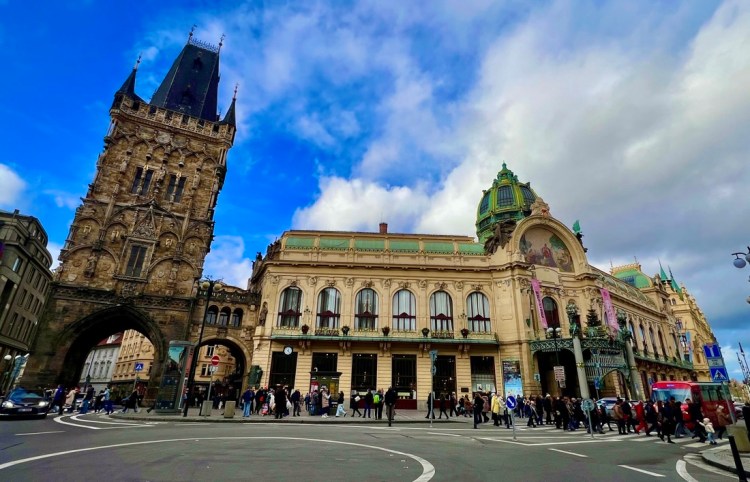
Next was a longer journey upriver to Vyšehrad. We took the tram out to the castle, which is as old as Prague Castle, but much smaller, and enjoyed its sights.
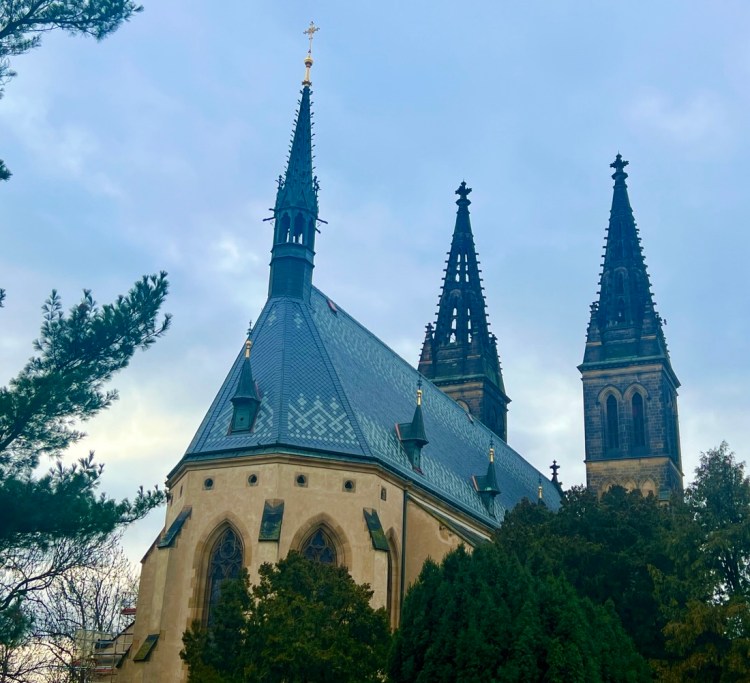

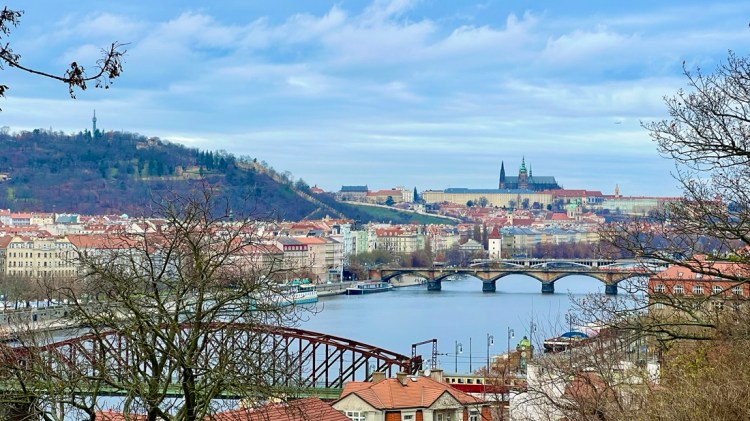
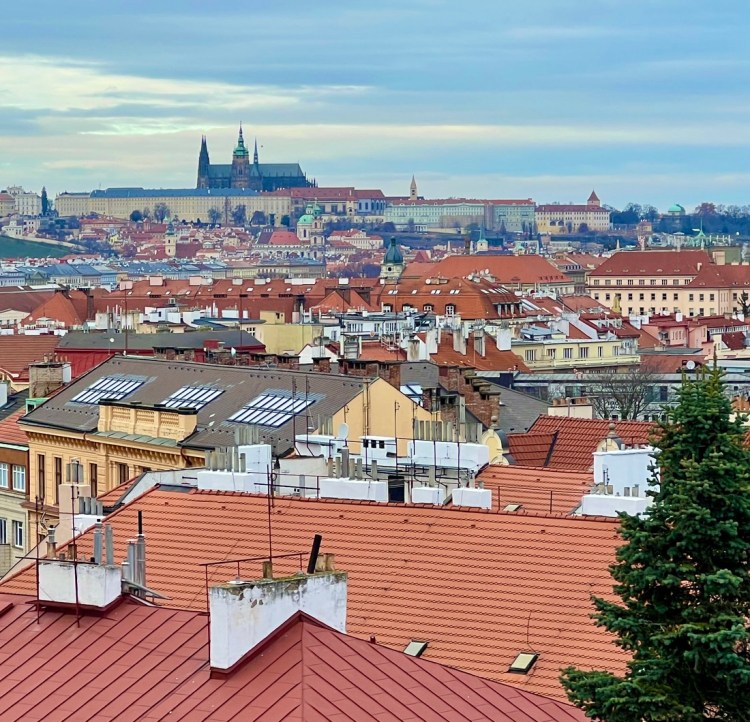
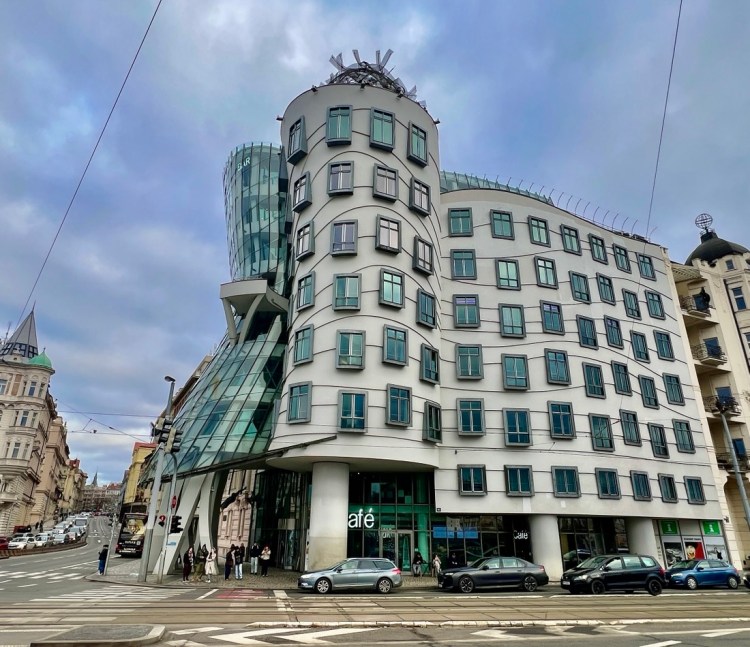
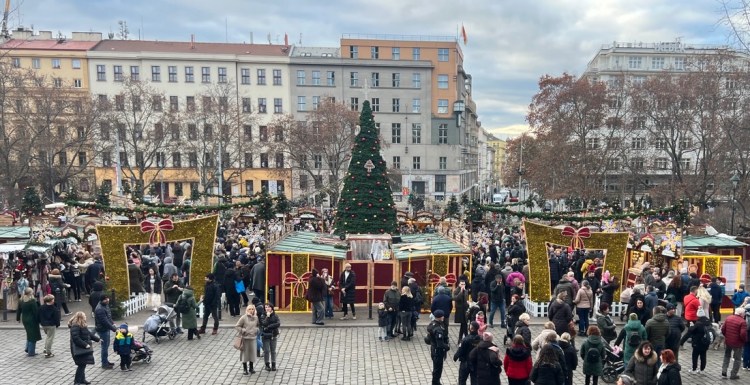
We chose to walk back from Vyšehrad, so that we could enjoy the views of the river and check out the Dancing House. We stumbled upon a special memorial to the two Czech paratroopers who assassinated Reinhard Heydrich in 1942. Heydrich was an architect of the Holocaust and was second-in-command of the SS. After they attacked Heydrich, the two Czechs fled to a church where they fought to their death. In retaliation, Hitler destroyed two Czech villages. Terrible times. After some somber moments, we checked out the fine Namesti Miru Christmas market.


In 1942, they assassinated Reinhard Heydrich, the Holocaust architect and number 2 in the S.S.
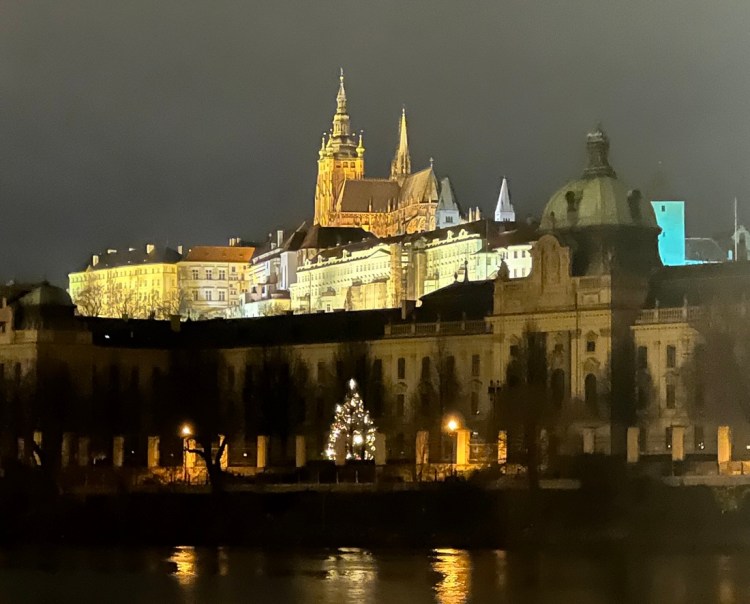
We headed back to the hotel to check in and rest. We were exhausted and thankful that the evening’s entertainment was a dinner cruise on the river with Prague Boats. For three hours, we floated on the river under the bridges, through the lock, with a fine buffet dinner, while seeing all the sights at night from a new perspective. It was a fun and relaxing change.
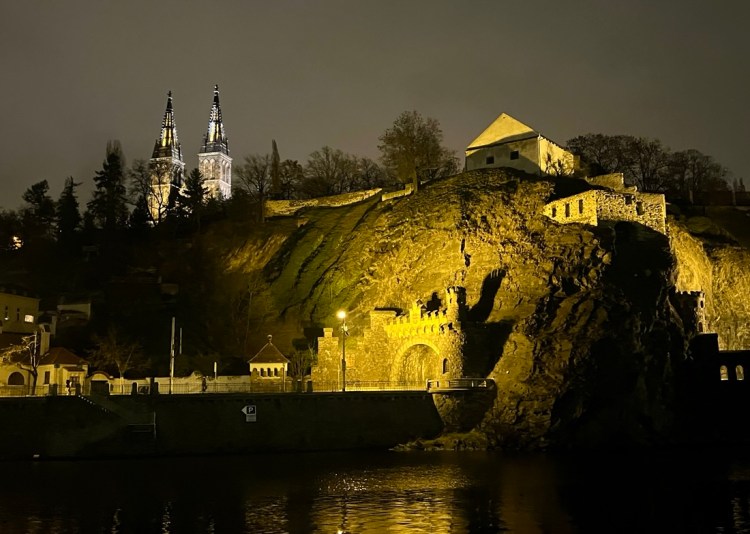
The road tunnel was built in the early 1900s and was designed to look like a medieval castle entrance.
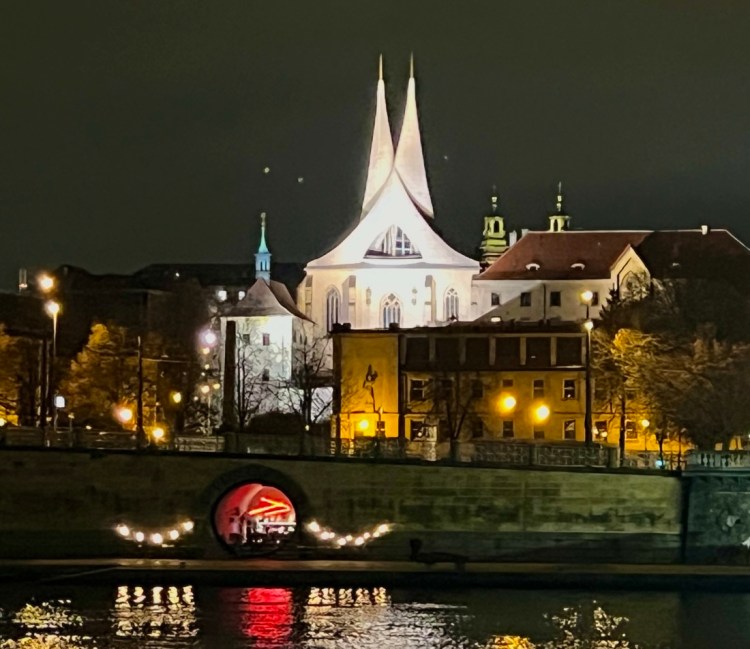
The Gestapo had seized the monastery and sent the monks to the Dachau concentration camp.
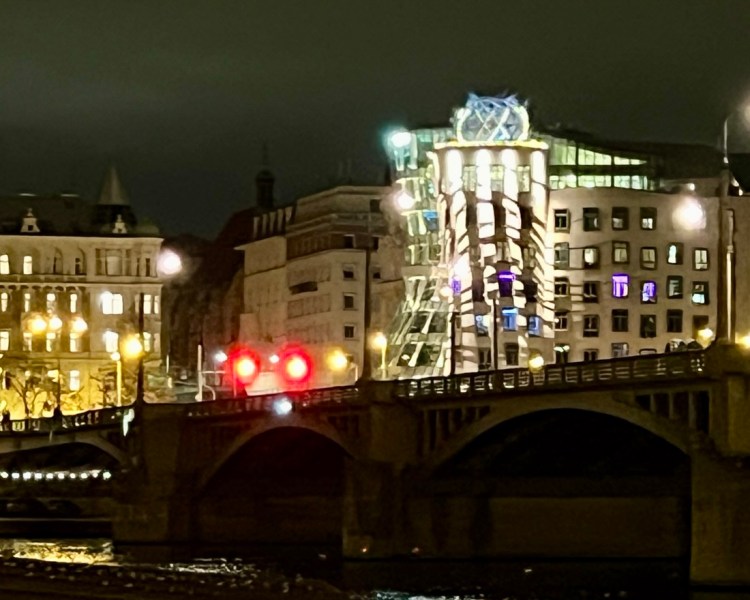


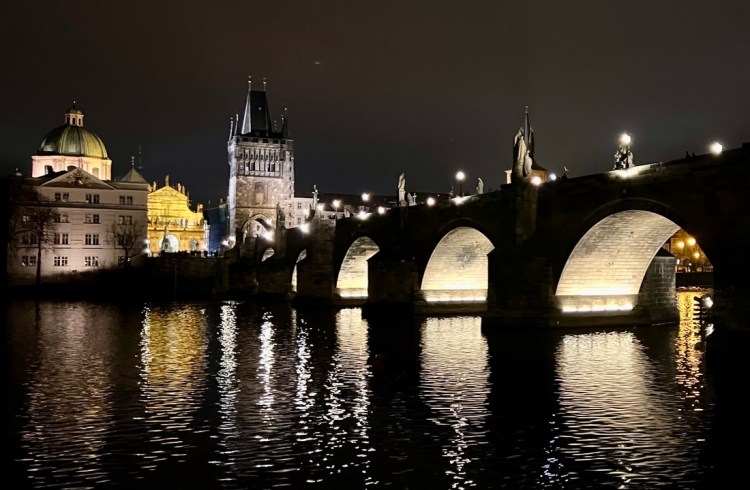
After returning to the boat’s dock, we enjoyed the fifteen-minute walk back to our hotel, enjoying the quiet streets and experiencing Old Town Square as the market traders packed up for the night.


Day 5: Bethlehem Chapel, the Jewish Quarter, and a Classical Concert
Our first night in the Andaz was not as comfortable as we had hoped. The room had been too hot, but we discovered it was due to floor heating in the bathroom. A request for extra pillows was efficiently answered, and we slept well subsequently. We had rested sufficiently for another full day, which we started with breakfast at Zrno Zrnko. The hotel concierge had recommended this low-key, non-touristy coffee shop, which we greatly enjoyed.
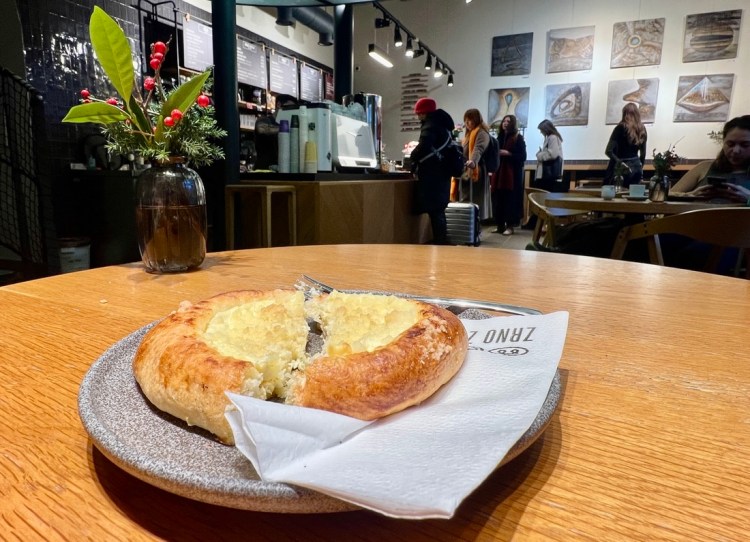
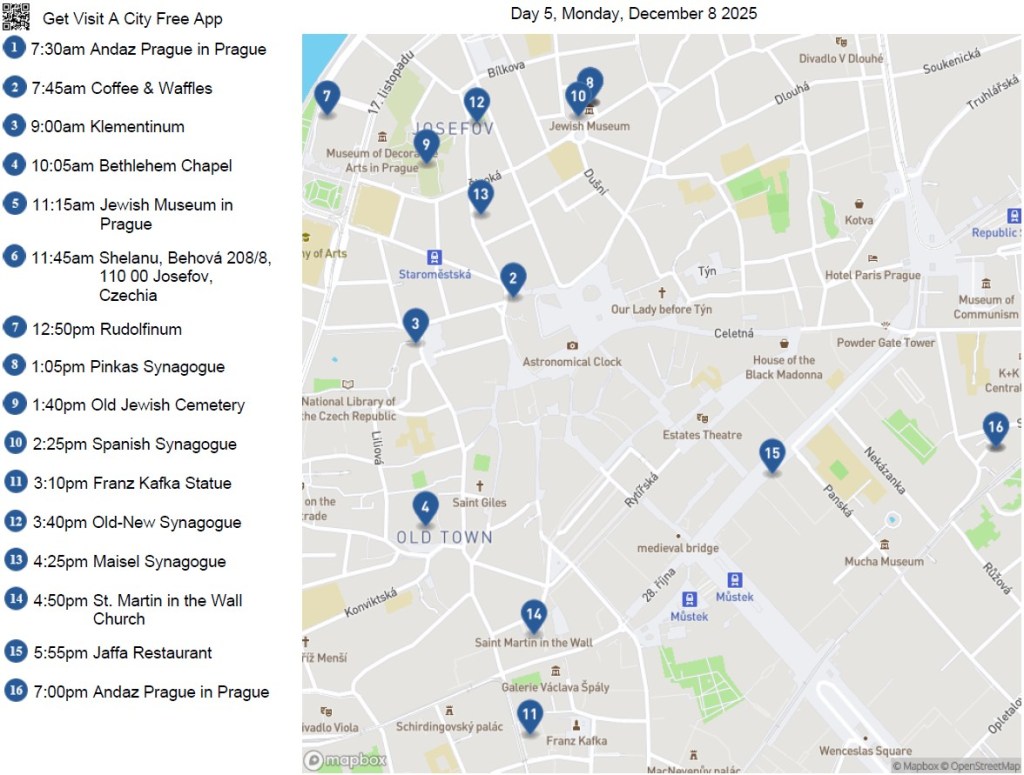
After breakfast, we headed to Bethlehem Chapel on our way to the Jewish Quarter. In the early 1400s, the Catholic Priest Jan Hus was a rector at this chapel and preached in Czech, defying the Pope and leading to his excommunication and execution. Unfortunately, it was the one site in Prague that would neither accept credit cards nor Euros, so we were unable to enter.
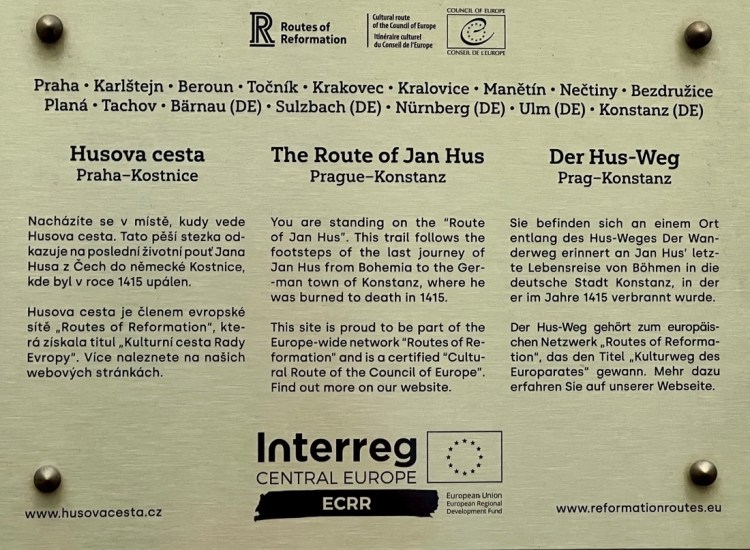
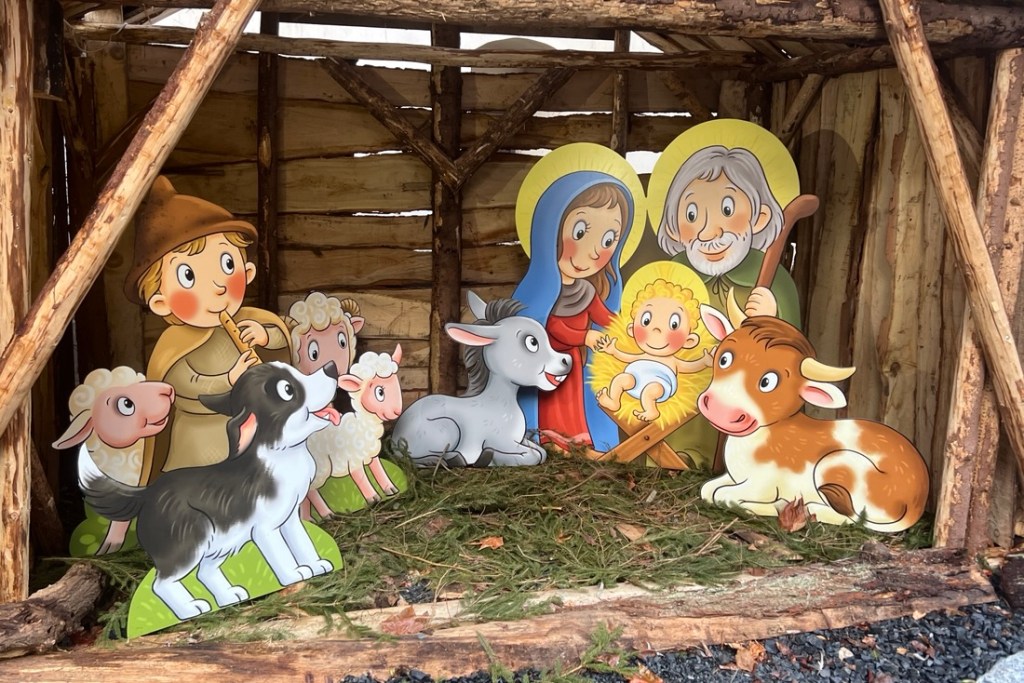
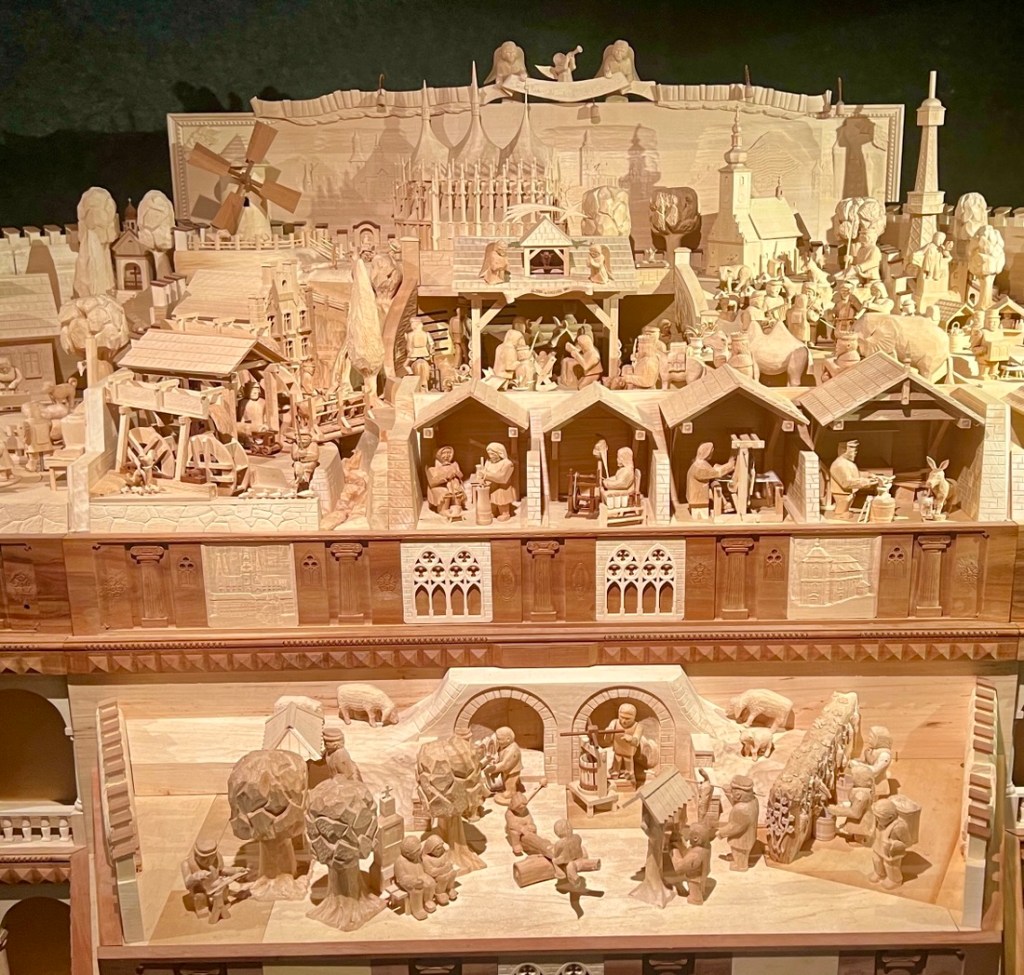
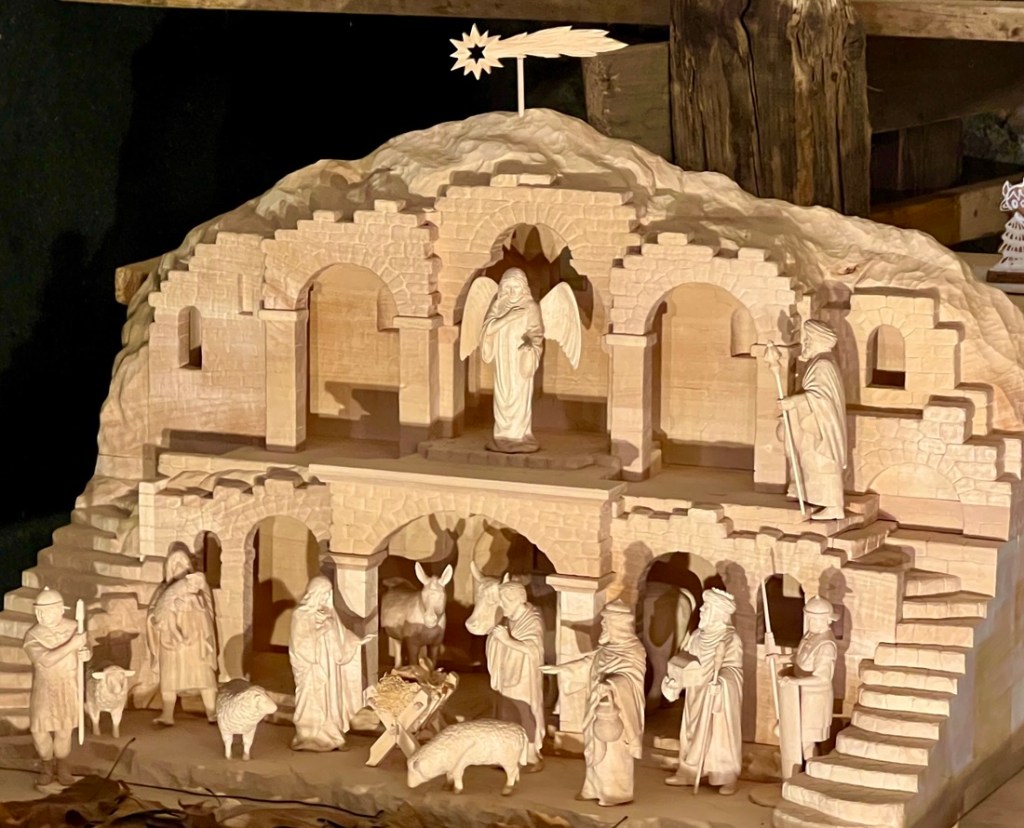
However, underneath the chapel was a separate exhibit showcasing local artists and their nativities. We followed a young school group! They didn’t accept credit cards, but Euros worked. It was fun seeing all of the different creations.


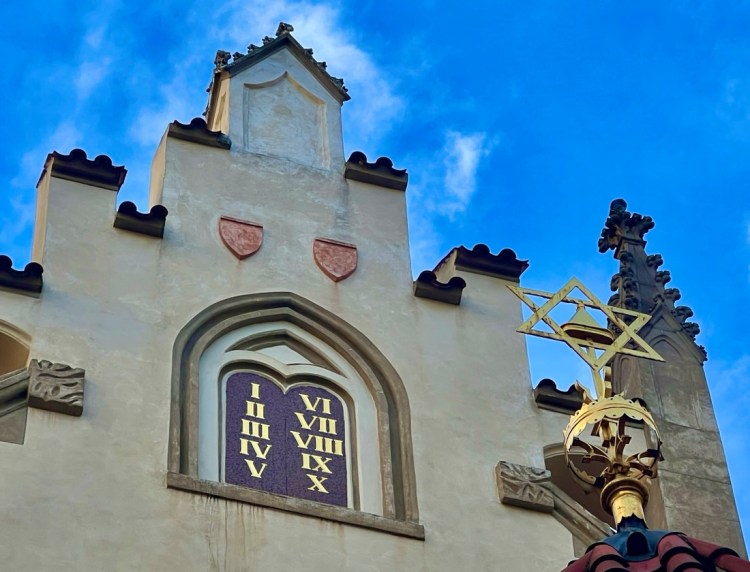
Next was a somber visit to the Jewish Quarter. The sites to visit were the Synagogues from the late 16th century that remained when the quarter was rebuilt around 1900. The first was the Maisel Synagogue, which was a museum about Jewish culture in Prague. Most items had been recovered after confiscation by the Nazis. The front of the synagogue depicts the Ten Commandments. Note the special Star of David, with the hat in the middle. Jewish men in Prague were forced to wear the yellow pointed hat in medieval times.
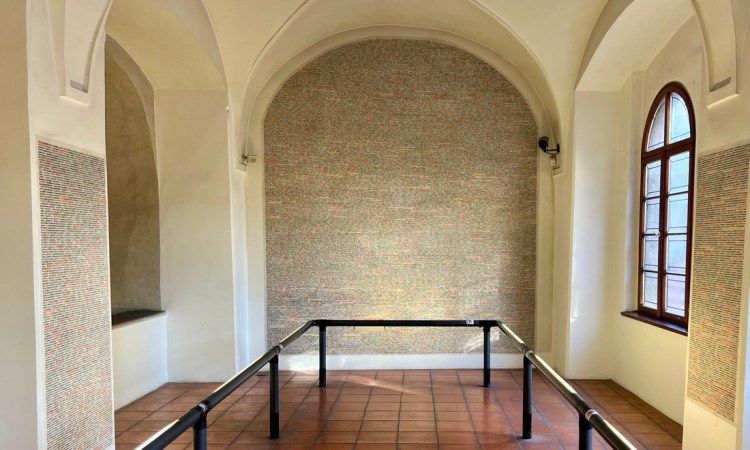
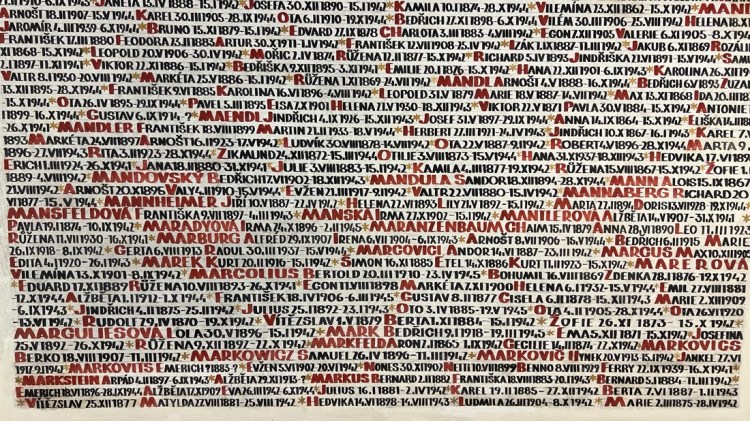
Next was the Pinkas Synagogue, also from the 16th century. Its walls were inscribed with the names of 77,297 Czech Jews who were sent to the gas chambers in the Holocaust. A recording read out their names, interspersed by passages from the Psalms. The names were organized by family and city and included dates of birth and death. If there was only one date, it was because the date of death was unknown. I found the names of the Margolius family members of Heda Margolius Kovaly, whose book, Under A Cruel Star: A Life in Prague 1941—1968, I had read before the trip. In another part of the Synagogue was the Terezin Children’s Art Exhibit. Terezin was the main Nazi processing center for Czech Jews before being dispatched to death camps like Auschwitz. Of the 8,000 children that passed through Terezin, only 240 returned. A teacher at Terezin used drawing lessons to help the children liberate their minds and kept some of the artwork hidden.



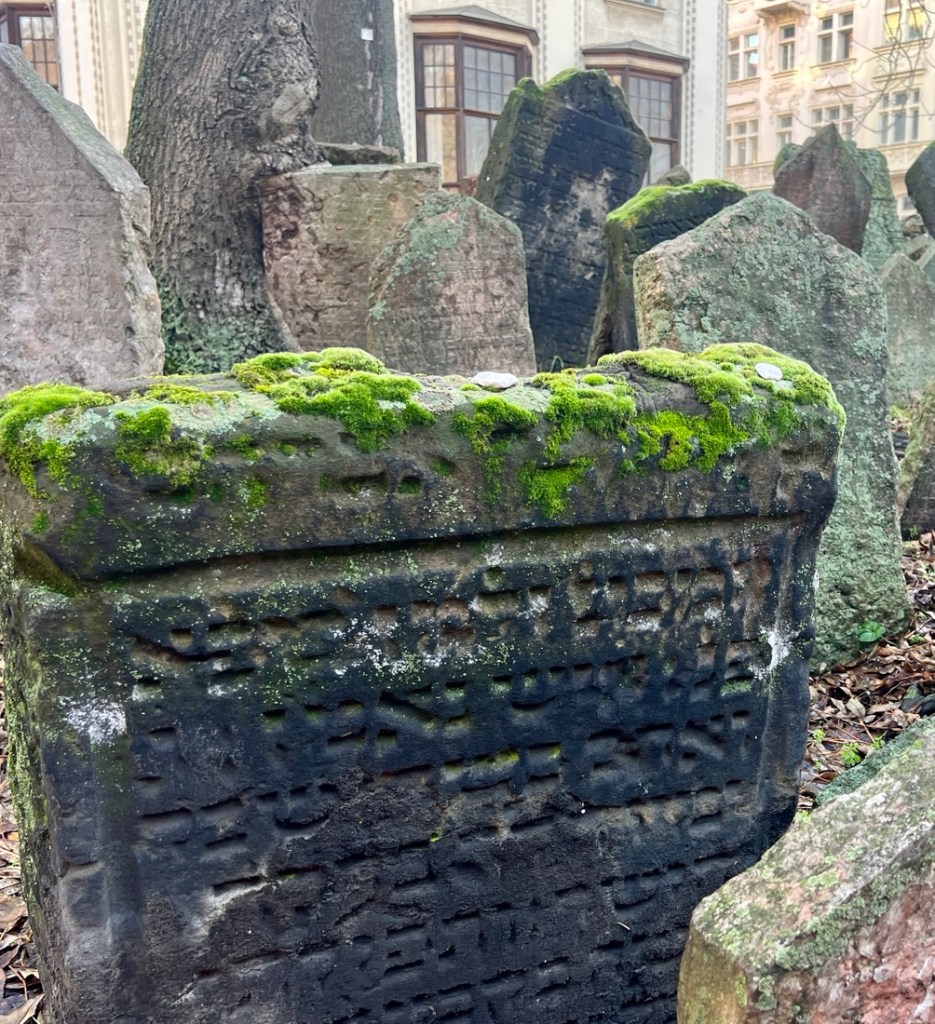
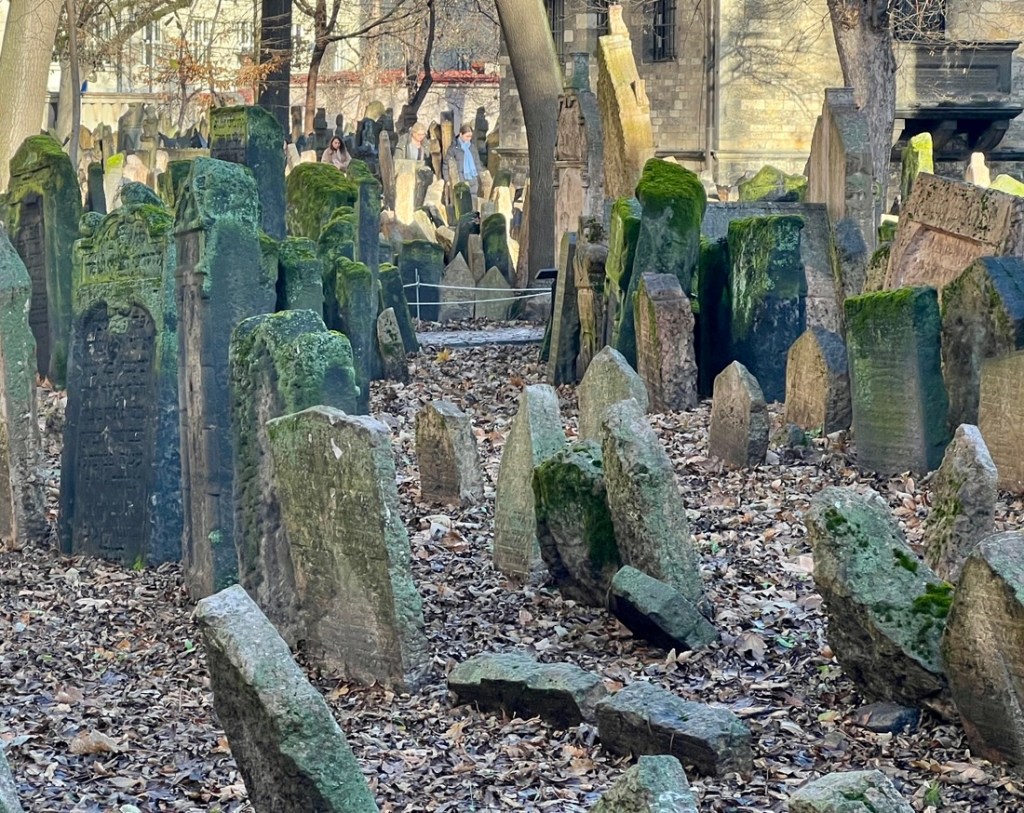
Outside the synagogue was the Old Jewish Cemetery. From 1439 until 1787, this was the only burial ground where the Jews of Prague could be buried. It was so cramped that bodies were stacked on top of each other, and Jewish tradition forbids a body to be moved after burial. This highlighted that, while the Holocaust was terrible, there had been centuries of antisemitism before the Nazis.

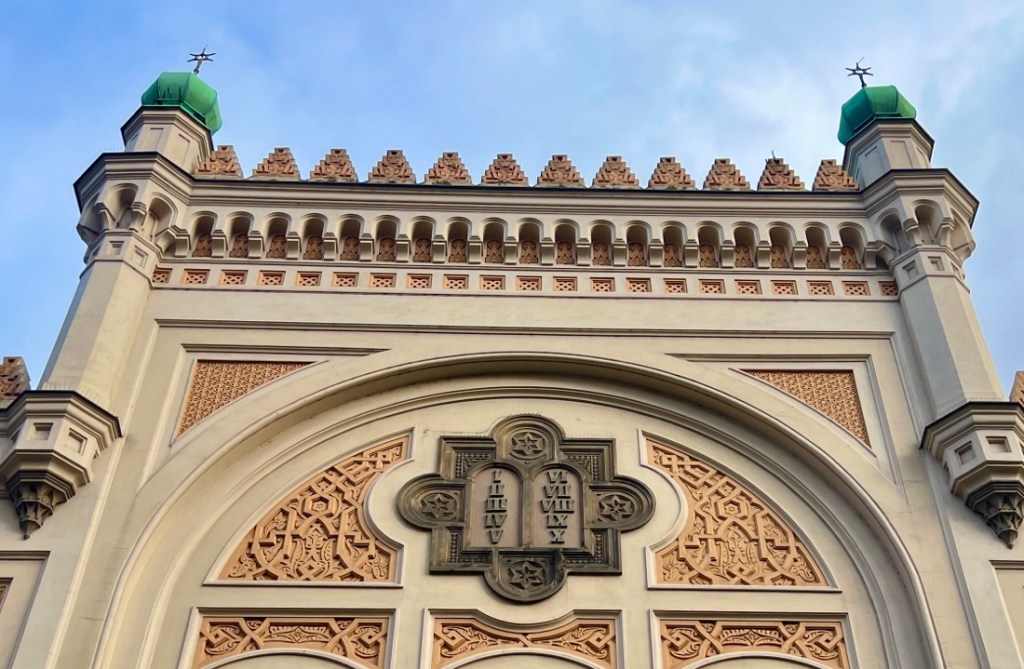
We also visited the Klausen Synagogue and Old-New Synagogue, but they are somewhat of a blur. Finally, we visited the Spanish Synagogue, built in 1868, following a Moorish revival style inspired by Arabic influence in Spain. Confiscated Jewish property was stored here during the Second World War. The Prague synagogues were not destroyed by the Nazis, as Hitler planned to convert them into an exotic museum of an extinct race.


Outside the Spanish Synagogue was a statue of Franz Kafka, riding on the shoulders of a headless figure, in reference to the author’s 1912 story, Description of a Struggle.

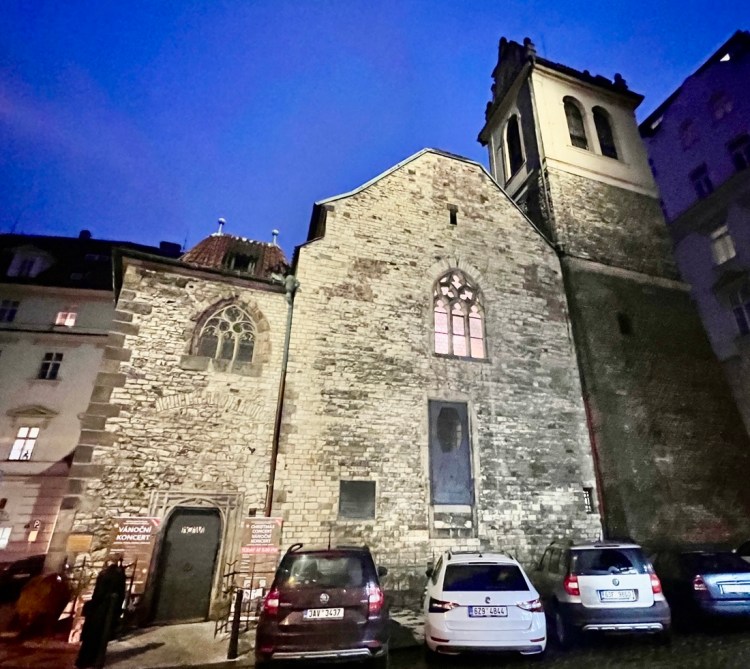
After a rest and catching a snack at our local Christmas market, we headed to the Church of St Martin in the wall for a classical concert. The church, which dates back to the 12th century, was built touching the old city wall, and hence the name. After WW1, the church was assigned to the Evangelical Church of Czech Brethren, and an open Bible in Czech suggested that it was of a protestant faith. We listened to a fine selection of musical pieces, ending with a medley of Czech and international carols.


Near the church was Cerzy’s rotating sculpture of Kafka’s head. It was another interesting one! A very cool idea.
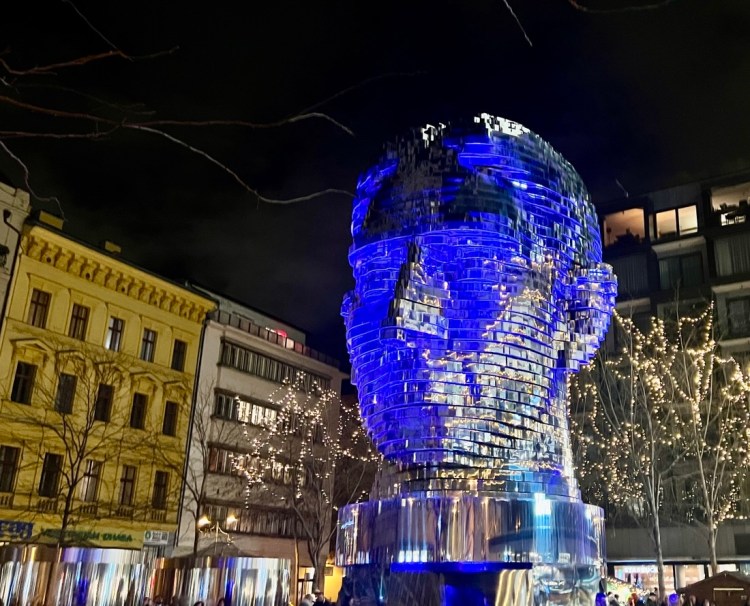
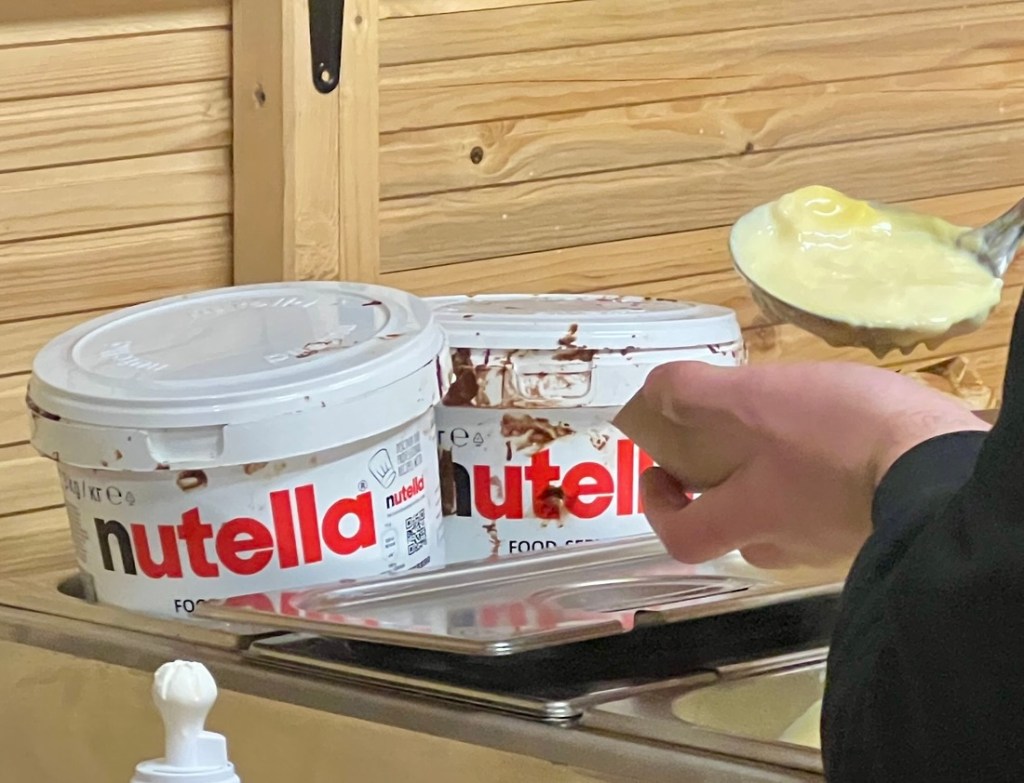
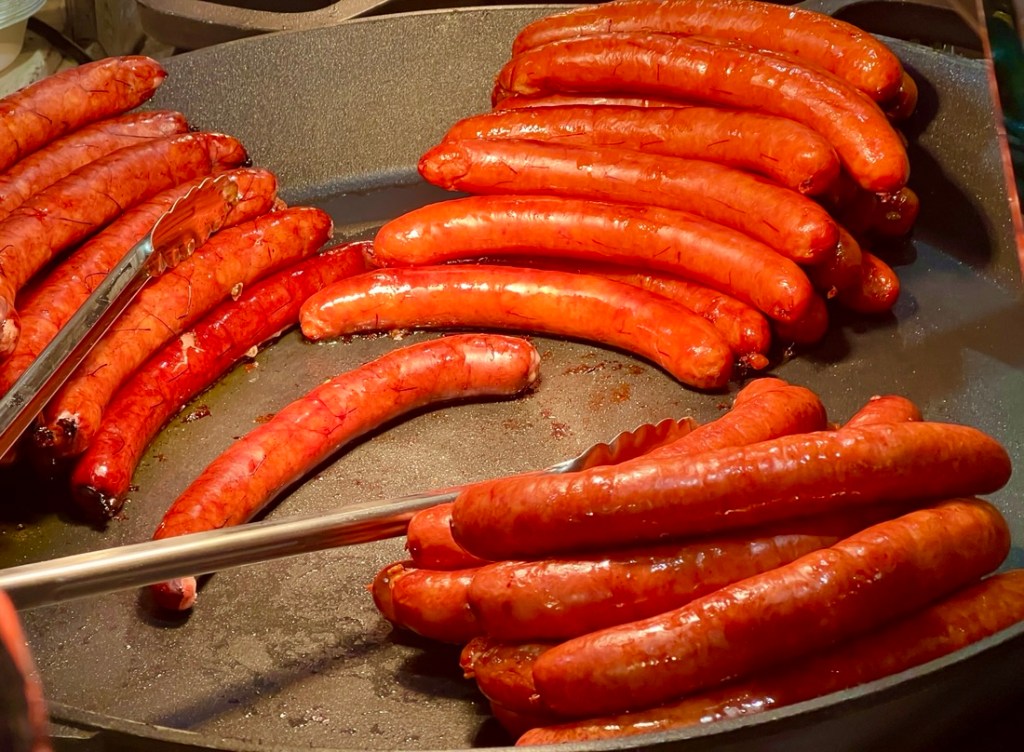
Under Kafka’s watchful gaze, we enjoyed a dinner of grilled sausage and mini pancakes with custard.


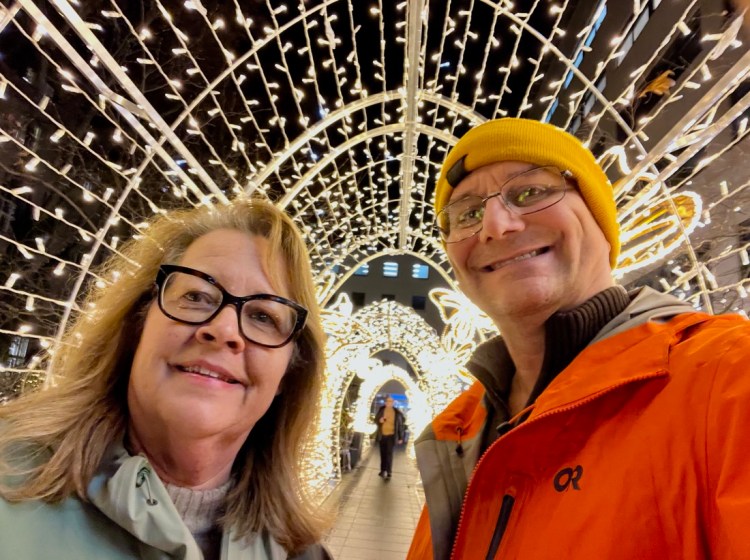
To get back to our hotel, Google Maps took us on a route through some buildings, which included this cool butterfly-themed light tunnel.
Day 6: Old Town, the Klementinum, and a Black Light Show
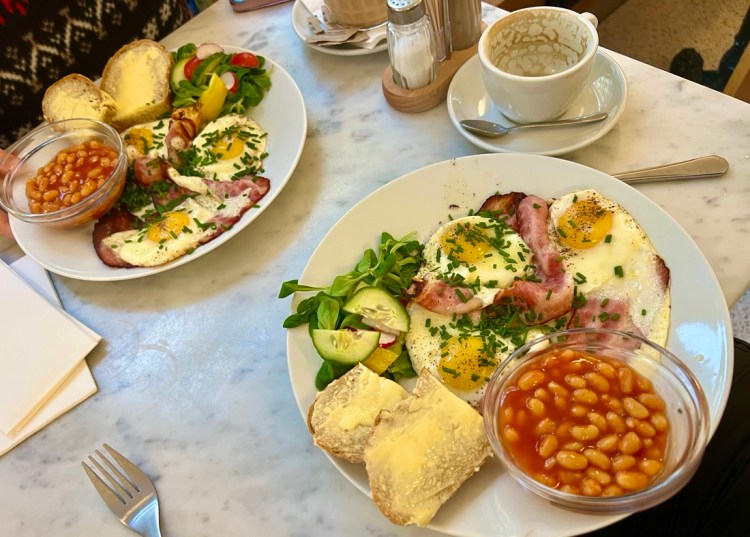
We started our final day by heading back into the Old Town for breakfast. The predawn Old Town Square was beautiful. Our target restaurant, Fat Cat, was only serving a buffet, which we did not want. We looked elsewhere, and we were very happy with what we had at the low-key Bistro Between the Lines, just off Old Town Square.


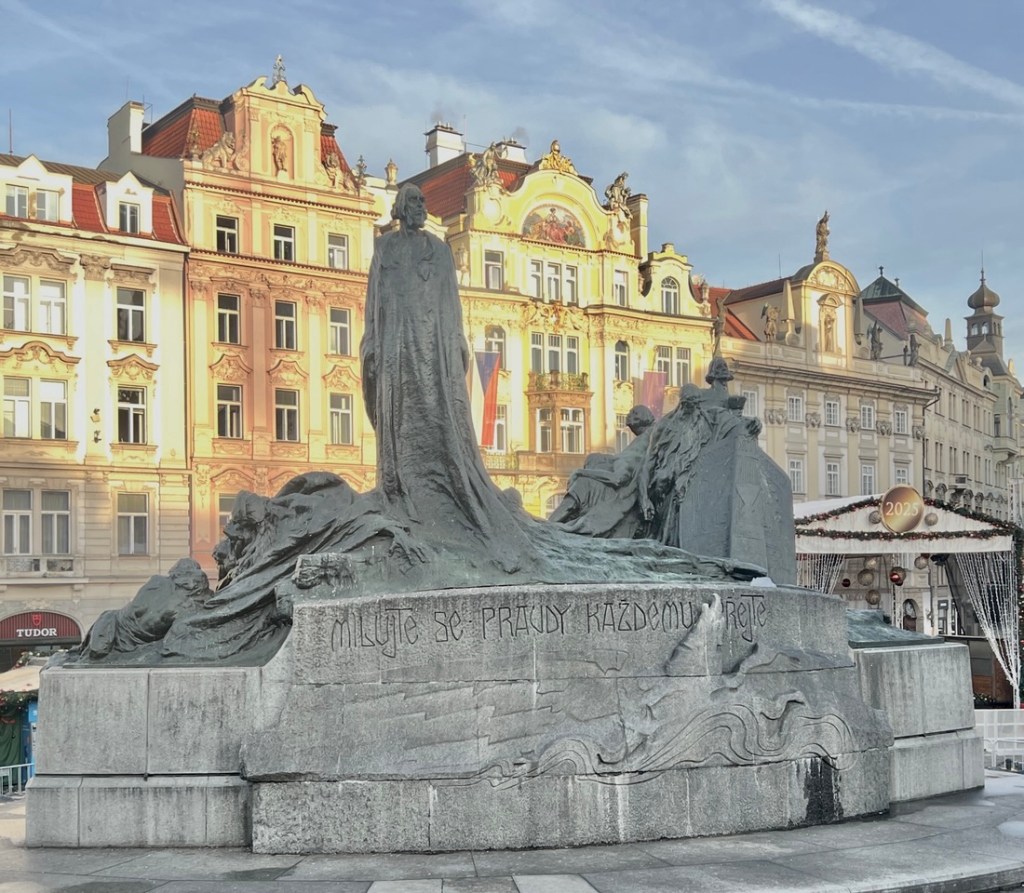
We watched the famous Astronomical Clock at both 8 am and 9 am, and the 30-second performance was a bit underwhelming. Our Rick Steves guide provided a 360-degree tour of Old Town Square, which was fascinating. We saw the symbolism on the central Tyn church reflecting how the church had changed from being Catholic, represented by a golden medallion of the Virgin Mary, to Hussite, suggested by the golden chalice, which represented the Hussites’ cause of communion for all. A stunning drawing of King Wenceslas adorned one building, somewhat ruined by Thai Massage’s storefront on the ground floor.



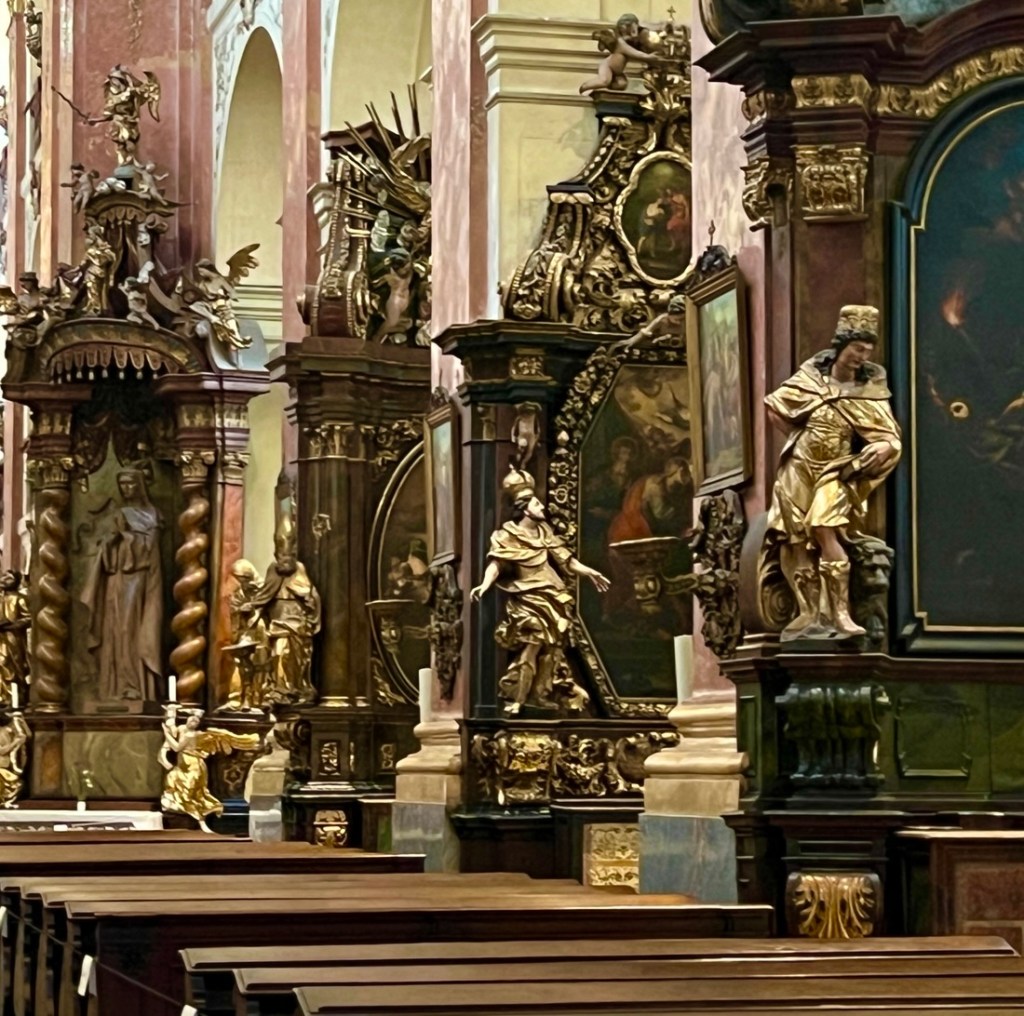
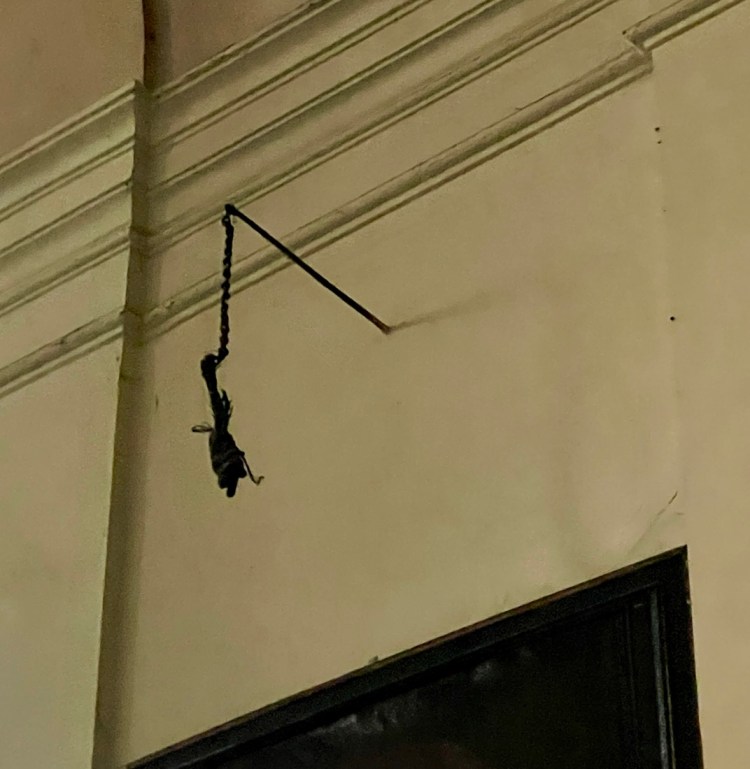
Just off the square was the Church of St. James. While the inside was elaborately decorated, its unique interest was the “Thief’s Arm,” a supposedly mummified arm of a thief who attempted to steal from the church, but a statue grabbed him, and they hung the arm on a wall to deter future thievery.
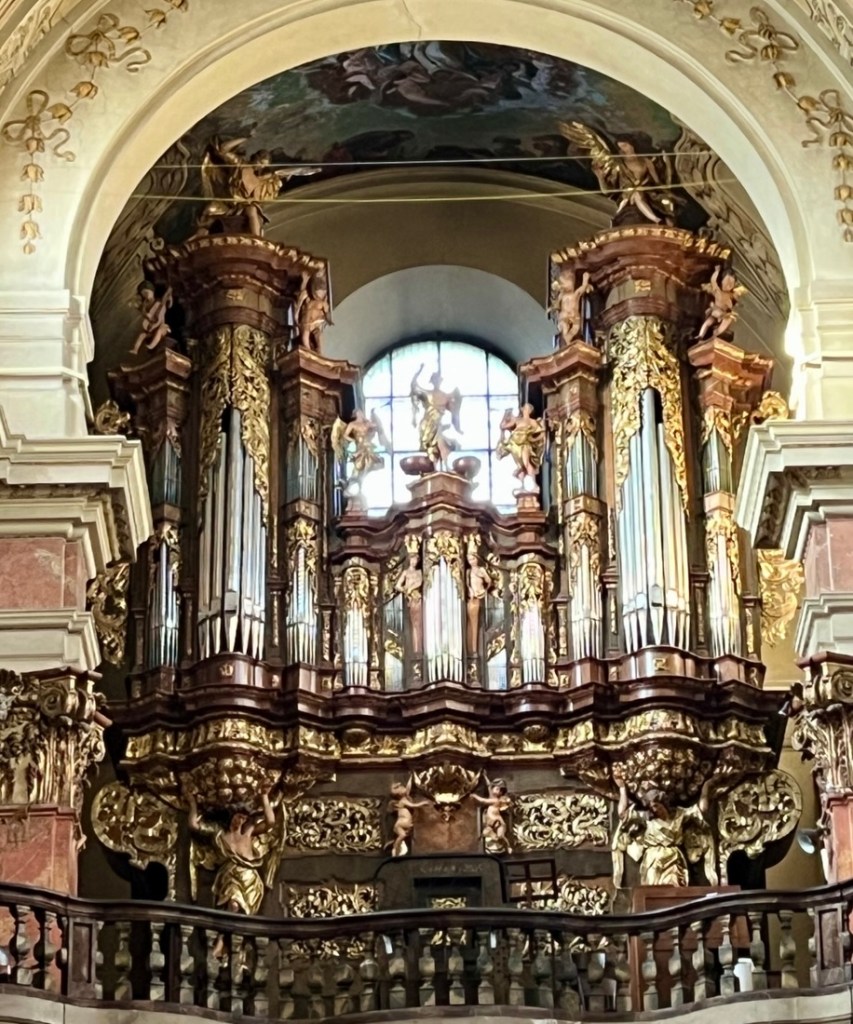

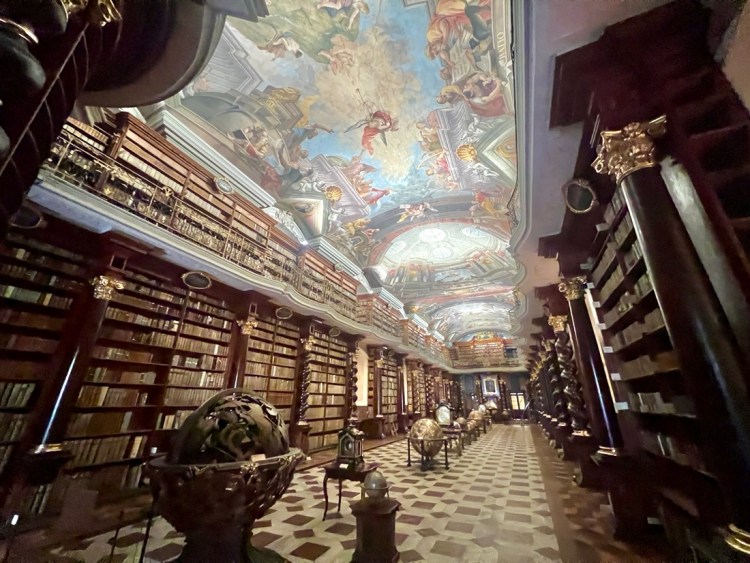
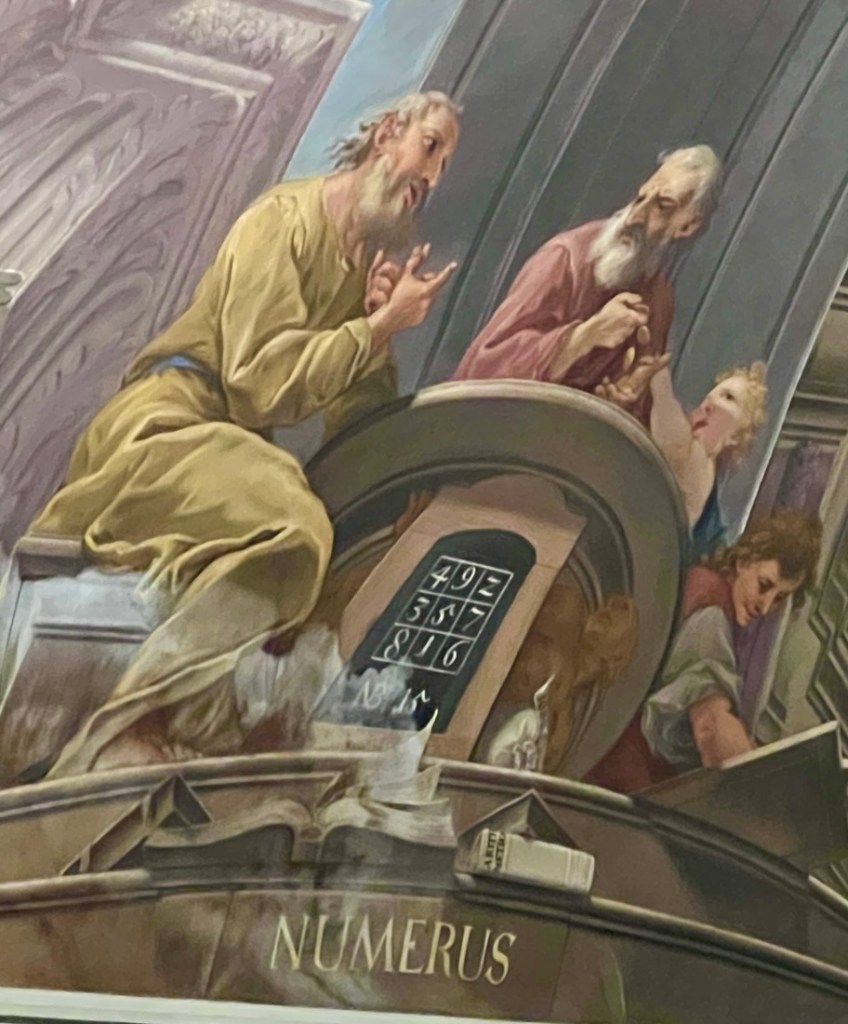
Next was our only tour of the trip. We like to do things by ourselves, but the only way to see the Klementium’s Baroque Library was with a tour. It sold out very quickly, and we were lucky to get the day’s 11 am tour. Our guide explained Klementium’s history to the group of twenty. Most were like us, primarily there to see the famous library. The site was a Jesuit monastery, built on the site of a 13th century Dominican monastery, that included a church dedicated to St. Clement (hence Klementium). The monastery evolved into a prestigious school, and Albert Einstein and Wolfgang Amadeus Mozart taught there. The library dates from the 1720s and housed 27,500 volumes on theological and scientific topics. Access is restricted to aid preservation.

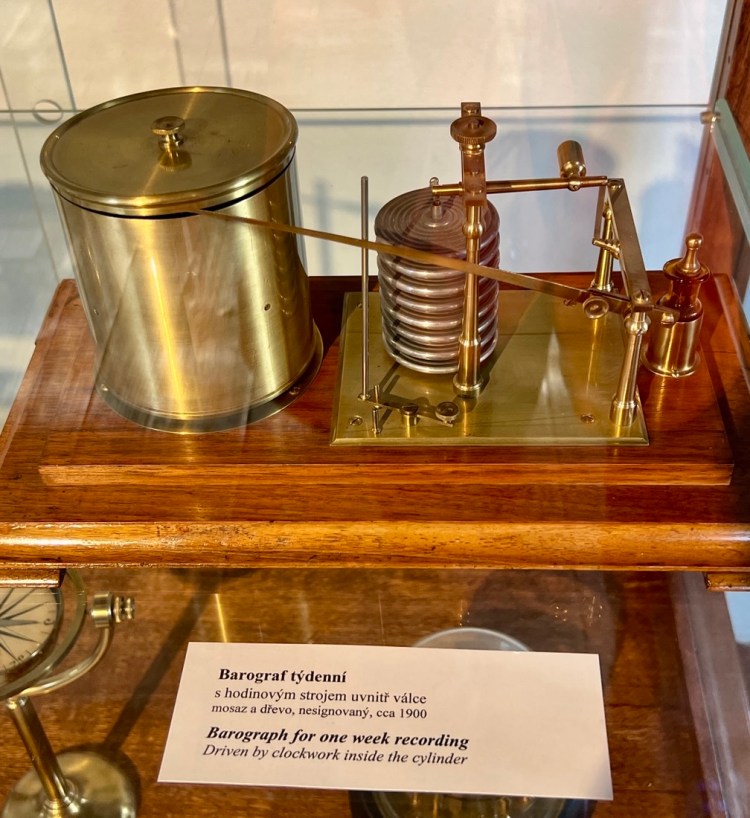
A very pleasant surprise was Klementium’s Astronomical Tower. Weather measurements had been recorded at this site since 1784. Additionally, from 1842, a camera obscura had been used to determine noon based on the sun’s direction. Finally, there were great views from the top. As this was our final day, we recognized many sites, working out where we had spent the previous five days.


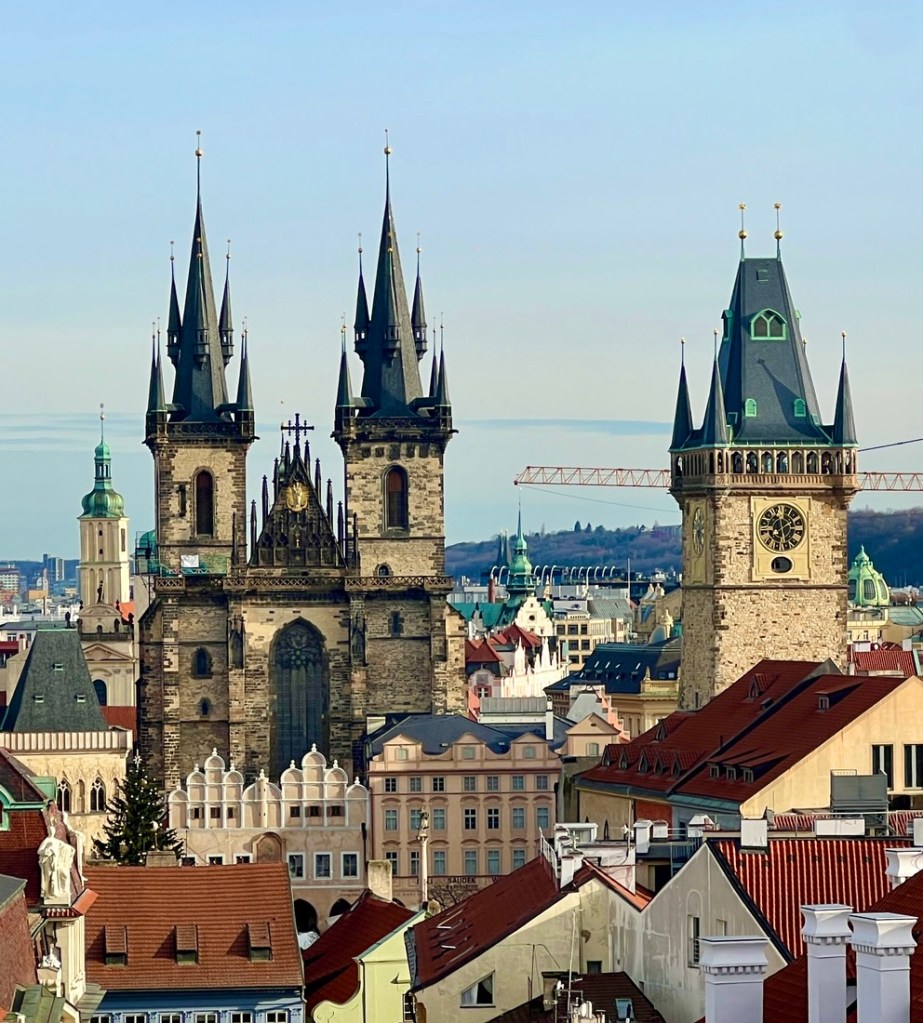


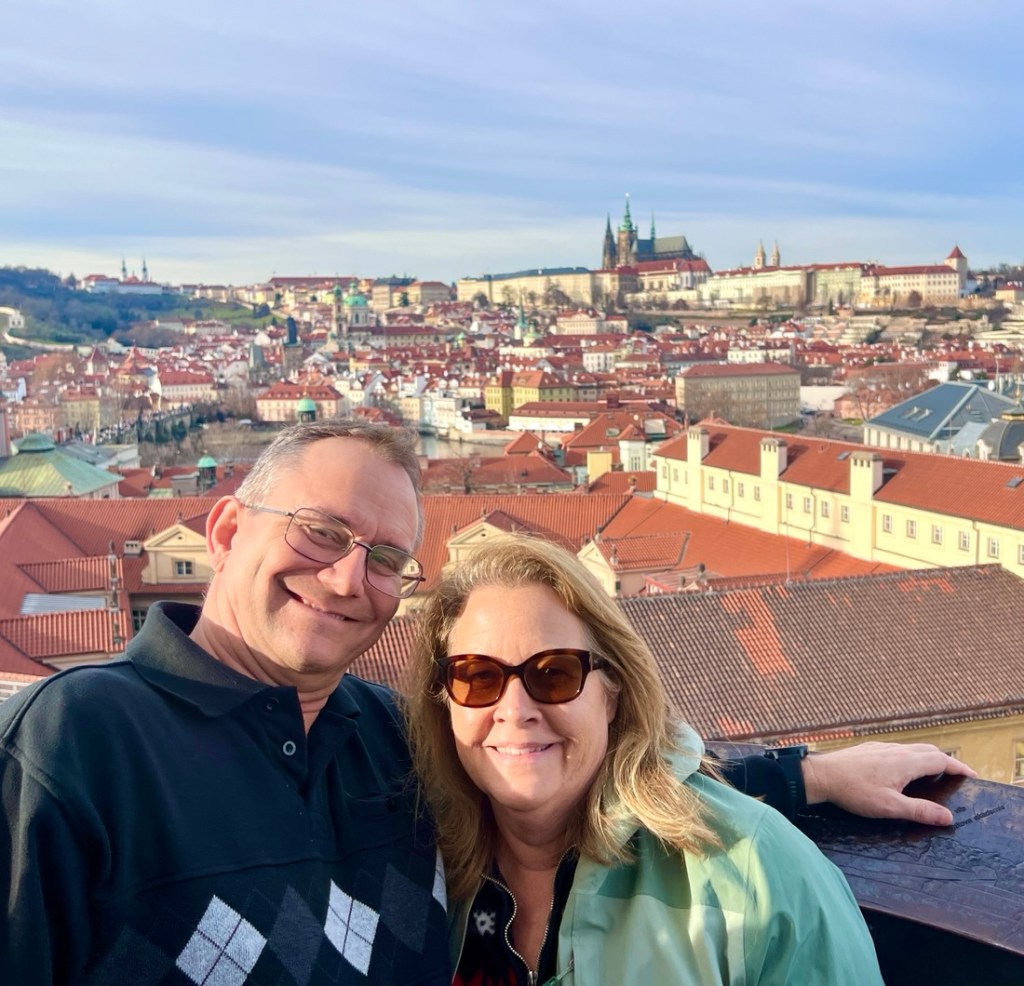
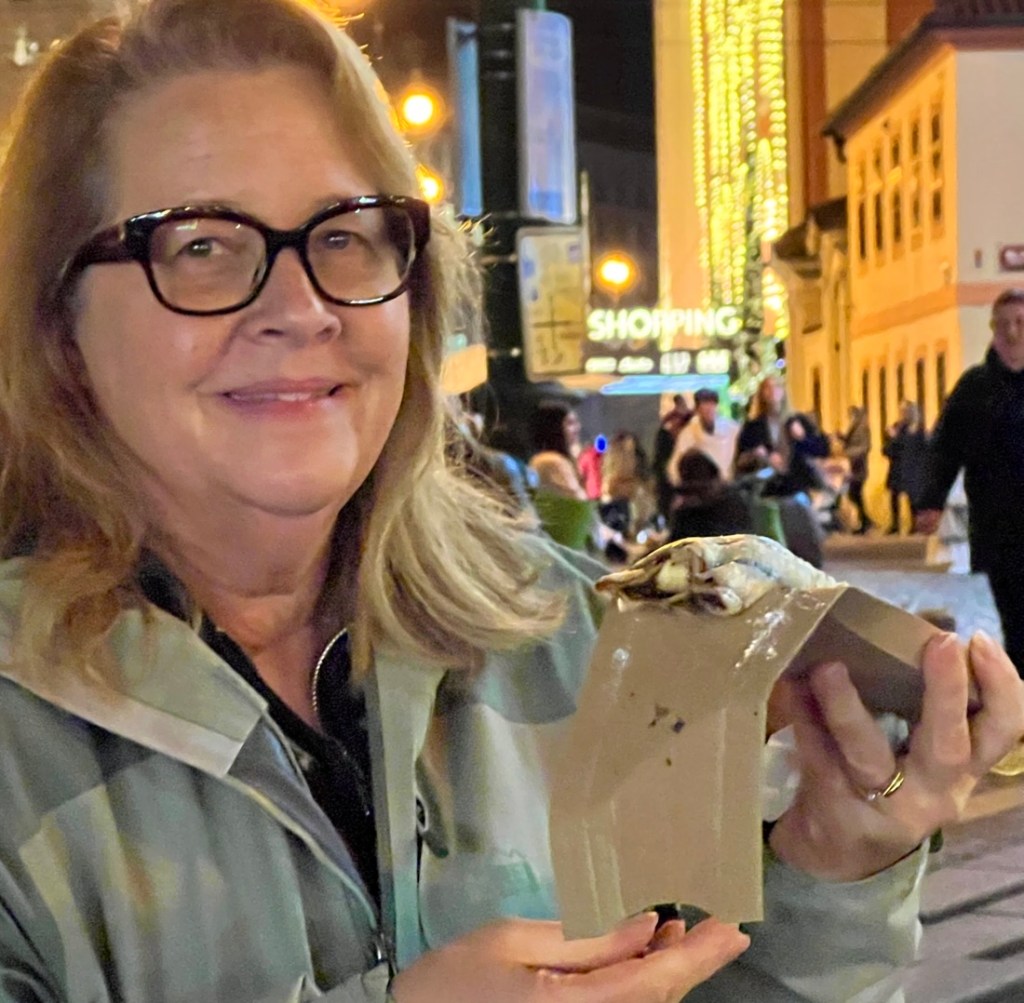
Next, it was time to head back to the markets for food and shopping. We had fun interacting with several vendors. One memorable one told us how his aunt made his goods. I didn’t want to take photos of them, and many purchases are gifts we haven’t given yet! However, we enjoyed drinking liquid Prague chocolate, eating pizza-like langos with a spiral of fried potatoes, more sausages, and a crepe.


Friends had recommended we go to a Black Light Theatre show. It was a lot of fun, with fascinating imagery possible with the special lighting. I could not work out how they did some of their acts!
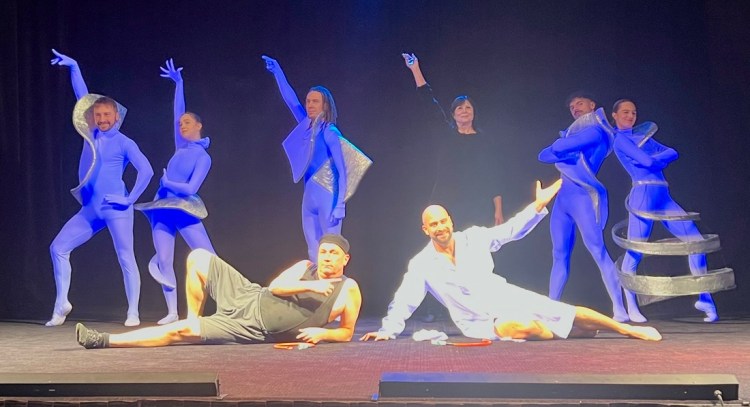
That marked the end of our Prague trip! We had a short sleep before getting up at 4 am for a 20+ hour trip back to Houston via Frankfurt.
Reflection
Prague was so much more than I had expected, so I was somewhat overwhelmed during the trip. Writing this article has helped me digest the trip and appreciate the tremendous history behind the city. There are parallels to London, which has 1000 years of “recent” history since England’s monarchy was established in 1066. But since then, England has won all of its wars, whereas the Czech Republic and Prague have bounced around between different powers. Remarkably, so much architecture had been preserved, and within all the conflict, knowledge and learning have remained prominent.
I expected to see a greater impact of communism on Prague. Perhaps its secularization was the main legacy, though I suspect that the historical quest for Czech identity, coupled with the infighting between the Roman Catholics, Hussites, and Protestants, has disenchanted many away from the Christian faith. The Jews faced centuries of discrimination, with the Nazis nearly wiping them out.
The Czech people we met were warm, friendly, intelligent, and welcoming. During our whole visit, we never felt threatened or in danger, which is remarkable in a large city. Well, perhaps we felt a bit scared by an Uber’s passionate driver…
Janet’s detailed plan was invaluable, allowing us to cover everything we wanted while giving us the flexibility to pivot when needed. I was so glad that I had read Under A Cruel Star before the trip to gain some insight into Prague’s history under the Nazis and communists. I don’t know how I could have appreciated more of its history before 1939. I need to read some Kafka. Rick Steves Pocket Prague generally gave us the amount of information that we like, though I found it lacking in a few areas and was hungry for more. Google and Wikipedia were my guiding companions. Even with comfortable shoes, we found that the cobblestones punished our legs, and we loved the great tram system.
This trip has inspired us to want to visit other former Eastern European countries. I look forward to finding other gems that were hidden under the communist shadow of Eastern Europe when we were growing up.
 The Adventures of the Cajunlimeys