
What evidence is there in Rome that Paul or Peter were in the city? The Bible describes Paul’s arrival in Rome (Acts 28:11-16) and that he lived there two years (Acts 28:30-31). In 2 Timothy, Paul references his time in Rome (2 Tim 1:17). Peter mentions his association with Silvanus and Peter in Babylon at the end of his first letter (1 Peter 5:12-13), and Babylon was used as a code-name for Rome in first century writings. Complementing the Bible are other accounts which range from probably accurate to fantastical legend. When I visited Rome in May 2025, I wanted to identify as best as I could the sites associated with Paul and Peter, giving me some insight into what their time in Rome had been like, supplementing similar Bible-exploration trips to Israel and Greece.
Locating relevant evidence from 2000 years ago is naturally difficult and is compounded by two factors in Rome. First, there are many historical artefacts from before and after the first century which complicates matters. Second, many of these artefacts are associated with stories and legends that were promoted by the Roman Catholic church but for which there is little evidence. As on my previous trips to Israel and Greece, I’d learned I needed a good book.
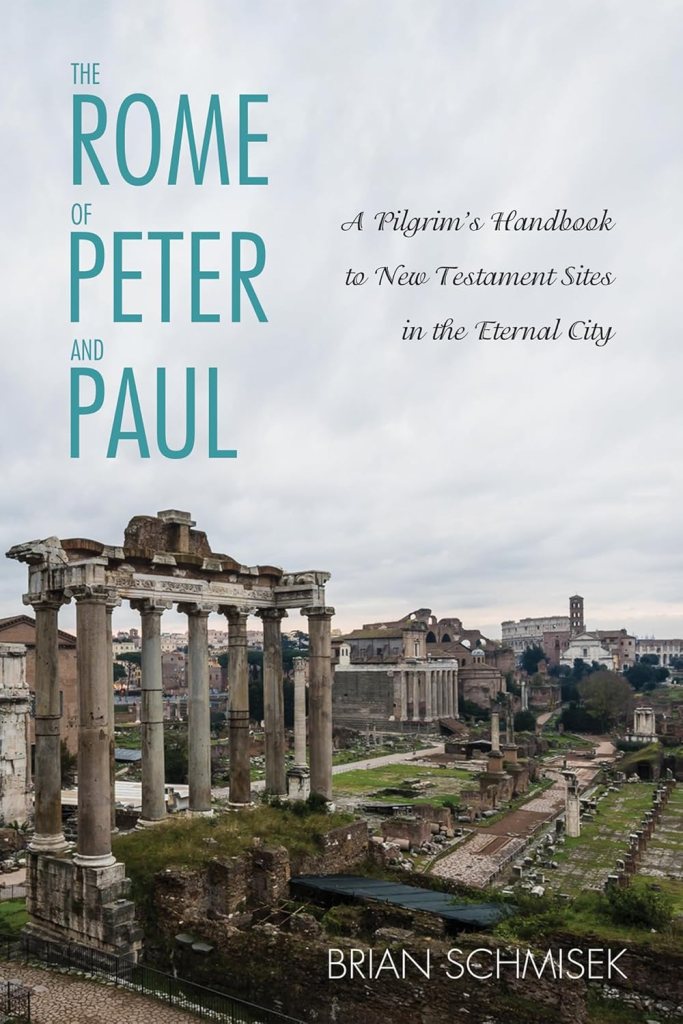
Brian Schmisek’s book compiles the notes he made for summer classes on the New Testament that he offered in Rome through the University of Dallas and Loyola University. It is an excellently balanced examination of the evidence of the association of Roman sites with the New Testament. This book allowed me to identify and prioritize which sites to visit as well as providing much of the background info I share below. I would highly recommended it for anyone visiting Rome with an interest in the New Testament.
Our Rome visit’s itinerary was driven primarily by main tourist sites such as the Trevi Fountain, the ruins of Ancient Rome, and the Vatican. Schmisek groups the biblically-relevant sites by regions which align with the tourist sites, facilitating our visiting such sites while passing rather than making specific trips. Below, I present the artefacts chronologically, as I found such a mindset greatly assisted in one’s understanding of the sites, illuminating what was present (and what was not) during the time of Peter and Paul. Also, the age of evidence and its proximity to the time of the events impacts its likely authenticity.
St. Peter in Chains (San Pietro in Vincoli)
Luke describes Peter’s rescue from Prison by an angel when “the chains fell off his hands” (Acts 12:7). Shortly after this, Peter left the Acts narrative, “Then he departed and went to another place” (Acts 12:17b), and some scholars suggest “another place” might have been Rome and that this occurred in AD 42. Mirabilia, manuscripts from around 1140 which describe Rome’s history, associate Peter’s chains with this basilica which is a short distance north of the Colosseum. The manuscripts explain that Eudoxia, the wife of Roman Emperor Arcadius, founded the church in the early 400’s as a place to keep Peter’s chains, that had been gifted to her on a visit to Jerusalem. There is also a claim that the chains that bound Paul are here too.

The church itself is similar to many other churches in Rome, with the pictures below showing its outside and inside.


The church receives many visitors because of Michelangelo’s Moses, sculpted around 1515. It was commissioned to be part of Pope Julius II’s tomb which was to have over forty statues, though interest in the grand tomb waned after Julius’s death and this statue was moved to this basilica in 1544 and has remained here since.

Most fascinating was the backstory of the horns on Moses’s head.

Michelangelo used the Latin Vulgate as his Bible which describes Moses as descending from meeting God on Mount Sinai “with horns” (Latin: cornata) (Exodus 34:29). The Hebrew word is “qâran” translated as “radiant” in today’s English Bibles, but it is similar to “qérén” which means “horned”, which led to the Vulgate’s mistranslation.
The Ancient Appian Way (Appica Antica)
The Appian Way was a Roman road, the construction of which started in 312 BC and connected Rome with Brindisi on Italy’s southeast coast. Luke describes Paul traveling as a prisoner from Puteoli (near modern Naples) to Rome along the Appian Way (Acts 28:14-16), around AD 59.
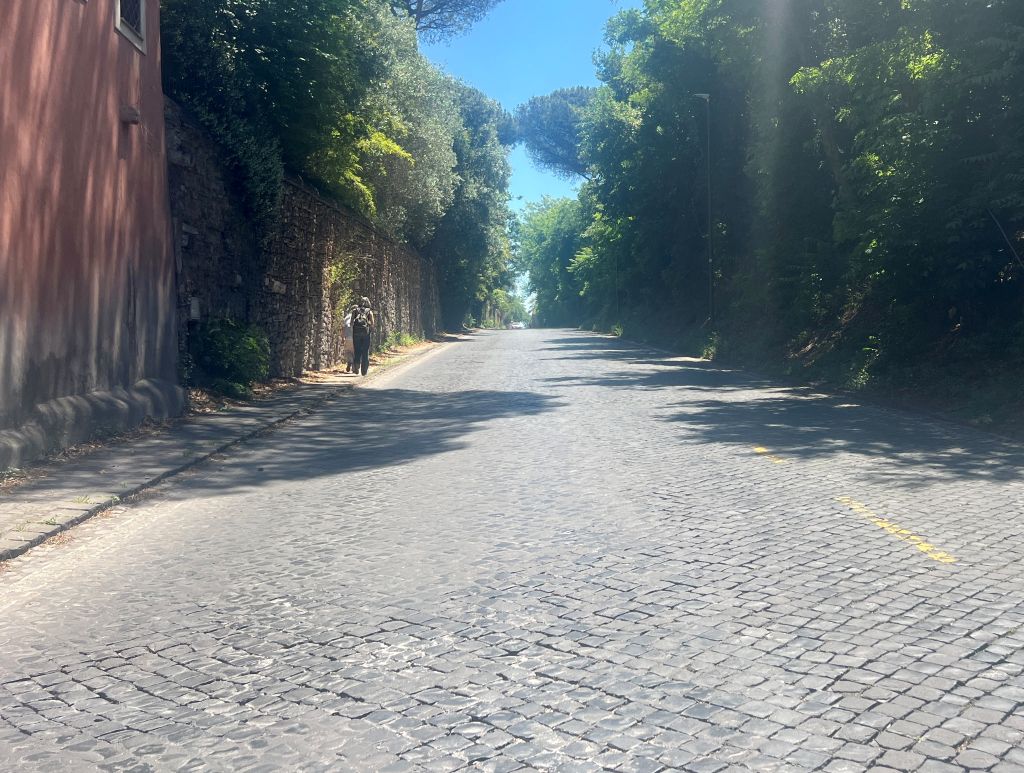
The Bible specifically mentions the Forum of Appius and the Three Taverns (Acts 28:15). The probable locations of these sites are about forty miles outside of Rome on the Appian Way. Little, if anything, of significance remains and we did not visit those sites. Paul would have known he had arrived in Rome by passing through a gate in the Servian Wall. The Aurelian Walls were built a couple of centuries after Paul. The Appian Way passes through the San Sebastien gate in the Aurelian Walls. While Paul did not pass through this gate, it helped me imagine Paul’s thoughts about seeing Rome’s wall and realizing he had finally made it to Rome.

Close to this area are several catacombs where some of the earliest Christians were buried, but we did not visit them. There is also the “Quo Vadis” church which we visited and I discuss below as it is later on my timeline.
Mamertine Prison (Carcere Mamertino)
The Mamertine Prison was probably the only prison in ancient Rome, so it is probable that Paul was imprisoned in it at some point. The prison dates from 640 BC, initially built as a cistern with a spring. During Paul’s time, it was known as the Tullianum., derived from the Latin tullus meaning “spring.” It is possibly the location where he wrote the prison epistles (Ephesians, Philippians, Colossians, Philemon) and 2 Timothy. The sixth-century legend, The Passion of Saints Processus and Martinianus, Martyrs, claims that Peter was imprisoned here with Paul, and that a spring formed to allow him to baptize his jailors, Processus and Martinianus. Such a legend is not historical yet gives insight into sixth century imagination. One of the series of images on the roof of the atrium on entering St. Peter’s Basilica depicts this baptism.


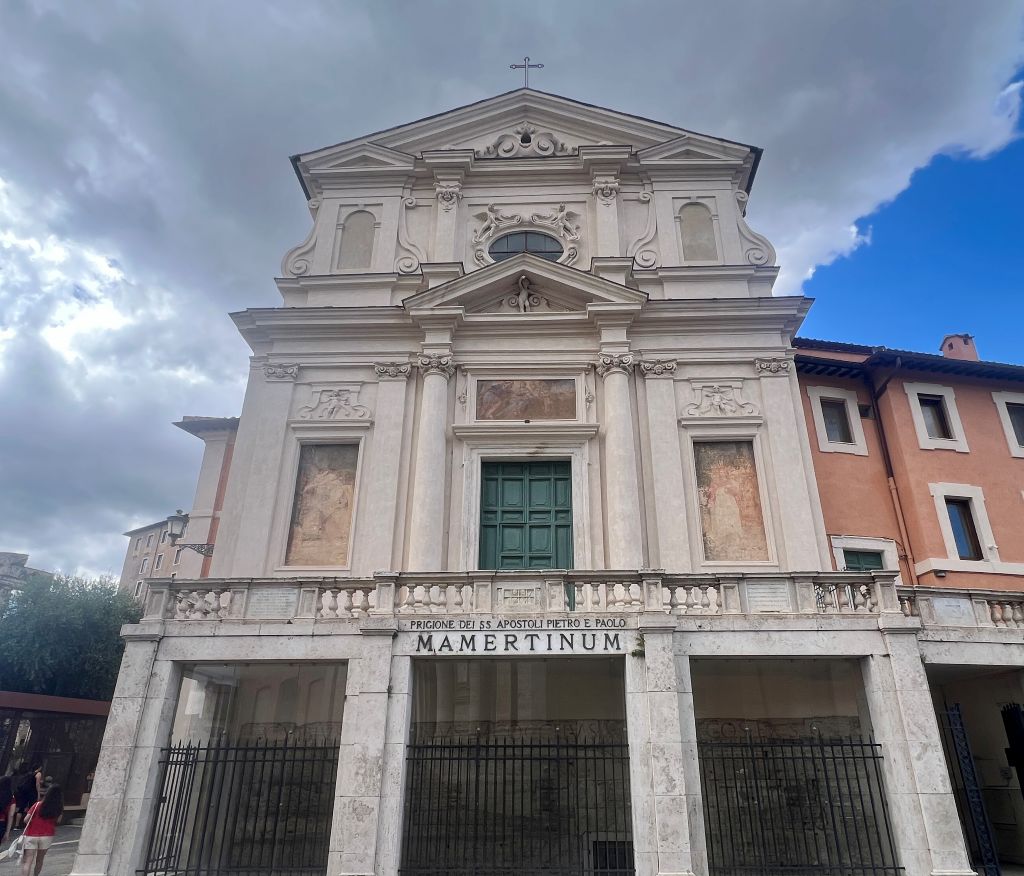
There is evidence of a church existing above the prison since at least the eleventh century. The current churches, which honor Peter and Paul, dating to the sixteenth century.
The prison is located next to the Roman Forum which was the center of activity in Rome. Paul and Peter likely walked through this forum. This reminded me of our trip to Greece and the Agora in Athens, where Paul debated with Jews and God-fearing Greeks (Acts 17:17). However, as Paul was not free in Rome, he probably was not allowed to roam around. Perhaps that is what inspired him to write more letters?
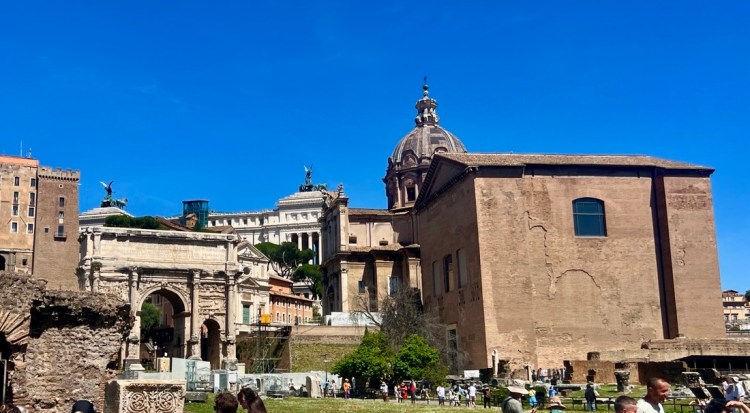
On the far left are the Capitoline museums, the buildings dating from the 15th century, though the hill had been a seat of government going back 2500 years. Next is the Arch of Septimius Severus from AD 203. Behind that is the green door of the site of the Mamertine Prison. Behind this building one can see the chariot on top of the Victor Emmanuel building, built in 1861. The church dome (Chiesa dei Santi Luca e Martina Martiri) dates from the 1600s. On the far right is the Curia, the ancient Senate House and the site of Rome’s official center of government. The first senate building on this site was built in the seventh century BC with the current structure built around AD 300. Wow! This one view covers millennia of history, including a site where some of the Bible was probably written.
Basilicas of St. Pudenziana, St. Prassede, and St. Maria in Via Lata
A short distance north of the Colosseum are several churches that claim to be at locations with links to the Bible. We visited three of them.

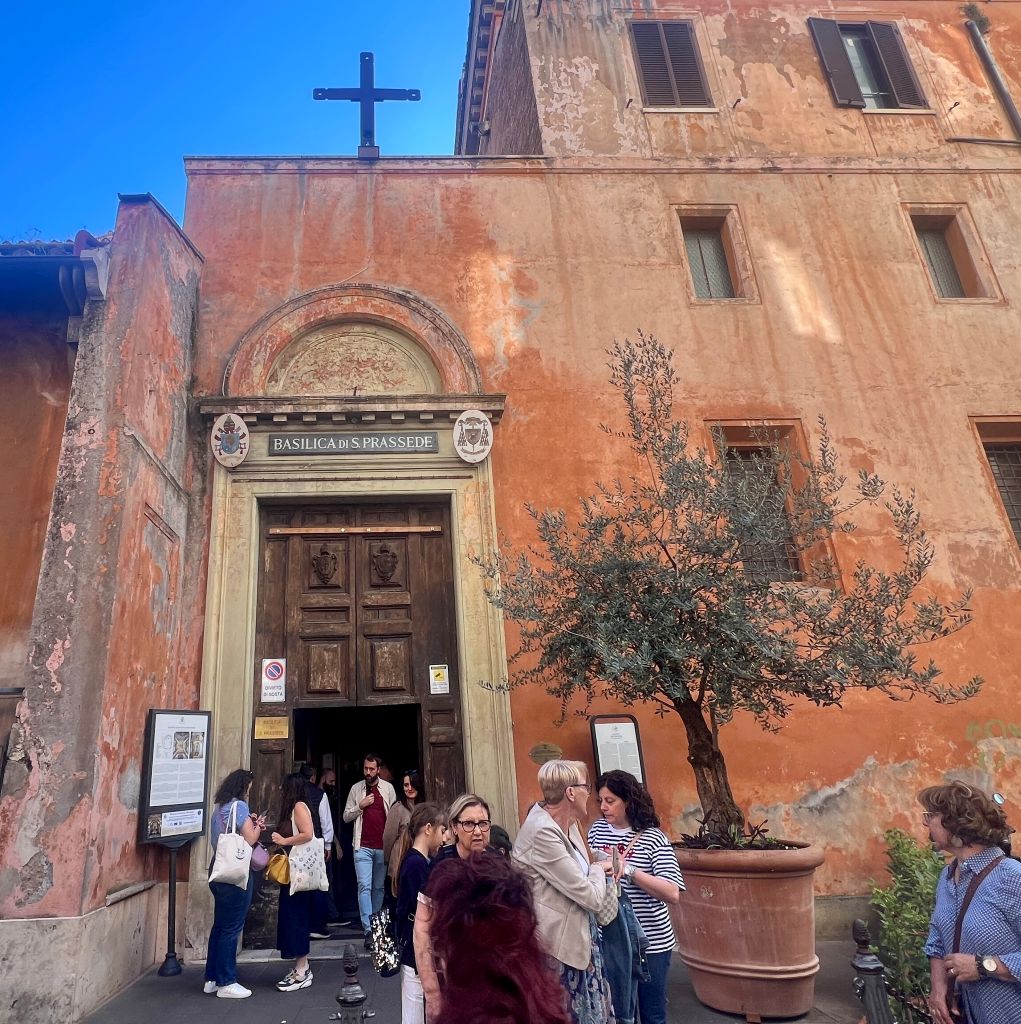
The third church with a tradition associating it with the Bible was the Basilica of St. Maria in Via Lata. Traditions claim different associations with this site: (1) it is where Paul lodged for two years in Acts 28:30-31, (2) it is where the centurion who watched over Paul lived, and (3) it is Luke’s house.
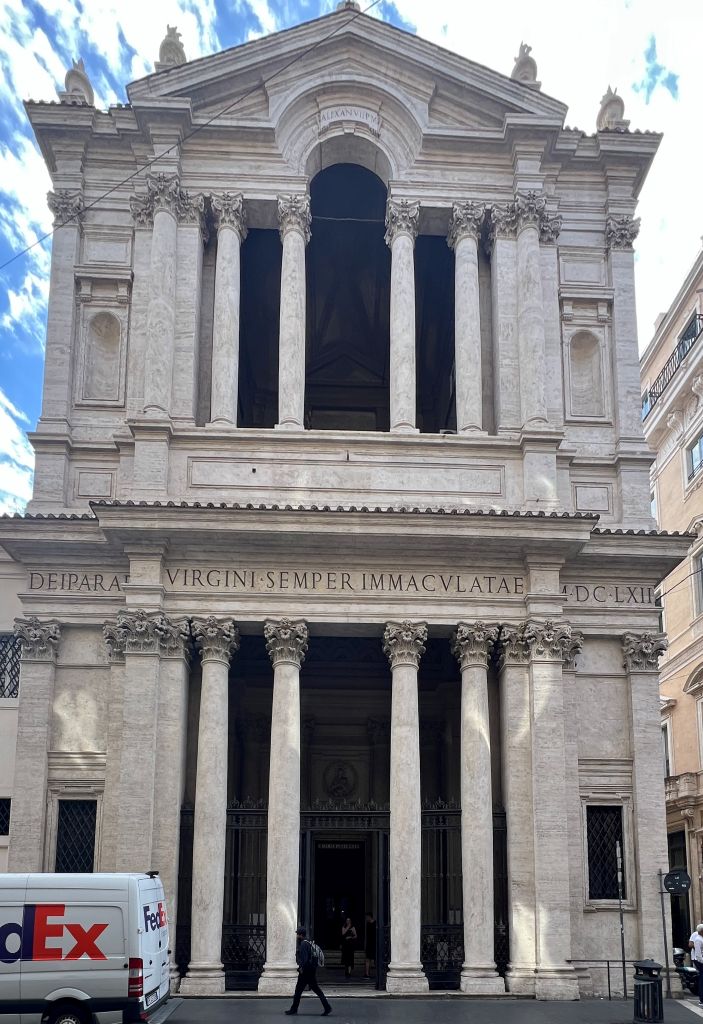


The claims associated with the three churches above illustrate how legends and traditions develop, especially when there is a lack of evidence of what actually happened. However, the next church we visited was associated with more fantastical events.
Church of Domine Quo Vadis
On the Appian Way, we visited the Church of Domine Quo Vadis. The Latin version of the sixth-century “Acts of Peter” describes an interaction at this site between Peter and Jesus. As Peter fled Rome along the Appian Way, he met Jesus. He asked Jesus, “Domine Quo Vadis?” which means “Lord, where are you going?” Jesus replied that he was going to Rome to be crucified again. This inspired Peter to return to Rome where he faced his own execution. This is another example of sixth century imagination. It is also illustrated in an image on the roof of the atrium on entering St. Peter’s Basilica.
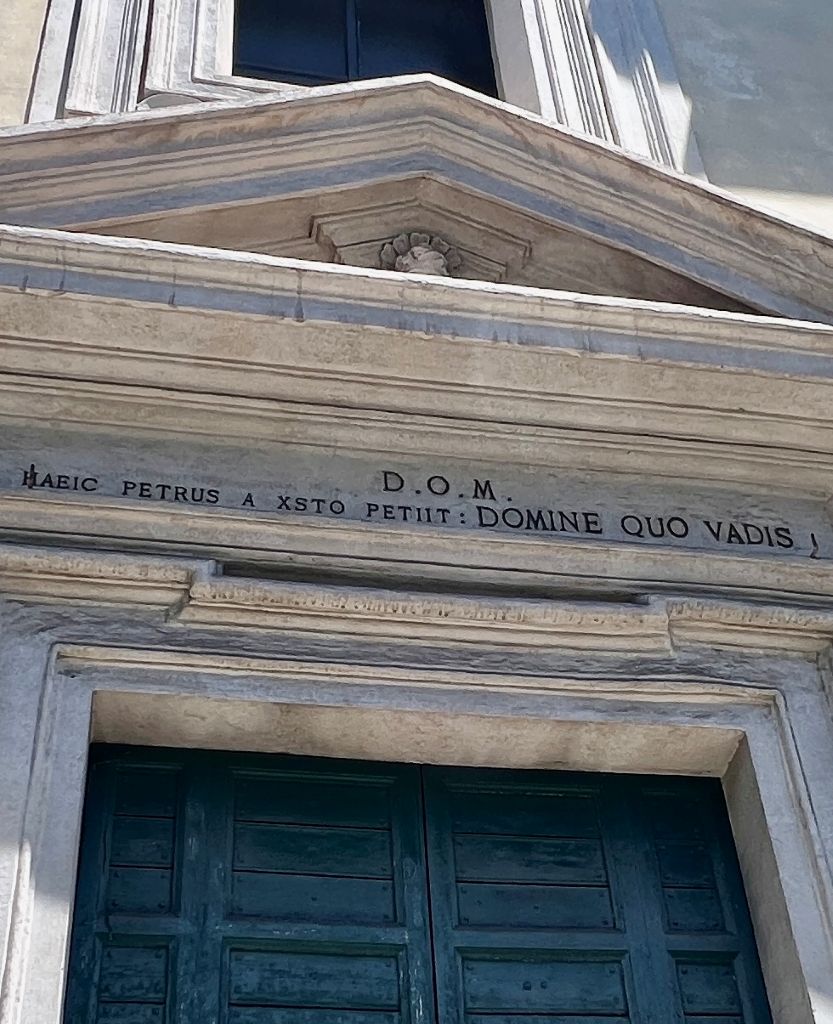
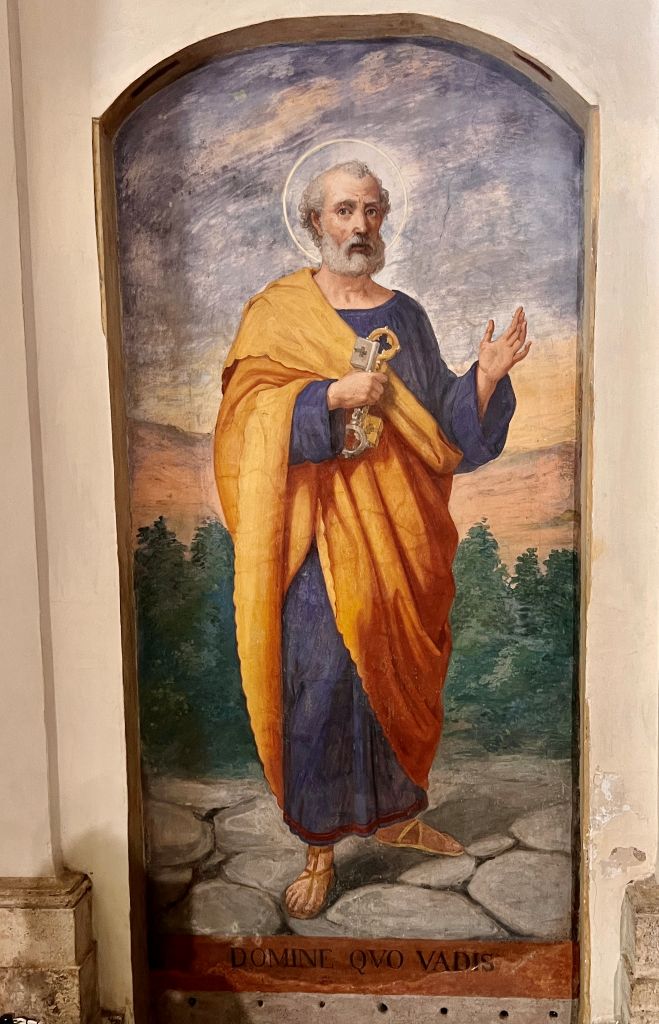
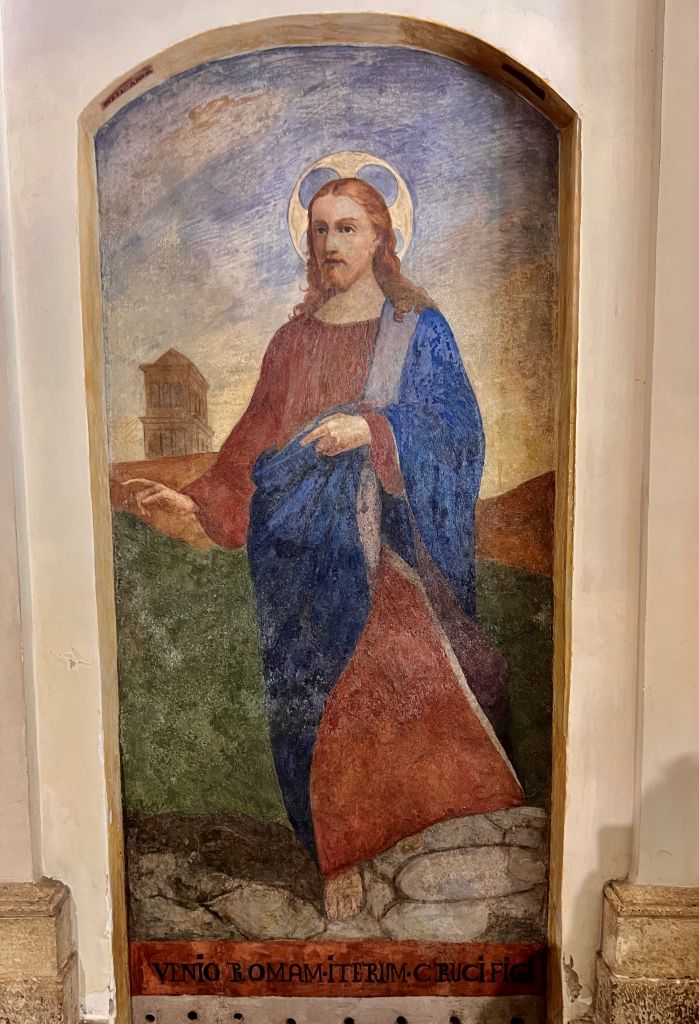
Note the keys that Peter is holding in the middle picture. This is a central aspect of Catholic tradition where Peter holds the keys to the kingdom, building on Matthew 16:19.

St Peter’s Basilica
The largest church in Christendom is built on what is claimed to be the site of Peter’s grave. The Vatican area is about two miles northwest of the Colosseum and the center of Ancient Rome, across the River Tiber, and outside the city limits. In antiquity, the location, Ager Vaticanus, was the site of a park, gardens, and a circus for entertainment. It was also the location of a couple of cemeteries as it was illegal to bury the dead inside the city. According to Catholic tradition, Peter was executed upside down by Nero in this area after the great fire of 64. The upside down reference comes from the non-biblical Acts of Peter, which were written in the late second century. Other ancient documents support Peter and Paul’s execution in Rome in the mid 60’s, such as Clement’s first letter to the Corinthians from the end of the first century and Eusebius’s Ecclesiastical History from AD 170. Jerome’s Chronicle from about AD 380 and the subsequent Liber Pontificalis (Book of Pontiffs) established Peter as the first Pope in the Roman Catholic tradition.
Archaeological evidence supports a first century cemetery with a small shrine below the basilica. The land was donated to the church during the reign of Constantine in the early 300s and the first basilica was built over the grave in AD 324. In 1452, Pope Nicolas V made plans to “renovate” the crumbling building but it wasn’t until 1506 that Pope Julius laid the first stone of a very ambitious project and appointed Bramante chief architect. Raphael became the project’s leader in 1514 followed by Michelangelo in 1547, who died before the dome’s completion in 1593. Maderno completed the nave and facade in 1614 and the building was consecrated in 1626. Bernini was appointed chief architect in 1629 and completed many of the statues.
To help raise money to pay for this 150-year “renovation,” there was an increase in paid-for indulgences, defined as “remission of punishment for sins, which reduces or eliminates the amount of time that an individual needs to spend in Purgatory after death.” A friar who led the campaign coined the phrase “when the coin in the box rings, a soul from purgatory sings.” It is unsurprising that the Protestant Church formed at this time. On 31 October 1517, Martin Luther (1483-1546) nailed his 99 theses on the door of Wittenberg Castle church in Germany, including thesis 86 which said, “Why does not the pope, whose wealth is today greater than the riches of the richest, build just one church of St. Peter with his own money, rather than with the money of poor believers?”


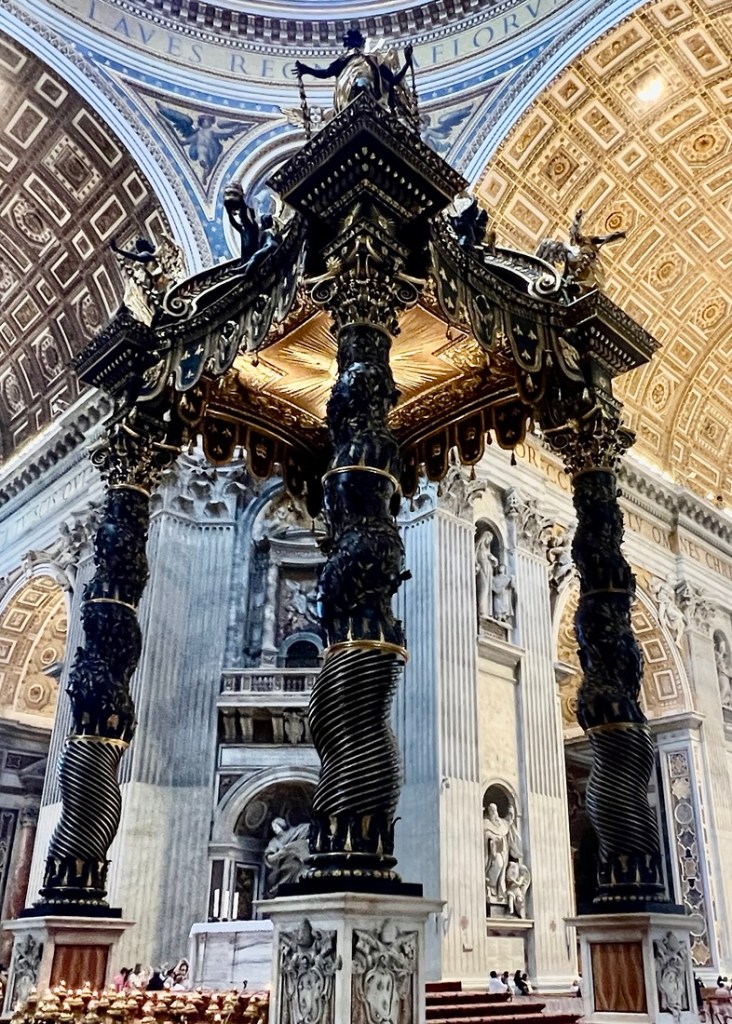
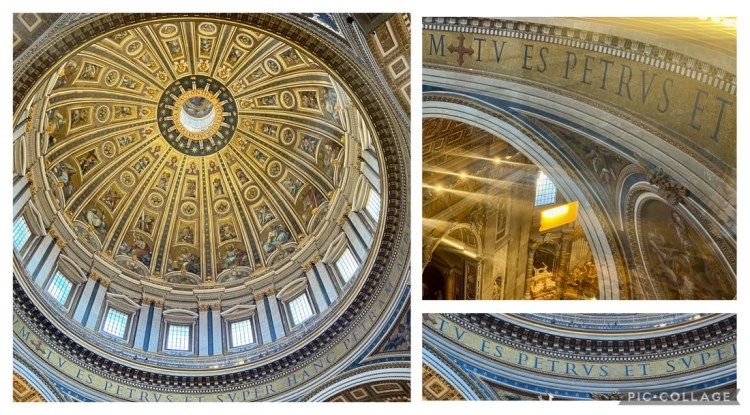
The number of works of art in the basilica was overwhelming. We felt that the whole Vatican was an opulent display of wealth, probably due to the Catholic church’s historical attempt to display her authority and power. Schmisek wrote, “It is difficult to see this mighty structure and not think that it might be more a monument to man than God. On the facade we see the Borghese family and Paul V’s name displayed prominently. But where is Jesus?” We witnessed it continuing to play its role with the Catholic faithful which saddens me as it is not aligned with what I believe the Bible teaches.
What About Paul?
We did not have time to visit a couple of sites that tradition associates with the death and burial of Paul. About five miles due south of the Colosseum is the Abbey of the Three Fountains (Abbazia delle Tre Fontane). One of the traditions that supports this as the site of Paul’s death and led to its name is the fourteenth-century work, Mirabiliana. It states, “There was the blessed Paul beheaded; and when he was beheaded, he cried thrice: Jesus, Jesus, Jesus; and in each place a well flowed, after the three leaps of the head.” I think that this is the most fantastical legend associated with the Bible that I have come across!
Tradition claims that Paul is buried at the Basilica of St. Paul Outside the Walls (San Paolo fuori le mura). A small basilica was built at this site in AD 324 during Constantine’s reign. Through the centuries, it was enlarged but the building was destroyed by fire in 1823. The resultant new basilica is one of the four major papal basilica’s in Rome that also include St Peter’s, St Mary Major (where the most recent pope was buried), and St. John Laterna. Schmisek writes that this simpler church is a more appropriate reflection of Paul compared to the opulence that commemorate Peter in his basilica.
The Colosseum
One of my main takeaways from this visit to Rome was learning that a couple of the great Roman constructions were from the first century AD but after the deaths of Peter and Paul. The first of these is the Colosseum which did not open until AD 80. The name “Colosseum” comes from a 106-foot statue of Emperor Nero that he built near his lake after Rome’s great fire in AD 64 but no longer exists. Vespasian, after becoming emperor in AD 69, drained the lake to make an amphitheater for the people. His son Titus oversaw its grand opening in AD 80, one year after Vespasian’s death. Notably, the Romans defeated the Jews in AD 70, destroying Jerusalem’s temple, whose riches helped pay for projects such as the Colosseum. While the Romans likely knew this site as simply the arena, the name “Colosseum” has been used for centuries.
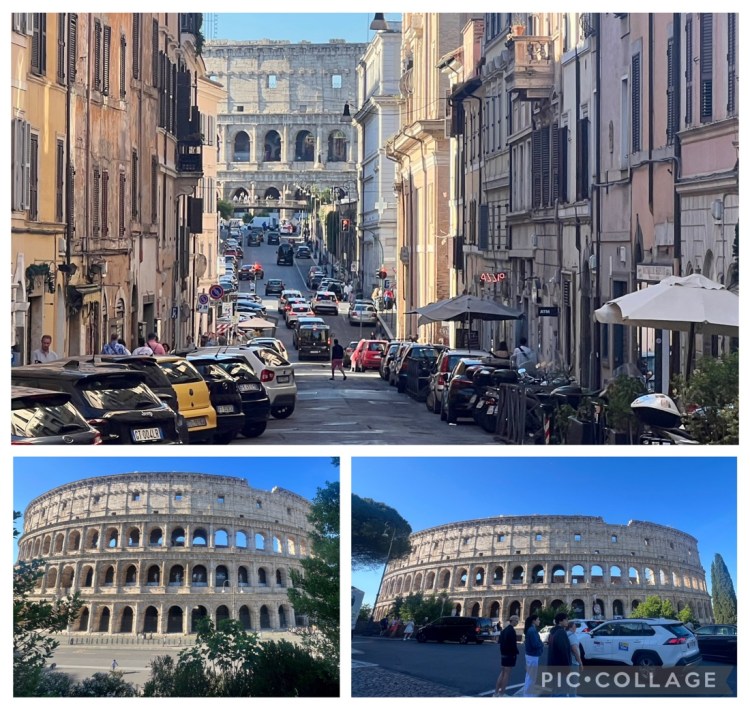

The Arch of Titus
The Arch of Titus was built close to the Colosseum around AD 81 by Emperor Domitian to commemorate his brother Titus who became emperor in 79 but reigned for only a couple of years before his death. The arch recognizes Titus’s greatest achievement before he was emperor when he quashed the Jewish rebellion and destroyed the Jerusalem temple in AD 70. This indicates the importance Rome placed on defeating the Jewish rebellion and the belief that Rome was greater than Yahweh, God of the Jews. Carvings on the arch show people carrying the temple’s treasure back to Rome including a seven-candled menorah.


The Arch of Constantine
This arch, right next to the Colosseum, was built in AD 315 to celebrate Constantine’s victory over his Roman rival Maxentius in AD 312. Tradition holds that Constantine had a divine vision before the decisive battle and thereafter legitimized Christianity in the empire by the Edict of Milan in 324. Constantine also convened the First Council of Nicaea in 325 which led to the Nicene Creed.

Just a couple of days prior to my writing this, the pope celebrated the 1700th anniversary of the Nicaean Council. Subsequent councils have determined which books were to be included in the Bible, such as the Council of Rome (382), Synod of Hippo (393) and two Councils of Carthage (397 and 419). In his work Ecclesiastical History from around AD 325, Eusebius presents the books that are being accepted as part of the Bible and notes other writings that could not make a legitimate claim as Scripture. To understand more about how today’s Bible came into being, I recommend Benjamin P. Laird’s Creating the Canon: Composition, Controversy, and the Authority of the New Testament (2023).
Summary and Reflection
Our attempt to uncover biblical history in Rome had similarities to our attempts in Israel and Greece. There will always be many challenges understanding relics that are 2000 years old. Subsequent traditions with their human-driven agendas influence those relics, and that influence seemed greater in Rome. As a travel companion shared in frustration, it was very difficult to tell which ancient artefacts were genuine and which were reconstructed. Some reconstructions can be hundreds of years old!
It was thought provoking trying to imagine what it was like for Peter and Paul in Rome. Our visits to Israel and Greece brought the Bible to life significantly more than this trip to Rome, simply because more of the Bible is set in those locations. Rome lacked locations where one felt certain that a biblical character had been present. Rome uniquely presents millennia of history in geographical proximity, forcing one to understand the construction timeline to determine what was there in AD 60.
It also illustrated how each leader tried to outbuild their predecessor, whether it was Nero’s 106 ft statue on the site of the Colosseum, St Peter’s Basilica lording it over Nero’s obelisk, or the modern Victor Emmanuel building from 1861. All human leaders are flawed, leaving behind their flawed legacy. This includes church leaders throughout history. While I can find fault, I cannot claim to be able to do any better, and the words of the psalmist come to mind: “It is better to take refuge in the Lord than to trust in man. It is better to take refuge in the Lord than to trust in princes” (Ps 118:8-9). The Lord is found in the Bible and in the hearts of those who believe in him.
 The Adventures of the Cajunlimeys
Totally amazing!
LikeLiked by 1 person