
The mountains of West Texas have continuously drawn us toward them. Unfortunately, the >10-hour trip from Houston has been a barrier, but we have still made multiple trips, and I hope for more in the future.
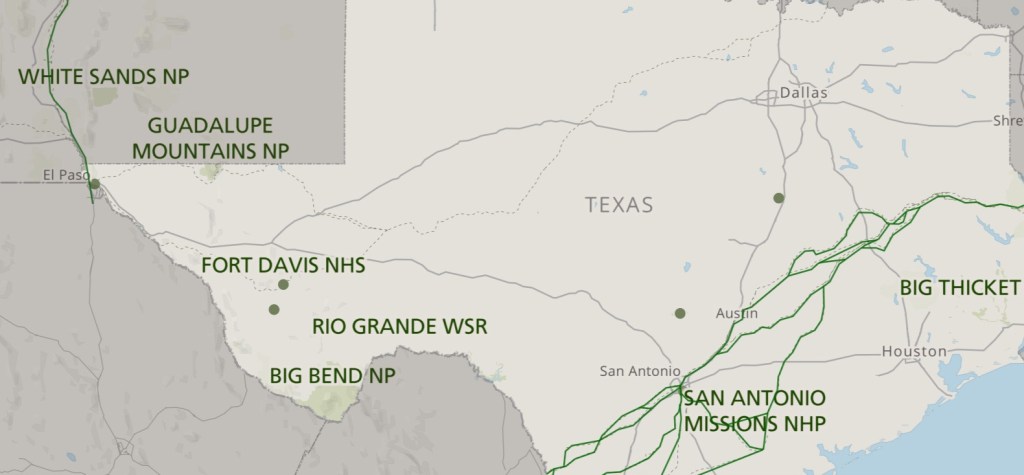
While most of the trips have been about hiking in either Big Bend National Park or the Guadalupe Mountains National Park, we’ve also canoed. This is where my backpacking skills progressed the most allowing multiple completions of the epic Outer Mountain Loop. The desert landscape is so different from anything else I have experienced and has led to a love of the solitude and an appreciation of the flora and fauna that make such a harsh environment their home.
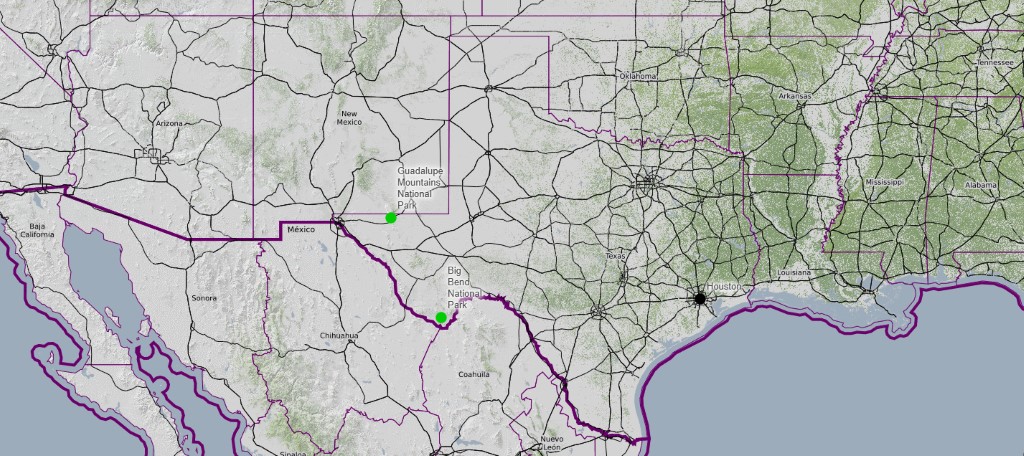
| When | Where | Who | What |
| March 1999 | Big Bend plus | Janet and Peter | Horseback ride. Overnight canoe the Rio Grande. McDonald Observatory. |
| June 2015 | Guadalupe Mountains | Samuel and Peter | Camp on Guadalupe Peak. |
| March 2016 | Big Bend | Samuel and Peter | Backpack the Chisos Mountains. Hike Casa Grande, Mariscal Canyon, Night-hike Marufo Vega Trail, Overnight canoe the Rio Grande. |
| December 2017 | Big Bend | Samuel and Peter | Backpack Outer Mountain Loop and Chisos Mountains. |
| December 2019 to January 2020 | Big Bend and Guadalupe Mountains | Samuel and Peter | Backpack Outer Mountain Loop. Bring in 2020 on Guadalupe Peak. |
| June 2021 | Big Bend | Samuel, Brant, Frankie, and Peter | Backpack Chisos Mountains. |
| February 2025 | Big Bend | Vance and Peter | Backpack Outer Mountain Loop and Chisos Mountains. Also, a video. |
Each trip has been a lot of fun and a learning experience.
Our March 1999 trip to Big Bend was when Janet and I had been married just a year and we hit several sites. We rode horses before an overnight canoeing trip down the Rio Grande followed by visits to the McDonald Observatory, Langtry, and the Landmark Inn in Castroville. This was a “warm-up” road trip before driving to Newfoundland that summer. Also, without realizing it at the time, Janet suffered from the cedar allergies.

My trip up Guadalupe Peak with 10-year-old Samuel in June 2015 was my first backpacking trip with him. This was before he joined scouts the following year, so we relied on my limited knowledge and a new entry-level REI tent. We camped one night at the base of the mountain and one night near the peak and hiked Devil’s Hall and Guadalupe Peak. I knew Texas was hot but did not appreciate the lower temperatures at altitude, and we had a very cold night at the peak in lightweight fleece sleeping bags. This was my first experience of being on a mountain in a thunderstorm with lightning so close we could smell it, but our love of adventuring remotely in the mountains continued to grow.

The March 2016 trip to Big Bend was the next step in backpacking growth. We’d bought good (i.e. warm and light) sleeping bags and this trip extended our experience with a three-night backpacking trip into the Chisos Mountains, a long desert hike above Mariscal Canyon, and a night hike along the Marufo Vega trail. The three-nights was limited by weight as we were not prepared to filter water so had to carry it all. We underestimated the heat and associated dehydration on the Mariscal Canyon hike but ended up being fine. The night hike on Marufo Vega was special though Samuel hit an exhaustion wall. We also did a two-day, one-night group canoeing trip with an outfitter. While the trip was fun and we wouldn’t have been able to do it without their equipment and logistics, we quickly realized that outfitters are not our preference as much of the enjoyment is the challenge of organizing and leading trips.
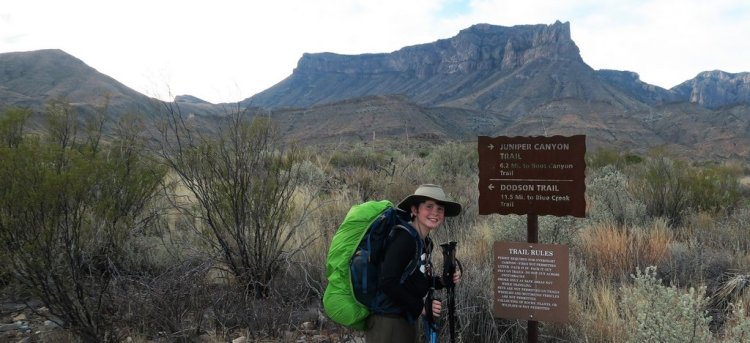
Our December 2017 trip to Big Bend to attempt the Outer Mountain Loop (OML) was a breakthrough trip. A colleague at work had told me about his time hiking this loop in the desert with is son, having to find remote desert springs, and the idea excited me tremendously. A backpacking water filter was essential, and my purchase of a Sawyer Squeeze opened our backpacking opportunities wide open, and the OML was first. I planned the trip over several months, scouring the internet and National Park sites. Completing this loop with 13-year-old Samuel was the game changer for our backpacking ambition. However, there were times when we really struggled and I realized that reducing weight was the next essential step. I had already done the most important step (weighing all items individually in ounces) and I had planned the food, but insecurity meant we brought more food than we needed, carried too much water, and we were still using hiking boots. I also had to accept that the greatest excess weight was around my belly, but that takes work rather than an equipment upgrade!
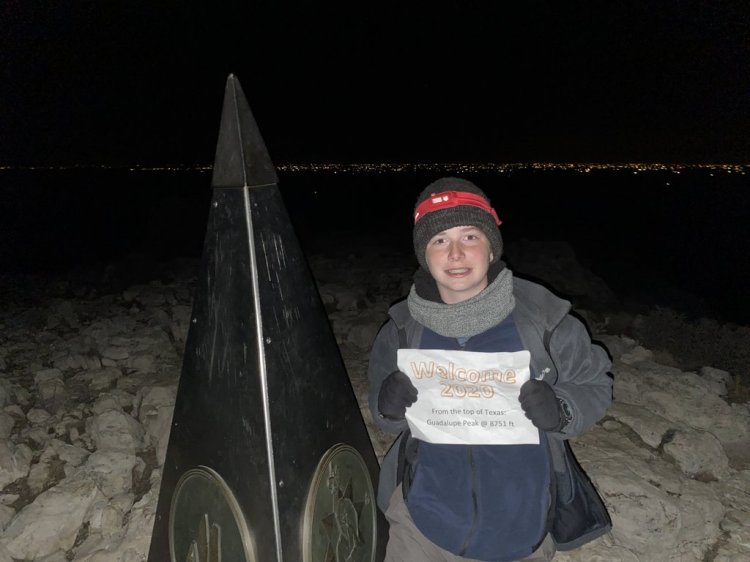
Our return to the OML at the end of 2019 was after we’d completed other trips where we had gradually reduced weight. We had completed challenging loops in Colorado and the Lake District, getting “better” with each trip, and this trip was more about the fun than the challenge, completing the OML in the opposite direction and bringing the new year in at the highest point in Texas. For the Colorado trip, we had upgraded the tent to an ultralight two-person (30 oz lighter). For the Lake District, I swapped out my 65-liter backpack to a 40 liter one (80.5 oz to 47 oz) and cut off non-essential straps etc. from Samuel’s (51.5 oz to 48.5 oz). With knowledge of the water sources on the OML and confidence in food usage, our starting pack weights were 22 lbs (360 oz) each with “dry weights” (no consumables) about 14 lbs (224 oz). With lighter packs, we could change from boots to trail runners, which arguably has the biggest impact. My boots were 54.5 oz/3.4 lbs and my trail runners were 26oz/1.7 lbs. Repeating the OML seemed “easy” and this appeared to impact our level of enjoyment as we liked the challenge. We changed our route (starting at Homer Wilson rather than Chisos mountains) which might also have impacted the satisfaction level. However, we might have been under the weather and my calf gave me issues. The trip’s highlight was recording our “Happy New Year” on the top of Guadalupe Peak at midnight just as 2020 started.

Samuel really wanted to share Big Bend with a couple of his buddies, so we planned a trip into the Chisos mountains for early June 2021. We were thinking the mountains wouldn’t be too hot but were excessively optimistic and the heat really impacted his two buddies who were new to backpacking. We decided to cut the trip short which was disappointing but a good lesson. We certainly had a memorable trip, seeing a black bear and her cub and having great sunsets on Emory Peak and the South Rim. For this trip, I’d upgraded my backpack saving 12 oz., bought myself an ultralight one-man trekking pole tent at 18 oz., and upgraded my sleeping mat and Jetboil to lighter versions. We had also upgraded Samuel’s backpack saving about 15 oz.
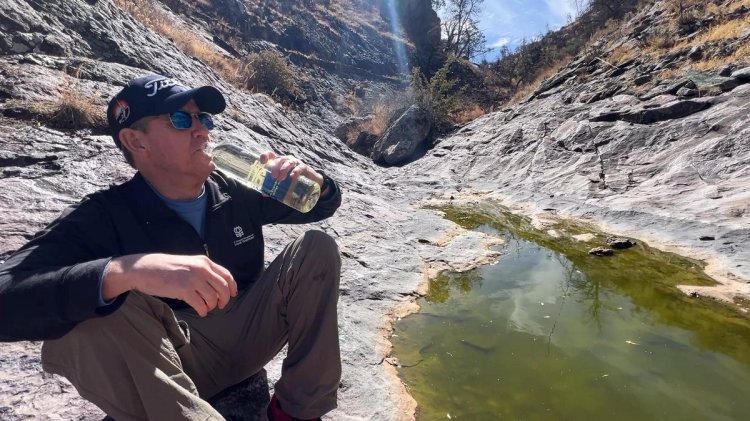
With Samuel away in college, I had trained Vance so he could join me on another Outer Mountain Loop challenge. He embraced filtering green puddles and was a great sport and companion, pushing himself harder than he had ever been before.
Big Bend and Guadalupe Peak gave Samuel and I the opportunity for our backpacking skills and experience to evolve such that we can take on any reasonable week-long trip away from civilization. We achieve this by understanding our pack weight, footwear, navigation, and limits. I have many great memories of these places and look forward to future trips.
 The Adventures of the Cajunlimeys
You must be logged in to post a comment.